
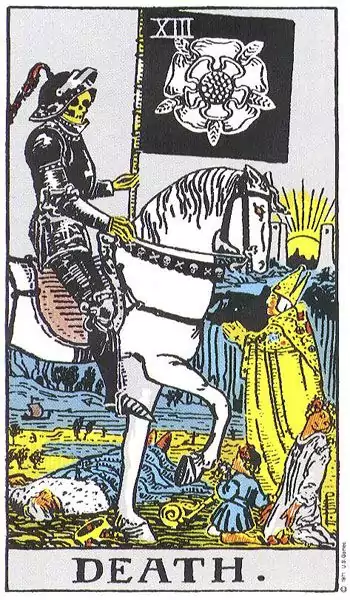
Death
The Fool’s Journey
With his head still clearing from the visions, The Fool makes his way through an empty field. The weather has changed, and winter is upon the land. Everything around him feels cold and lifeless.
In the distance, as the sun begins to rise, so does the figure of a skeleton, wearing black armor, riding upon a white horse. The Fool recognizes Death, and he feels as though he, too, has been stripped to the bone.
“Am I dead?” The Fool asks.
“In a way,” Death responds. “You have given up your old self and your old world. Both are dead.”
The Fool feels the truth in those words, and begins to morn his loss.
“But,” Death continues, “a new sun is rising, and you will be reborn with this day. Sometimes death is the only way to effect great transformation.”
Card Meaning
I want to take a moment to address one of the shadowed perspectives of Death right off. A lot of readers/teachers will tell you that Death doesn’t represent physical death, however, in my own experience it CAN and often DOES, especially when in the presence of the Four or Ten of Swords. Dismissing Death as death does you a disservice.
However, the most common story is one of painful transition and transformation—and it is most often painful because it references a transformation from which we are holding ourselves back.
The image of the Death Tarot card is enough to strike fear into any person, because we, as human beings, fear the unknown most of all. But the transformation Death brings is always a standard course, one that leads to the next level of life, a rebirth after stripping away all that no longer serves you. A river and a rising sun are often symbols found on the card, to remind us that just like water, we ebb and flow in cycles, sometimes spilling over our banks, rushing toward a vast ocean, only to be picked up by the clouds and rained down again.
There can be no birth without Death. If the Death card appears, expect big changes to happen in your life. The sooner these changes are accepted the sooner you can celebrate your rebirth. The change is going to happen regardless, so it is best to allow it to happen quickly (as soon as possible) to avoid as much suffering as possible.
While The Hanged Man was a symbol of voluntary sacrifice, Death also requires a sacrifice, although it is a sacrifice taken by force. When Death appears, take stock of your life and the parts of you that no longer serve you, and as painful as it may be, it’s time to let them die, to wither away in the past.
Frequently Asked Questions About Death Tarot Card
Death signals painful but necessary transformation. It strips away what no longer serves you so a rebirth can follow. The card marks the end of one chapter and the beginning of the next, like a river cycling through seasons.
Shadow meanings include physical death (especially near the Four or Ten of Swords) and sacrifice taken by force. Dismissing Death as only symbolic does you a disservice, per the card text.
The Fool meets Death in a winter field. Death tells him his old self and old world are gone. But a new sun is rising, and he will be reborn. Death frames the meeting as transformation, not an ending.
Tarot cards are too layered and contextual to reduce to yes or no. For that, try a pendulum or dowsing rods. Death asks whether you are resisting a transformation that is already underway, and whether you are ready to let the old self go.
In love, Death points to a major transformation in the relationship or the end of its current form. It asks you to release what no longer serves the bond so something new can be born from the change.
The card text says yes, it CAN represent physical death, especially near the Four or Ten of Swords. Most teachers dismiss this, but the card text says doing so does the reader a disservice.
The card uses a river and rising sun to show cyclical rebirth. Just as water evaporates and falls as rain, the self is stripped bare and reborn. There can be no birth without Death, the card states directly.
In career, Death points to a major ending, such as a job loss, career pivot, or the collapse of a project. Accept the change quickly to reduce suffering and allow your professional rebirth to begin sooner.

