
The Devil
The Fool’s Journey
The Fool’s Journey brings him to the base of a towering black mountain. At the foot sits a giant creature, part man, part animal, and part god. As The Fool nears, he feels all his base desire rise up in him. All around him are people indulging in sex, drugs, alcohol, and gold—and The Fool wants nothing more than to join!
“I won’t give into you!” The Fool yells at the giant horned figured.
“I just bring out desires you already have,” The Devil responds.
“How can you say that? These people are in chains, enslaved to their vices!”
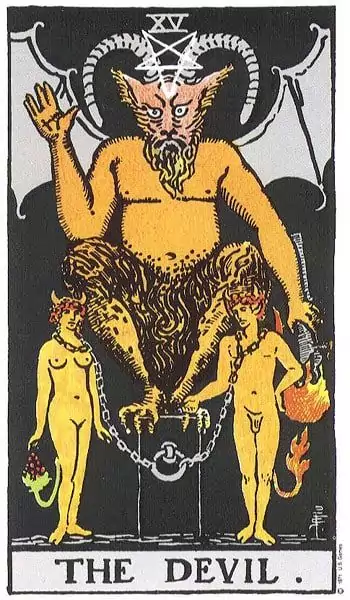
“Look again,” The Devil commands, gesturing to the two figures he has chained at his feet.
Sure enough, the chains are loose enough for the people to easily slip out, if only they so desired.
“You are free if you wish to be, as are they,” the goat god says. “I am the god of your strongest desires. You only see those here who have allowed those desires to control them.”
The Devil gestures to the peak of the mountain before continuing. “Many have allowed their aspirations to take them to the top of the mountain instead. It is only those whose inhibitions prevent them from being ambitious that remain here. Inhibitions can enslave as easily as excess, because they keep you from reaching your truest potential. Which path will you choose?”
The Fool realizes the truth in this. He has misjudged this god. While true that great power is frightening and dangerous, it is also the key to freedom and transcendence if understood and well used.
Card Meaning
The Devil is a tragic story of addiction and fear, but the most important lesson it teaches is that you have the power to free yourself at any time you choose. The Devil is an acknowledgement of our own darkness, and the truth is that the worst kind of evil comes from within. But it’s important to remember that in spite of fear, there can be no shadow or darkness cast unless there is a source of light. In this, we find the duality in this card.
If you believe you have lost, you have. If you give yourself to darkness and focus on the shadow, all outside forces will conspire to strip you of your power. The chains that bind the figures in the card can be cast off at any time, so long as they reclaim their personal power, tap into their inner light, and have the ambition to do so.
The illustration of The Devil is a mockery of two other cards: The Lovers, and The Hierophant. The figures on the card are the same as in The Lovers, but their love has been perverted and they have fallen to lust. The Devil mocks the hand gesture of The Hierophant, because what it taught us in regards to overcoming fear has been long forgotten during the night.
The Devil is indeed a cancer of the self, and when he appears it is because you are not in control of your own life. Going even further, the control you lack has been given away to others by your own action or inaction—it is a disease of your own making. As a result, you may find your thoughts muddled, your creativity damned, and your own energy seriously impaired.
To trust yourself again you must acknowledge the shadow, but turn toward the light so that it falls behind you. Reclaiming your personal power by taking a hard look in the mirror and confronting your addictions head-on is the only way to throw off the chains. Your mindset when you face The Devil is critical. You haven’t lost unless you believe you have.
There is a shadow side to each of us. It’s important to remember that there is no outside force to blame, and no “devil made me do it” excuse that can help you escape. Acknowledge the shadow, but turn toward the light, and then drag yourself and that shadow up the mountain of your ambition.
Frequently Asked Questions About The Devil Tarot Card
The Devil represents addiction, fear, and self-imposed bondage. The most important lesson is that you hold the power to free yourself at any time, just as the chains in the card are loose enough to remove at will.
The shadow meaning is that the chains binding the figures can be cast off at any time, if they reclaim personal power, tap inner light, and have the ambition to do so. The bondage is self-made, not imposed by an outside force.
The Fool confronts a horned creature at the foot of a black mountain and nearly surrenders to base desires. The Devil reveals the chains are loose and freedom is a choice. The Fool learns that inhibitions can enslave just as easily as excess.
Tarot cards are too layered and contextual to reduce to yes or no. For that, try a pendulum or dowsing rods. The Devil asks whether you are in control of your own choices or whether fear and addiction are making decisions for you.
In love, the Devil points to lust overtaking genuine connection, codependency, or a bond built on fear or control. The figures on the card are the same as The Lovers, but their love has been perverted into something that traps rather than frees.
The loose chains show that bondage is self-imposed. The figures could slip free at any time if they chose to. The card teaches that you have not lost control unless you believe you have, and that reclaiming power begins with acknowledging the shadow.
The card text says the Devil is a deliberate mockery of both. The figures are the same as in The Lovers, but lust has replaced love. The Devil mimics The Hierophant’s hand gesture, mocking the teachings about overcoming fear that have been forgotten.
In career, the Devil points to work driven by fear, greed, or addiction to status. Creativity feels blocked and energy impaired. Confront what controls you and reclaim your ambition by dragging yourself up the mountain.

