

Quick Specs
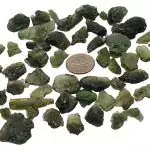
- Type: Untumbled raw tektite lot
- Size: 1″
- Size/Quantity: 50 grams
- Best for: Advanced crystal work, transformation rituals, third eye activation, shadow work
Moldavite: Geological Origin and Why It Is Rare
Moldavite is a tektite, a natural glass formed by the heat and pressure of a meteorite impact. The impacting body struck what is now southern Germany approximately 14.8 million years ago in the Nordlinger Ries event. The force of the impact vaporized both the meteorite and the surrounding terrestrial rock, and the resulting glass was ejected in a wide strewn field that extends into the Bohemian basin of the Czech Republic, where virtually all commercial-grade moldavite is found. The Czech Republic government strictly regulates the mining of this deposit, which is the only significant source of gem-quality moldavite in the world, and the known remaining reserves are finite.
The characteristic deep forest green color and the textured, irregular surface of each piece come from the rapid cooling of the ejected glass. No two pieces are alike in shape, and the surface shows natural flow lines, bubbles, and etch marks produced by millions of years of dissolution in acidic soil. Raw untumbled pieces preserve all of these surface features, which many crystal workers and collectors prize over tumbled pieces. Authenticity is a real concern in the moldavite market, as synthetic glass imitations and dyed stones are sold alongside genuine material. Genuine moldavite will always be irregular, textured, and translucent when held to strong light.
Moldavite in Crystal Work: Intensity and Approach
Moldavite has a reputation among crystal workers for producing strong physical sensations on first contact, including heat in the hand, tingling, or a feeling of sudden disorientation that practitioners call the moldavite flush. Not everyone experiences this, and intensity varies widely between individuals and between individual pieces. Practitioners who work with high-frequency stones regularly tend to report milder initial responses than those new to this category of stone.
In practice, moldavite is associated with accelerated change, catalyst energy, and the kind of deep transformation that disrupts established patterns. It is commonly paired with grounding stones such as black tourmaline, obsidian, or smoky quartz to balance the high-frequency stimulation it brings. A fifty-gram lot provides enough material for meditation work, grid placement, and personal collection. For additional raw and specimen-grade minerals, browse my raw stone collection.
How to Use Moldavite Untumbled Stones
Three practical approaches to working with raw moldavite, from introductory sessions through paired grounding work to third eye meditation.
- Begin with short introductory sessions
Hold one small piece for five minutes during a seated session before extending the time. New moldavite workers often overload themselves in early sessions. Short contacts spread over several days allow a gradual adjustment.
- Pair with a grounding stone during sessions
Place black tourmaline or smoky quartz in your non-dominant hand while holding moldavite in the dominant. The grounding stone counterbalances the tektite’s stimulating quality. Most practitioners treat this pairing as standard.
- Place a piece at the third eye in lying meditation
Lie flat and rest one small piece at the center of the forehead. Set a timer for ten minutes. Breathe slowly and allow impressions or sensations to arise without directing them. Journal immediately after the session ends.
The Tarot Fellow Standard
I source this moldavite lot with attention to authenticity. Genuine raw material shows the characteristic textured surface and translucency under direct light. This is not a stone I recommend for beginners working alone, but for practitioners who already have a crystal practice and understand how to work with high-frequency material, the fifty-gram raw lot is a meaningful acquisition. Browse my full crystal collection for complementary grounding stones to pair with this tektite.
Frequently Asked Questions
Genuine moldavite is always irregular, has a deeply textured or pitted surface, and appears translucent green in strong light. Uniform shape, smooth glass, or coloring that blocks all light are signs of synthetic imitation material.
The moldavite flush describes the sensation some people experience on first contact: heat in the hand, tingling, or brief lightheadedness. Not everyone experiences this. Intensity varies widely based on the individual and the piece.
Moldavite comes from a single finite deposit in the Czech Republic, which is strictly regulated and slowly depleting. Finite supply, regulated mining, and global collector demand across multiple markets all push prices substantially higher.
Most experienced crystal practitioners recommend building a grounding practice with black tourmaline, smoky quartz, or hematite before working with moldavite. Its reputation for intensifying change works better with a stable foundation.



Reviews
There are no reviews yet