
Quick Specs
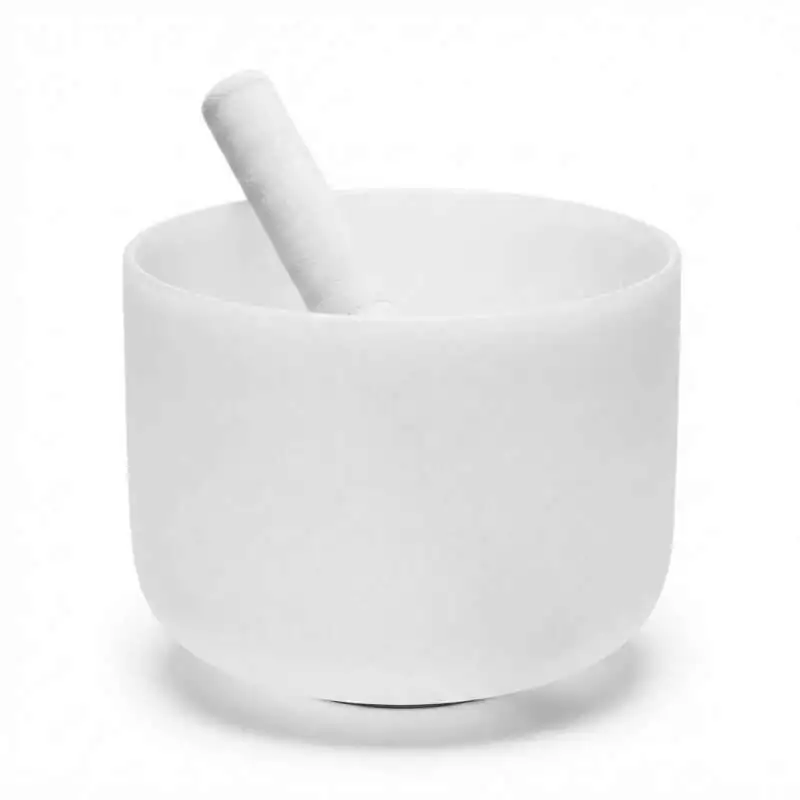
- Type: Frosted crystal (quartz) singing bowl
- Diameter: Approximately 8″
- Material: Unleaded crystal, smooth plated finish
- Best for: Sound healing, meditation, energy work, chakra balancing
Frosted Quartz Singing Bowls: How They Are Made and How They Work
Frosted crystal singing bowls are manufactured from 99.9 percent pure crushed quartz powder, which is compressed into a mold and then fused at extremely high temperatures. The resulting bowl has the characteristic matte, white frosted surface that distinguishes it from clear or alchemy crystal bowls. When the rim is struck or stroked, the quartz vibrates and produces a sustained, resonant tone that is determined primarily by the bowl’s diameter and wall thickness: larger bowls produce lower tones, smaller bowls produce higher ones. An 8-inch frosted bowl typically resonates in the C or D range, frequencies that sound healing practitioners commonly associate with the lower chakras, though the exact note varies from piece to piece unless the bowl is specifically precision-tuned and labeled as such.
The question of 432 Hz versus 440 Hz tuning comes up frequently with singing bowls. Standard Western musical tuning uses A at 440 Hz. The 432 Hz tuning lowers A by approximately 8 Hz, which some practitioners and researchers describe as more harmonically resonant with nature. Whether that claim holds under scrutiny is debated, but the experiential difference is real to many players: 432 Hz-tuned instruments often do sound slightly warmer and less bright. Most frosted crystal bowls sold without a specific tuning designation are manufactured to general tonal ranges rather than precision-tuned to either standard, so if tuning is critical to your practice, look for bowls that specify their exact note and Hz in the listing details.
Playing Technique and Practical Use
Crystal singing bowls can be played in two ways. Striking the outer rim with the rubber mallet produces an immediate bell-like tone that decays over several seconds. Circling the mallet around the outside of the rim with consistent pressure produces the sustained, singing tone the instrument is named for: the friction of mallet against bowl lip creates a continuous resonance that practitioners sustain for as long as they maintain contact and pressure. Both techniques have different applications: striking is well suited to opening or closing a meditation, marking a transition, or clearing a space, while circling is used for sustained sound baths, focused chakra work, or extended group meditation. Browse my sound and vibrational healing collection for other instruments I stock alongside this bowl.
The bowl ships with the rubber ring base and mallet needed to play it. Place it on a flat, stable surface before each session: a rubber ring on a wood table works well, but hard bare surfaces can allow vibration to move the bowl unpredictably. Some practitioners place the bowl directly in the palm of one hand for smaller instruments, but at 8 inches this bowl is better suited to tabletop use. Allow the tone to decay naturally after each strike or circle session rather than dampening it, since the decay is part of the acoustic experience that many practitioners find most useful for quieting mental chatter.
How to Use an 8 Inch Crystal Singing Bowl
The fundamentals of playing and working with an 8-inch frosted crystal singing bowl.
- Strike or Circle the Rim
Strike the bowl lightly on the outside rim with the rubber mallet for an immediate tone. For a sustained singing tone, press the mallet to the outer rim and move it in slow, steady circles, maintaining consistent pressure throughout.
- Prepare Your Surface
Place the bowl on a rubber ring or foam pad on a stable, flat surface before playing. Hard surfaces amplify vibration unpredictably and can cause sliding. A stable base also protects the bowl from cracking if the mallet slips during use.
- Work with the Resonance
Let the tone decay naturally rather than dampening it. Sit within the sound field and focus on the tone as it fades. Many practitioners coordinate bowl playing with breath cycles, inhaling as the tone rises and exhaling as it settles.
The Tarot Fellow Standard
I stock this bowl because an 8-inch frosted instrument occupies the practical middle ground of crystal singing bowls: large enough to produce a full, room-filling tone, small enough to be manageable on a standard altar or meditation table, and sized appropriately for solo practice without needing the space demands of larger floor instruments. The frosted surface produces the warm, resonant tone that most practitioners associate with crystal bowl work. The mallet and rubber ring are included, so you’re ready to play from the moment it arrives. Browse my chakra and meditation products for other tools I carry in this category.
Frequently Asked Questions
An 8-inch frosted bowl typically produces a tone in the C or D range, associated with the root or sacral chakra in sound healing. The exact note varies by manufacturer, so tuned instruments specify their note and octave in the product listing.
432 Hz is an alternate tuning where A equals 432 Hz rather than the standard 440 Hz. Proponents say it sounds warmer. Most frosted crystal bowls are not precision-tuned to either standard unless specifically labeled as tuned in the listing.
Frosted bowls are made from crushed quartz powder fused at high temperature, producing a matte, opaque surface. Clear crystal bowls use a single piece of fused quartz. Clear bowls ring longer; frosted bowls tend to have a warmer, fuller tone.
Strike the outside rim with the rubber mallet for an immediate tone. For a sustained singing tone, press the mallet to the rim and move it in slow circles with consistent pressure. Adding water changes the resonance and is an advanced technique.


Reviews
There are no reviews yet