

Quick Specs
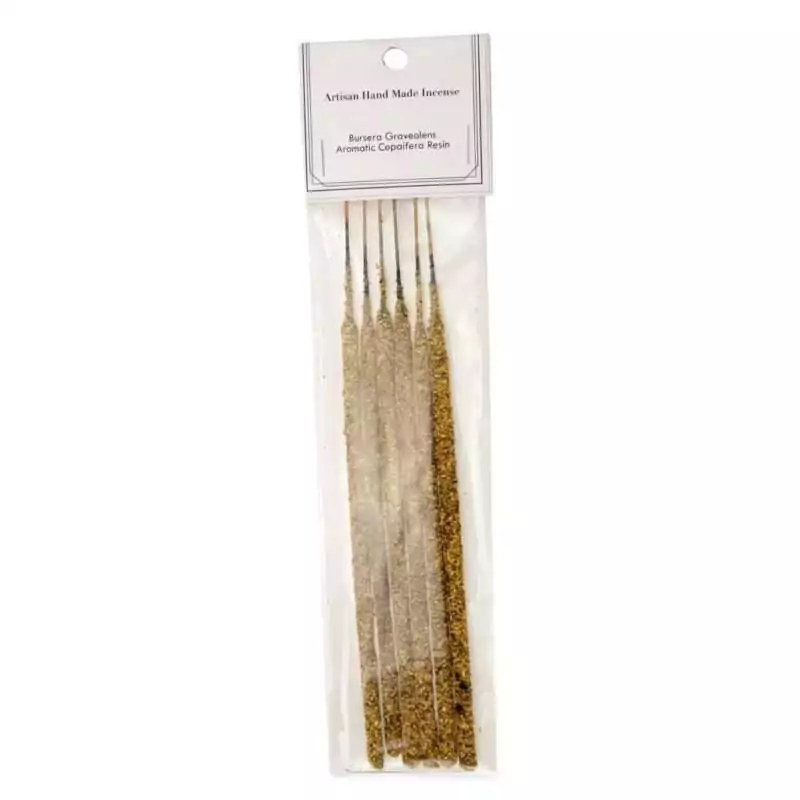
- Contents: Blended sticks with Frankincense, Myrrh, Copal, Palo Santo, White Sage — 6 sticks total
- Format: Incense sticks
- Origins: Middle East (Oman/Somalia), Horn of Africa, Mesoamerica, Andes & Pacific Coast (Ecuador/Peru), Pacific Coast (USA/Baja California)
- Use: Space clearing, ritual, meditation, offering
Five Resins That Predate Every Major Religion
These five materials share something remarkable: every major religion on earth inherited them from cultures that came before. Frankincense (Boswellia sacra) was already old when Egyptian Queen Hatshepsut traded for it around 1500 BCE — her priests burned it in temple censers to carry prayers skyward, and its smoke is dense with α-pinene, camphene, and the boswellic acids that give the resin its distinctive weight and slow, even burn. Myrrh (Commiphora myrrha), harvested from the same Horn of Africa trade routes, releases furanosesquiterpenoids — the bitter, balsamic compounds that made it indispensable for Egyptian embalming, Ayurvedic wound care, and eventually the Christian liturgy. The two resins were already paired as sacred offerings in Babylon by the seventh century BCE.
Copal (Bursera spp.) occupies the same cultural weight in Mesoamerica. The Nahuatl word copalli simply means incense, which tells you how completely the Maya and Aztec world organized their ritual life around it — it was described in their sources as the blood and flesh of the gods, burned in clay censers called popoxcomitl at every significant ceremony from planting rituals to coronations. The fresh resin carries volatile terpenes: α-pinene, β-phellandrene, limonene, and δ-carene give it a bright, piney citrus character that hardens into something more resinous with age. Palo Santo (Bursera graveolens) shares the same Burseraceae family — copal’s close cousin — and comes from the Andean coast of Ecuador and Peru, where Inca-era shamans burned it in limpias (ritual cleansings) to clear mala energía. Its aged heartwood concentrates limonene and α-terpineol; this is why it lights easily, self-extinguishes, and produces that clean, sweet, citrus-and-resin smoke without anything added to it.
White Sage (Salvia apiana) is the only herb in the set rather than a resin, and it belongs to a different geography entirely: the coastal chaparral of California and Baja California, where Chumash people called it khapshikh and used it as a ritual calmative, a medicine for colds, and a sacred smudge. Its smoke is dominated by camphor and 1,8-cineole — the same aromatic compounds that make eucalyptus sharp and clearing — along with α-pinene and β-pinene. Research on S. apiana constituents has documented interactions with GABA, opioid, and cannabinoid receptors, which is a long way of saying the plant has always done something to the nervous system when you burn it. Together, these five materials form a kind of incense atlas: three resin-producing tree genera, one herb, four continents, and several thousand years of continuous use before any of them showed up on the internet.
How to Run a Five-Resin Space-Clearing Ritual
A step-by-step space-clearing ritual using all five resin and herb sticks from the sampler, moving through setup, burning, and a formal closing.
- Setup – Prepare Your Space
Open a window or door before you begin. Smoke needs somewhere to go, and so does whatever you're releasing. Set out a fireproof dish, a small sand-filled bowl, or an incense holder that can catch ash safely. Arrange your six sticks nearby.
- Burn – Move Through the Space
Light the first stick at a 45-degree angle, let it catch for about ten seconds, then gently blow out the flame so it smolders. Starting at the front door, move clockwise through the room – corners, doorways, and window frames get extra attention
- Close – Ground the Ritual
When you've moved through the entire space, return to your starting point. Rest any remaining embers safely in your holder and let them burn down on their own – do not blow them out forcefully, as this scatters ash and breaks the continuity of the
Tarot Fellow Standard
I source these sticks from a supplier I’ve worked with since 2020 whose quality controls are consistent enough that I’ve never pulled a batch for off-smell or uneven burn — which, for compressed incense sticks, is actually a meaningful bar to clear. The Frankincense and Myrrh are resin-forward rather than perfume-heavy; the Palo Santo is aged heartwood (not green wood), which is why it self-extinguishes properly instead of burning straight through. The material quality is the reason I keep this brand on hand.
Practical note: these sticks produce real smoke. If you’re burning them indoors, a window cracked a few inches is enough for most rooms — but if your space is small or you’re sensitive to smoke, burn one stick at a time rather than layering two or three. You will want a burner that can support an upright stick and catch falling ash — a simple ceramic incense holder or a small bowl filled with sand works fine. A flat dish alone won’t do it safely.
If you’re building out your ritual supplies, a charcoal disc is the other way to work with loose resin — heat the disc in a heat-safe burner, then place a small piece of the stick directly on top for a slower, more sustained release of smoke than a stick provides. For keeping the ash contained during a walking smudge, an incense burner with a handle or a small ceramic censer makes the circuit through a room much cleaner.
These are compressed incense sticks, not loose resin – they light directly with a match or lighter, no charcoal required. Hold the tip at a 45-degree angle, let the flame catch for about ten seconds, then blow it out. The stick should smolder on its own from there. Charcoal discs are useful if you want to burn raw resin chunks (Frankincense or Myrrh pieces, for example), but they're not needed for these sticks.
Not exactly, though it's used for the same purpose. Smudge sticks are bundles of dried herbs – White Sage is the classic example. Palo Santo is a solid wood stick cut from the heartwood of Bursera graveolens. It burns differently: it self-extinguishes after a short time rather than smoldering continuously the way a sage bundle does, and it produces less total smoke volume. In practice, both are used for space clearing – the distinction is botanical, not functional. These sticks include powdered Palo Santo wood.
Yes. All sticks in this sampler can be relit multiple times. You can even put them out with water, dry them, and relight! Let the tip cool completely before storing, then light from the same end the next time. Store them upright or flat in a dry place, and they'll hold their scent and burn quality for months.
2 reviews for Frankincense, Myrrh, Copal, Palo Santo & White Sage Incense Sticks — 6-Pack