

Quick Specs
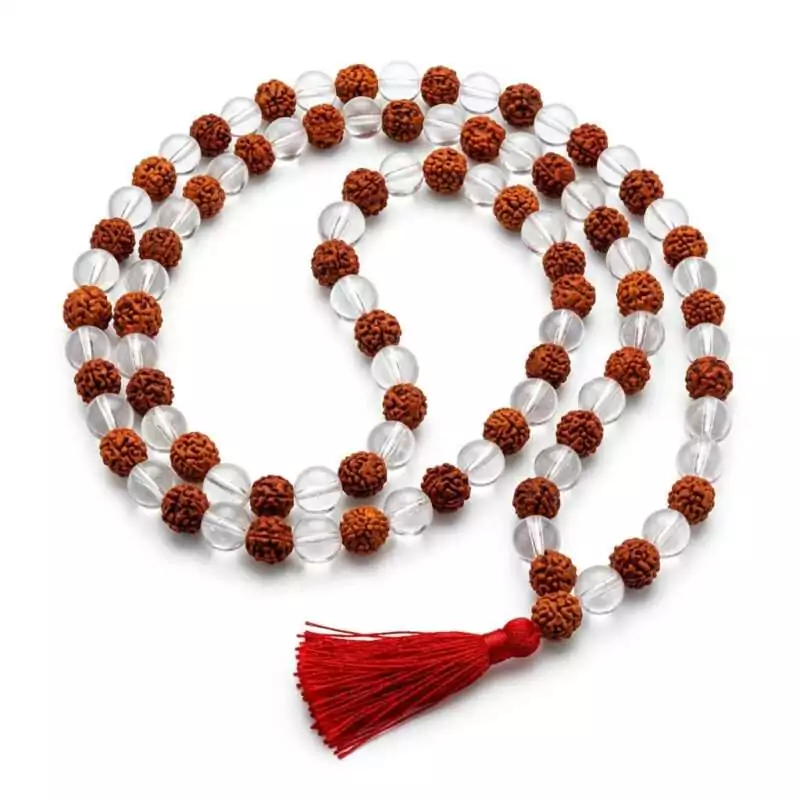
- Type: Rudraksha and Quartz Japmala, 108 beads
- Materials: Elaeocarpus ganitrus seed (rudraksha) and natural clear quartz
- Best for: Mantra meditation, japa practice, spiritual protection
Rudraksha: The Seed Behind the Sacred Bead
Rudraksha beads are the dried seeds of Elaeocarpus ganitrus, a large evergreen tree native to the Himalayan foothills of Nepal, northern India, and extending into Indonesia. The name combines the Sanskrit words for Rudra (a form of Shiva) and aksha (eye), and tradition holds that the beads formed from the tears of Lord Shiva’s eyes. Botanically, the fruit resembles a blueberry in color and houses a single hard, deeply grooved seed. These natural ridges, called mukhi or faces, run from the top to the bottom of the seed, and the number of faces ranges from one (very rare) to twenty-one, with five-mukhi being the most common and the form typically used in japmala construction.
The quartz beads interspersed in this mala serve a functional and symbolic role. Clear quartz is among the most electrically neutral and optically pure minerals, and its presence between rudraksha seeds provides a textural contrast that helps practitioners maintain accurate counting during extended japa sessions. Quartz is associated in crystal practice with amplification and clarity, making it a considered pairing for a meditation tool where mental focus is the primary aim. The combination of organic seed and mineral crystal is found across traditional mala constructions from Nepal and India.
The 108-Bead Structure and Japa Practice
The traditional japmala contains 108 beads plus one additional guru bead, called the Meru bead, which marks the start and end of a complete round. The number 108 appears throughout Hindu cosmological mathematics: there are 108 Upanishads, 54 letters in the Sanskrit alphabet each with masculine and feminine forms (54 x 2 = 108), and the distance from Earth to the Sun is roughly 108 times the Sun’s diameter. Practitioners do not cross the Meru bead during recitation but reverse direction at it, a gesture of respect for the teacher principle the bead represents.
Japa practice involves repeating a mantra once for each bead, using the thumb and middle finger to move from bead to bead. The index finger is traditionally not used to touch the beads. Beginning practitioners often start with a short mantra such as Om Namah Shivaya or a simple affirmation and work up to longer texts as concentration develops. The physical rhythm of bead-to-bead movement is itself part of the practice, providing a body-centered anchor that supports sustained mental focus in ways that sitting with eyes closed alone may not.
How to Use a Rudraksha Quartz Japmala
Three steps for beginning a traditional japa practice with your rudraksha and quartz mala.
- Find the Guru Bead
Before starting, locate the Meru or guru bead, the larger distinct bead at the top of the mala. Hold the mala in your right hand, draped over the middle finger, with the guru bead between your thumb and middle finger as the starting point.
- Begin Japa Practice
Chant your chosen mantra once, then use your thumb to move to the next bead. Continue bead by bead through the full 108. The index finger traditionally does not touch the beads. Move at whatever pace allows clear, focused recitation.
- Reverse at the Meru Bead
When your thumb reaches the guru bead after 108 repetitions, do not cross it. Reverse direction and begin the next round. The Meru bead marks a pause for reflection, and many practitioners offer a moment of silent gratitude before continuing.
The Tarot Fellow Standard
I carry this mala because the combination of rudraksha seed and quartz produces a tool that bridges two distinct traditions without compromising either. The rudraksha brings the full botanical and devotional history of Himalayan japa practice, while the quartz adds a mineral clarity that practitioners from crystal healing backgrounds will recognize. The construction is firm enough for daily practice, the Meru bead is distinct enough to find by touch in the dark, and the bead size is practical for extended use without fatigue. Browse my mala and prayer bead collection for other japa tools, or explore my meditation and reiki products to support a complete sitting practice.
Frequently Asked Questions
Rudraksha is the seed of Elaeocarpus ganitrus, native to the Himalayan foothills of Nepal and northern India. The dried seeds have natural ridged grooves called mukhi. Five-mukhi seeds are the most common form used in traditional japa malas.
108 appears in the count of Upanishads, Sanskrit alphabet numerology, and astronomical ratios such as the Earth-Sun distance. One complete round of the mala represents 108 mantra repetitions, considered a full spiritual practice cycle.
The Meru bead marks the start and end of each 108-bead round. Not crossing it is a traditional gesture of respect for the teacher principle it represents. At the Meru bead, practitioners reverse direction rather than looping through continuously.
Quartz creates textural contrast between seeds, helping count accuracy in long sessions. In crystal practice it is associated with clarity and amplification, pairing well with the focused concentration that rudraksha traditionally supports.
Reviews
There are no reviews yet