
Quick Specs
- Type: Polished palm stone
- Size/Quantity: Single stone, palm-fit size (dimensions vary by piece)
- Best for: Meditation, throat and third eye chakra work, communication, alignment practice
Kyanite: Mineral Properties and Formation
Kyanite is an aluminum silicate mineral (Al2SiO5) that forms in blade-like, elongated crystal structures as a result of high-pressure metamorphic processes. It is found primarily in Brazil, Switzerland, Russia, Serbia, India, and Kenya, with blue being the most common color, though green, orange, black, and indigo varieties also exist. Kyanite has an unusual physical property called anisotropic hardness: its hardness measures approximately 4.5 to 5 on the Mohs scale along the length of the blade, but 6.5 to 7 across the blade, meaning it is easier to split or scratch in one direction than the other. This structural quality is part of what distinguishes it from other blue stones in the gemological and metaphysical markets.
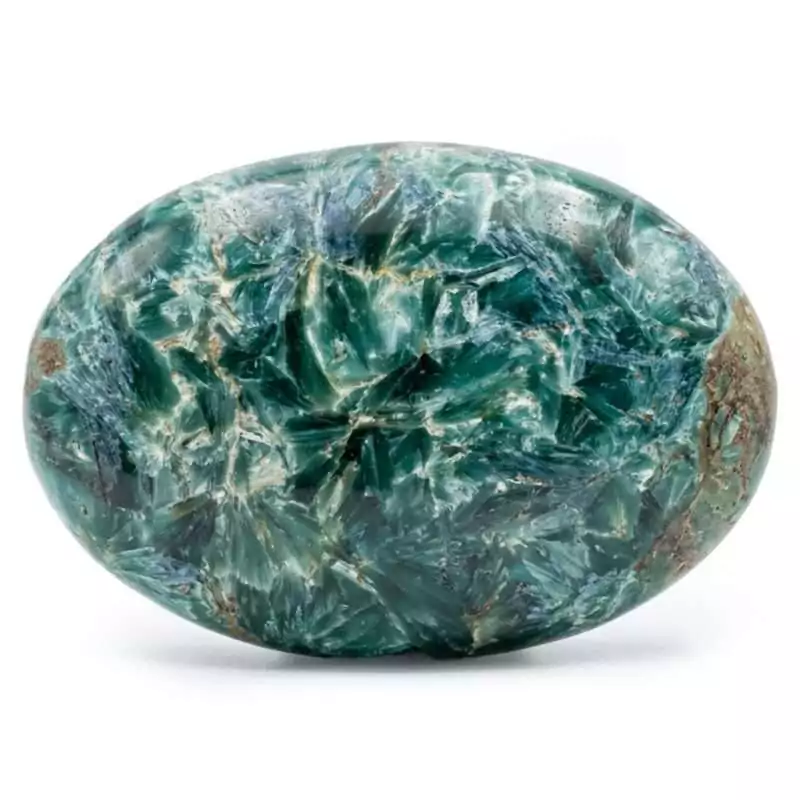
When polished into a palm stone, the blade-like internal crystal structure is contained within a smooth, rounded form suitable for holding during meditation. The natural striations and gradients of blue and white within the stone are part of its character and vary meaningfully from piece to piece. This is a natural material, not manufactured glass, so color intensity, the presence of white inclusions, and the exact contours of each stone will differ. For the full crystals and stones collection, palm stones in multiple varieties are available.
Kyanite in Crystal Healing Practice
Kyanite is one of the few minerals that practitioners consistently report does not require energetic cleansing between uses. The explanation offered in the crystal healing community is that kyanite does not hold or accumulate negative energy in the way that many other stones are said to do; instead, it is described as a continuous transmitter that moves energy through rather than storing it. This is a practitioner-reported property rather than a scientifically verified one, but it has been noted consistently across independent sources in the metaphysical community and sets kyanite apart from virtually every other stone in the collection.
The primary chakra associations for blue kyanite are the throat chakra (Vishuddha), which governs communication and self-expression, and the third eye chakra (Ajna), which governs intuition and inner vision. Practitioners use it in meditation, in chakra balancing layouts where a piece is placed at each chakra point, and as a general alignment stone held during any focused inner work. Its high vibrational quality is also noted in energy healing contexts where the goal is clearing blocked pathways rather than adding new energetic input.
How to Use Kyanite Palm Stone
How to use a kyanite palm stone in meditation, chakra work, and daily spiritual practice.
- Hold During Meditation
Sit comfortably and hold the stone in one or both hands. Focus on the cool surface and natural striations. Practitioners report kyanite helps quiet mental chatter and supports a clear, aligned state for deeper meditation or focused visualization.
- Use in Chakra Layouts
Place the kyanite stone on the throat or third eye area during a reclined chakra session. Practitioners report it aligns all chakras simultaneously from any single point, making it a convenient single-stone option for a full-body alignment practice.
- Keep on Your Altar or Workspace
Because practitioners report kyanite does not accumulate negative energy, it can serve as a permanent altar piece without regular cleansing. Place it near other stones as a clearing support, or set it where you sit for focused work or reading.
The Tarot Fellow Standard
I stock kyanite palm stones because they fill a specific need in a crystal collection. Most stones require periodic cleansing, which is a real maintenance consideration for practitioners who work with multiple pieces. Kyanite’s reported self-cleansing property makes it low-maintenance and, if practitioners’ accounts hold up for your experience, a reliable clearing presence near other stones. The palm stone form is the most practical format for meditation use. Browse my tumbled stones collection for additional crystal options in complementary forms.
Frequently Asked Questions
Practitioners report kyanite does not accumulate negative energy and requires no cleansing between uses. This is a practitioner-reported property rather than a scientific claim, but it is consistently noted across many independent community sources.
Blue kyanite is associated with the throat chakra (Vishuddha), governing communication, and the third eye chakra (Ajna), governing intuition. Practitioners report that kyanite aligns all chakras simultaneously when placed at any single chakra point.
Kyanite is an aluminum silicate mineral (Al2SiO5) formed in blade-like crystal structures through high-pressure metamorphic processes. It has anisotropic hardness, measuring differently on the Mohs scale depending on the axis of the crystal tested.
A palm stone is polished into a smooth, rounded form for comfortable hand-holding during meditation. Raw kyanite has the blade-like structure visible but can be sharp and fragile. Palm stones are more durable and better for extended daily handling.


Reviews
There are no reviews yet