

Quick Specs
- Type: Polished free shape / freeform specimen
- Size/Quantity: Approximately 1.7 lb single piece
- Best for: Altar anchor, third eye work, meditation focal point, collector display
Lapis Lazuli Free Shape: An Ancient Stone of Wisdom and Truth
Lapis lazuli is one of the oldest and most prized ornamental stones in human history, with continuous use documented from at least 7000 BCE at the Neolithic site of Mehrgarh in present-day Pakistan. The stone is a metamorphic rock rather than a single mineral, composed primarily of lazurite (a sodium calcium aluminosilicate sulfate) alongside calcite and iron pyrite. The signature deep royal blue comes from the lazurite content, while the scattered gold flecks are natural pyrite inclusions that formed within the matrix during metamorphism.
The dominant source of quality lapis for thousands of years has been the Sar-i-Sang mines in the Badakhshan region of northeastern Afghanistan, the same deposits that supplied ancient Egypt, Mesopotamia, and the Mediterranean world. Ancient Egyptians ground lapis into the pigment ultramarine for painting, carved it into amulets of Horus and scarabs for burial, and fashioned it into royal jewelry. The gold and blue color combination held deep ceremonial meaning: blue for the heavens and truth, gold for divine light and incorruptibility.
Third Eye Activation and Contemporary Ritual Use
In crystal healing and chakra traditions, lapis lazuli is associated with Ajna, the third eye chakra, and Vishuddha, the throat chakra. Practitioners use it for deepening meditation, stimulating intuitive perception, and clearing the pathway for honest communication. Its visual density and weight give it a grounding quality that counterbalances its stimulating effect on upper chakras, making it well-suited for advanced practitioners who work with visionary states.
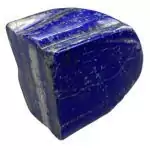
A polished free shape of this scale functions as an altar anchor piece. At approximately 1.7 lb, it carries genuine physical presence and visual impact, with the polished surface catching light and revealing the full depth of the blue-gold-white matrix. This is a natural stone specimen; coloration, pyrite distribution, and shaping vary between pieces.
How to Use a Lapis Lazuli Free Shape
A three-step guide to positioning, meditating with, and maintaining a large lapis lazuli free shape.
- Position as an Altar Anchor
Place the free shape on a stable flat surface where it will not tip. Lapis at 1.7 lb has considerable mass. Position it as a central altar anchor with the polished face oriented toward you to maximize visual engagement during meditation.
- Use for Third Eye Meditation
Sit before the stone in a relaxed posture and focus on the deep blue field and gold pyrite inclusions. Lapis is commonly used in crystal practice for third eye activation and truth-seeking. Breathe slowly and let the visual complexity draw attention inward.
- Cleanse and Store Properly
To cleanse the stone, pass it through sage smoke or hold it briefly under cool running water and dry it thoroughly. Lapis is moderately hard but pyrite inclusions can oxidize if the stone stays wet. Store it away from prolonged intense light.
The Tarot Fellow Standard
I stock this piece because large polished lapis freeforms at this weight are genuinely uncommon at accessible prices. The combination of deep royal blue, natural pyrite constellations, and substantial mass makes this a statement altar piece rather than a shelf decoration. It belongs on a working altar, not a windowsill. Explore my full free shapes collection for other large polished freeforms, or browse my meditation and wisdom crystals for companion stones that support truth-seeking and third eye work.
Frequently Asked Questions
Lapis lazuli is a metamorphic rock composed primarily of lazurite, along with calcite and golden pyrite inclusions. The vivid blue color comes from the lazurite content. It is a composite rock, not a single mineral, mined mainly in Afghanistan.
The gold flecks in quality lapis are iron pyrite, a natural inclusion that forms within the lazurite matrix during metamorphic processes. High pyrite in a deep blue matrix is valued. White streaks are calcite, considered lower quality.
Lapis has been prized since at least 7000 BCE, mined predominantly from the Sar-i-Sang deposits in the Badakhshan region of Afghanistan. Ancient Egypt imported it for pigment, amulets, and royal ornamentation, including Tutankhamun’s burial mask.
Lapis connects to the throat and third eye chakras in crystal healing. It is associated with wisdom, truth, and psychic vision.

Reviews
There are no reviews yet