
Quick Specs
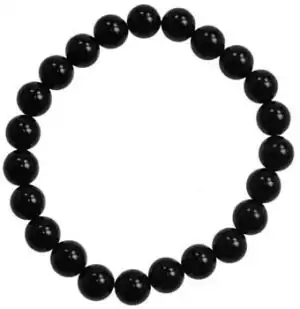
- Stone: Tiger’s eye, blue
- Bead Size: 10mm
- Shape: Round, smooth
- Finish: Polished, glossy
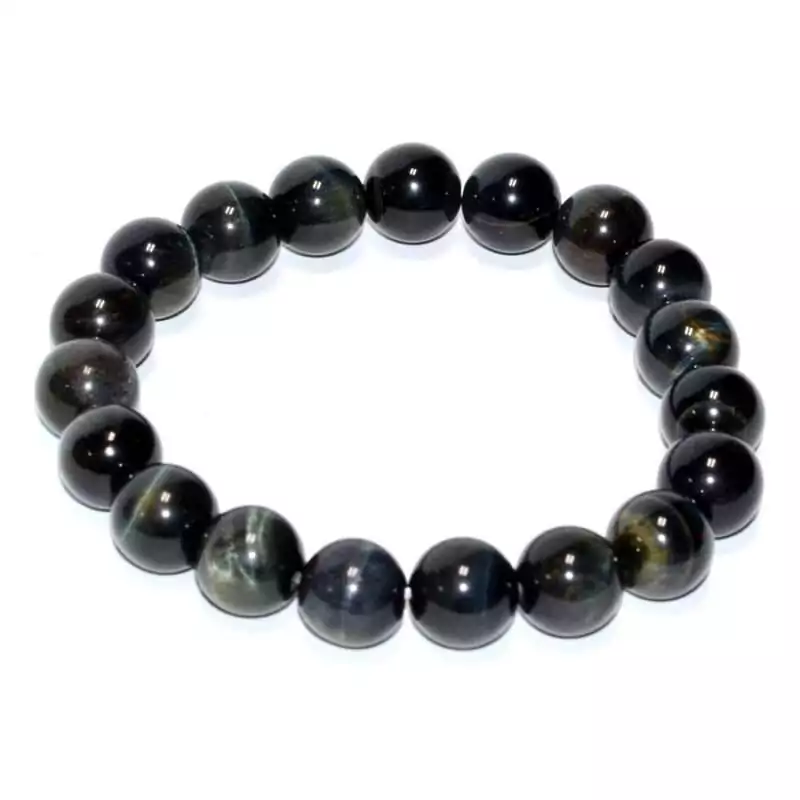
- Color: Deep navy to black-blue, with silvery streaks and a few gold glints
- Closure: None, one continuous loop of beads
Blue Tiger Eye in 10mm Beads
Blue tiger’s eye is the cool-toned end of a stone best known in gold. The 10mm beads on this strand are smooth, polished and round, in deep navy that turns almost black, with silvery blue streaks running across several of them and a few golden-brown glints. The streaks run in different directions from bead to bead. Blue-gray tiger’s eye is called hawk’s eye, and the glints show where the stone grades toward the golden-brown form more familiar as tiger’s eye. A bright band of light shows on some of the beads, the silky chatoyancy that gives tiger’s eye its name, while other beads look close to black. Ten millimeters is a large bead. Each stone has enough surface to show its streaks, and the strand sits on the wrist as a bold, dark band. Turned toward a window, the navy and silver come forward; in dim light the strand reads as nearly black. Quartz rates about 7 on the Mohs scale, and the glossy polish gives each large bead bright highlights. The beads form one continuous loop with no clasp, so the deep blue carries all the way around.
The dark beads of this strand are easy to style, and they suit formal clothes as well as casual ones. Navy and black sit well beside silver, steel and white gold, and the gold glints on a few beads pick up brass buckles, bronze rings and warm leather. A deep blue strand also makes gold-toned jewelry stand out beside it. Worn alone, a 10mm strand reads as a statement piece, a heavy band of color with a glossy finish. In low light the polished beads pick up small reflections from lamps and windows. Because the stone varies from bead to bead, the strand looks different in bright sun, under indoor light and in shade, and you can spend a moment finding the bead with the brightest streak. Crystal guides tie tiger’s eye to courage, confidence and protection, and call it a grounding stone that pairs the steadiness of earth with the warmth of the sun. Several guides give it the solar plexus chakra. These are crystal-lore associations, and you can take them as symbolism to carry into a day.
Practical Ritual Applications
Wear the bracelet when you want a visible reminder to keep your nerve in a long meeting, a trip or a tense conversation. When you sit down to journal or to read cards, slip it off and lay it beside the page so the silvery streaks catch the lamp. On an altar it can circle a dark blue candle or rest beside a bowl of water. At a desk, a small dish near a window shows the streaks changing with the light. If you build stacks from large beads, my 10mm and 12mm beaded bracelets collection shows other strands in this size. Take it off for sports, heavy lifting and cleaning, and set it down on a soft cloth where the large beads can rest without knocking against anything hard.
How to Wear and Care for Your Blue Tiger Eye Bracelet
Three steps cover looking at the stone, wearing it as a signal, and keeping the polish.
- Look for the streaks
Hold the bracelet in bright light and turn it slowly. Find the beads with silvery streaks and the ones with golden-brown glints, and notice how the band of light moves as the angle changes. A strand this dark rewards a slow look, with the streaks appearing and fading as the beads move.
- Use the dark band as a signal
Put the bracelet on at the start of a task that needs steady focus, such as a long drive, an exam or a difficult meeting. When your attention drifts, look down at the dark band and take one slow breath. In crystal practice tiger's eye is tied to courage and confidence, so the band works as a prompt to refocus.
- Wipe it clean and store it apart
Use a soft cloth dampened with warm soapy water, then dry the beads. Keep the strand away from bleach, ammonia, acids, hairspray and perfume, and from extreme heat, which may change the color. Store it apart from harder stones that could scratch quartz, and take it off before vigorous activity.
The Tarot Fellow Standard
I stock this bracelet for its size and its depth of color. The 10mm beads are large and glossy, the blue runs from navy to near black, and one stone in one bead size carries the strand around the loop. The courage and solar plexus chakra lore comes from modern crystal practice, and I offer it as symbolism you can take or leave. It is a substantial strand for a dark, bold look. For more dark-toned stones in bracelet form, browse my stone and crystal beaded bracelets collection.
Frequently Asked Questions
Both start as the same crocidolite fibers replaced by silica. In golden tiger's eye the iron oxidized, which produces gold and brown. In blue tiger's eye, called hawk's eye, the iron stayed in its unoxidized state, which keeps a steely blue-gray body color. The two form a continuum, and transitional pieces with golden-brown patches or bands are common.
Blue is a natural color of the stone, called hawk's eye, and several dealers describe it as sold natural and untreated. Dyed blue material is also sold. The Gem Society lists bleaching, dyeing and heat treatment among the typical treatments for tiger's eye, and a dealer encyclopedia says dye is applied less often to hawk's eye than to golden tiger's eye.
South Africa is the foremost source of hawk's eye, mainly the Northern Cape around Griquatown and the Asbestos Hills region. Western Australia is a secondary source, in the Hamersley Range and Pilbara region. Minor occurrences are reported in India, Brazil, Myanmar and Namibia.



Reviews
There are no reviews yet