
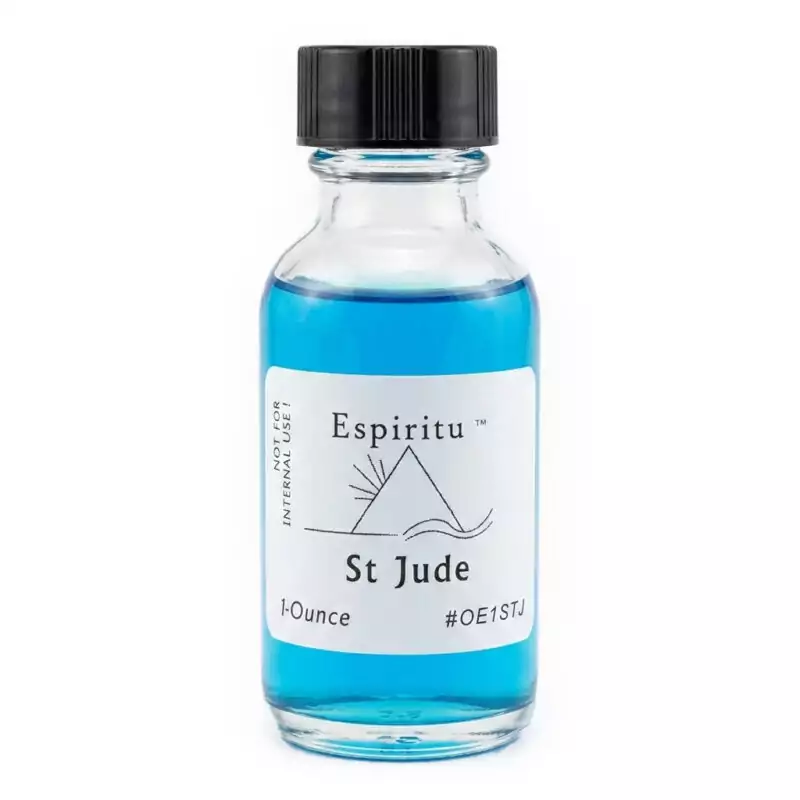



Quick Specs
- Brand: Espiritu
- Type: Ritual aroma oil
- Size/Quantity: 1 fluid ounce
- Best for: Novena candle work, petitions for desperate situations, folk Catholic practice
Saint Jude Thaddeus, Patron of Impossible Causes
Saint Jude Thaddeus is one of the twelve apostles and, in folk Catholicism, arguably the most widely invoked saint for situations where all other options have failed. His title as patron of desperate and hopeless causes originates partly from a historical accident: because his name resembled that of Judas Iscariot, medieval Christians were reluctant to pray to him, fearing association with the betrayer. Over time, this neglect made Saint Jude the saint who would respond to anyone who called, precisely because few did. That legacy of responsiveness to the overlooked and desperate persists in both formal Catholic devotion and in the folk Catholic practice that developed around his veneration.
The situations traditionally brought to Saint Jude are not minor inconveniences. They include terminal illness, devastating job loss, legal proceedings with no apparent path to resolution, and relationships that have completely broken down after a long period of strain. His feast day is October 28, celebrated jointly with the apostle Simon, and the Basilica of the National Shrine of Saint Jude in Chicago holds one of the most significant ongoing St. Jude devotions in the United States. In New Orleans, the International Shrine of St. Jude on Rampart Street draws petitioners from across the country.
Candle Tradition and Novena Practice
The nine-day novena is the cornerstone of traditional St. Jude petitioning, structured to mirror the nine days of prayer between Christ’s Ascension and Pentecost that produced the original Christian novena form. Practitioners light a candle anointed with St. Jude oil on each of the nine days, recite the traditional prayer, and state the petition clearly each time. In folk Catholic practice, green and white are the saint’s primary candle colors, with green associated with hope and miraculous breakthrough and white associated with spiritual purity of intention. Some practitioners supplement the candle work with small offerings of water, flowers, or coins placed near a St. Jude image or statue. Browse my 7-day jar candles for glass-enclosed candles suitable for a nine-day novena cycle.
Practitioners may anoint the oil on a petition paper, on themselves before prayer, or on a photograph of the person in crisis. A distinctive folk Catholic custom associated with answered St. Jude petitions is the publication of a small thanksgiving notice in a newspaper, bulletin, or online space acknowledging that the prayer was heard. This act of public thanks is seen as fulfilling a promise made during the novena and as an act of charity toward others in similar need.
How to Use St. Jude Ritual Oil
A practical three-step approach to integrating this oil into traditional St. Jude novena and petition work.
- Set Your Petition Before Anointing
Write your specific need clearly on paper before working with the oil. St. Jude is petitioned when all other avenues are exhausted, so precision in your written petition gives the novena a focused anchor point through each of the nine days.
- Anoint a Green or White Candle
Apply oil to a green or white taper candle, rubbing from base to wick while naming the crisis you bring forward. Green and white are St. Jude’s traditional colors in folk Catholic practice, representing hope and spiritual clarity.
- Begin a Nine-Day Novena Practice
Light the anointed candle on the first day of a nine-day novena cycle. Re-anoint a fresh candle each day if the first burns down. The nine-day structure is core to traditional St. Jude petitioning, mirroring the early Christian Pentecost novena.
The Tarot Fellow Standard
I carry this oil because the St. Jude devotional tradition represents one of the most widespread spiritual practices in the folk Catholic world, with historical depth and a community of devotees who take the novena seriously. This is a ritual aroma oil and it is not a substitute for prayer, medical attention, or legal counsel. What it provides is a tangible, sensory anchor for a focused petition practice, which is exactly what the candle-and-oil tradition has always offered. For practitioners interested in related folk Catholic practice, browse my Angels and Saints collection for complementary supplies.
Frequently Asked Questions
St. Jude oil supports petitioning Saint Jude Thaddeus, patron of desperate causes. Practitioners anoint candles and petitions during novenas when facing job loss, grave illness, legal hopelessness, or a relationship that has completely broken down.
Green and white are St. Jude’s primary colors in folk Catholic tradition. Green represents hope; white represents purity of intention. Some also use yellow for petitions tied to his October feast day.
Holy Oil is a general blessing oil. St. Michael oil is for warrior work and banishing evil. St. Jude oil is crisis-specific, petitioning the saint whose ministry is intercession when human effort has been fully exhausted.
A folk Catholic custom holds that if St. Jude answers a petition, the petitioner publishes a small thanksgiving notice in a newspaper or bulletin. This publicly acknowledges the answered prayer and informs others of his intercession.



Reviews
There are no reviews yet