

Quick Specs
- Brand: Espiritu
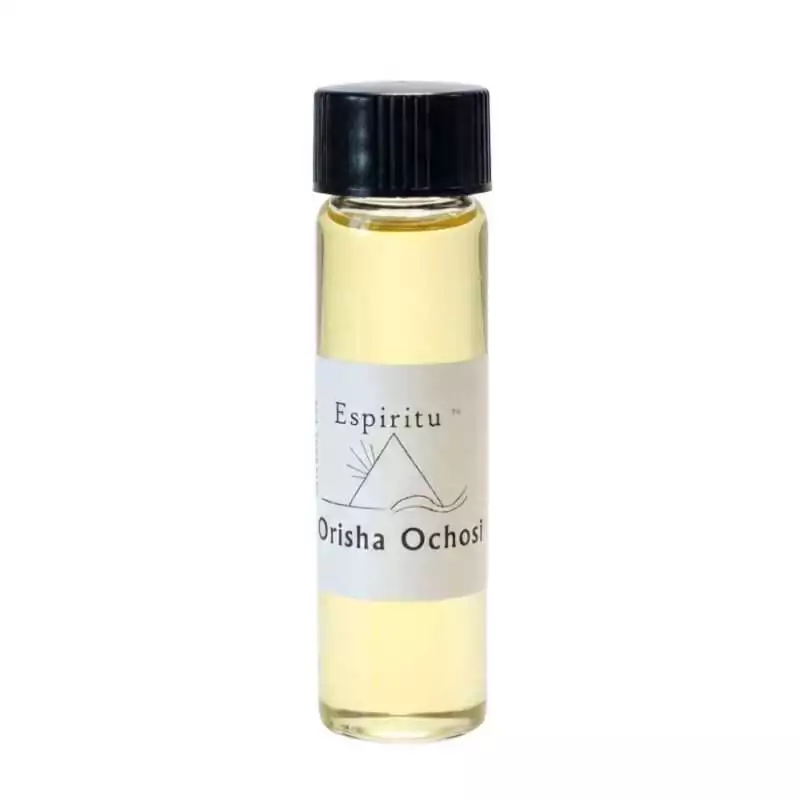
- Type: Ritual fragrance oil
- Size/Quantity: 2 dram
- Best for: Court case petitions, justice work, truth-seeking, legal proceedings, Lukumi and Yoruba devotional practice
Ochosi in Yoruba and Lukumi Tradition
Ochosi, also spelled Oshosi or Oxossi, is one of the three warrior orishas of the Lukumi (Santeria) tradition, working alongside Elegua, the orisha of crossroads, and Ogun, the orisha of iron and labor. He originates in the Yoruba religion of West Africa and was carried to the Americas during the transatlantic slave trade, where his worship was preserved through Afro-Cuban Santeria and later spread throughout the diaspora. In Yoruba lore, Ochosi is the master hunter, an archer of such precision that his arrow, once released, will always find its mark. In Santeria, this quality of unerring aim became a metaphor for justice: what is set in motion by truth cannot ultimately be stopped.
Ochosi is widely regarded as the orisha of justice, and his domain includes court cases, legal proceedings, and any situation where truth is being suppressed or fairness is being denied. This does not mean he functions as a simple luck charm for legal matters. His tradition carries the deeper concept of “blind justice,” where his arrow flies without prejudice and finds what is real rather than what is convenient. Practitioners who appeal to Ochosi are expected to approach him with an honest account of their situation, including their own faults, because the orisha of the hunt rewards candor and rejects manipulation. His sacred colors in Lukumi tradition are blue and yellow, and his number is three.
Justice, Legal Work, and the Forest Orisha
Court case work is among the most practically oriented forms of orisha devotion, and Ochosi is the primary advocate for those facing legal proceedings, immigration hearings, workplace disputes, or any institutional process where outcome depends on truth being recognized. In Cuban Santeria, practitioners facing trial would ask Ochosi to “remove the arrow from their path,” meaning to prevent incarceration, while those who had been wronged would ask him to “set the arrow flying” against injustice. This dual role, as both protector of the innocent and executor of deserved consequences, makes Ochosi one of the most nuanced orishas in the tradition. Browse my Gods and Goddesses collection for more oils suited to orisha devotion.
Beyond court cases, Ochosi is invoked for any goal that requires sustained focus and precision: tracking down a solution to a problem, finding the right path when options seem closed, or seeking truth in a situation obscured by deception. His forest domain gives him authority over hidden things, making him a natural ally for any practitioner who needs something lost or concealed to come to light. The 2-dram Espiritu Ochosi oil is sized for this kind of deliberate, directed ritual use rather than casual or everyday application.
What to Know Before You Buy
Espiritu Ochosi oil is a ritual fragrance oil. For more aroma oils, browse my oils and diffusers collection. If you are new to working with orisha oils, I recommend learning about the Lukumi tradition’s protocols before beginning, as Ochosi responds to respect, honesty, and prepared intention.
How to Use Espiritu Ochosi Ritual Oil
Three focused approaches to working with Ochosi ritual oil for justice and legal petitions.
- Set Your Petition
Before lighting a candle, write your petition clearly: name the legal matter or goal you need Ochosi to guide. State it precisely, as the hunter-orisha rewards clarity and focus. Place the petition beneath a blue candle dressed with the oil.
- Dress Candles for Court or Justice Work
Apply Ochosi oil to a blue or yellow candle, moving from the base upward to draw the desired outcome toward you. Blue suits justice petitions and honors Ochosi’s colors in Lukumi tradition. Many practitioners work on Thursdays for this ritual work.
- Anoint Before Legal Proceedings
Apply a small amount to your wrists or soles of your feet before court dates or hearings. This draws on the Lukumi tradition of seeking Ochosi’s precision and justice, asking the hunter-orisha to ensure his arrow finds its mark in revealing truth.
The Tarot Fellow Standard
I stock Espiritu Ochosi oil because court case and justice work is among the most underserved categories in the spiritual supply market. Most listings for orisha oils treat them as generic “good luck” products without explaining who the orisha is or why the tradition developed in the specific way it did. Ochosi’s history as the blind-justice hunter-archer of the Lukumi tradition deserves a clear, honest account, and that’s what I try to provide here. Practitioners who work with this oil seriously understand that it isn’t a shortcut; it’s a tool for aligning with an ancient principle of truth-finding. Ochosi belongs to a living tradition, and this oil is a supply for devotion, not a substitute for initiation or for the guidance of a godparent and house. See the full Espiritu oils collection for related titles.
Frequently Asked Questions
Ochosi is the orisha of the hunt, tracking, and justice in Yoruba and Lukumi (Santeria) tradition. He works alongside Elegua and Ogun as a warrior orisha known for precision. Devotees petition him especially for court cases and truth-seeking work.
It is a ritual fragrance oil for ceremonial and devotional use.
Ochosi is honored with blue and yellow candles, game meat, plantains, and hunting tools. His sacred number is three, and offerings are typically given in threes to reflect his association with precision, focus, and the pursuit of righteous outcomes.
Ochosi oil is used in court case work, legal petitions, and when truth needs to surface in disputes. It suits goals requiring precision and focus. Devotees call on Ochosi when fair outcomes have been denied and a higher power of justice is needed.






great