


Quick Specs
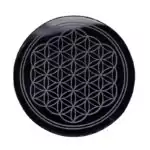
- Material: black obsidian (natural volcanic glass)
- Size: 4 inches
- Design: Flower of Life, laser-etched or hand-engraved
- Form: flat polished tile/slab
Volcanic glass, ancient pattern
Obsidian isn’t a crystal in the strict mineralogical sense. It’s an amorphous volcanic glass, composed mainly of silicon dioxide (SiO2, roughly 70% by weight), formed when silica-rich lava cools so rapidly that atoms never settle into a crystalline lattice. What you’re holding is frozen geology. The deep black color comes from finely dispersed magnetite and iron oxide particles suspended in that glassy matrix, and the mirror-like polish reveals a conchoidal fracture surface that’s been used for tools and ritual objects for at least 30,000 years.
The Flower of Life is one of those patterns that keeps showing up across time and geography. It’s a precise geometric construction: 19 interlocking circles arranged in a hexagonal grid. The oldest confirmed examples appear at the Temple of Osiris at Abydos in Egypt, etched in red ochre on granite columns. The same pattern appears in Assyrian palace carvings (the threshold of the palace of King Ashurbanipal at Dur Sharrukin, now in the Louvre), and Leonardo da Vinci studied it in his notebooks, working through its mathematical proportions and its relationship to the Platonic solids. This tile puts that long lineage in your hands in a form you can actually use.
I stock this piece because it sits at the intersection of two things I find genuinely interesting: the real material science of volcanic glass and the cross-cultural staying power of a single geometric idea. It’s a solid working tool for anyone who uses an altar, runs crystal grids, or just wants something beautiful and grounded on their shelf.
How to use your obsidian altar tile
Three ways to put your black obsidian Flower of Life tile to work on your altar or in your practice.
- Charge stones or objects on the tile
Set the tile on a flat surface with your intent in mind. Place the stones or objects you want to charge directly on it, centering them over the pattern. Leave them in place for at least one full hour, or overnight for deeper work.
- Use it as a crystal grid anchor
Use the tile as a grid anchor by arranging tumbled stones in a circle around the outer edge of the Flower of Life. Start at the top and work clockwise, setting each stone with a spoken intention as you go.
- Set it as a meditation focal point
Position the tile at the center of your altar as a focal point during meditation. Sit comfortably, fix your gaze on the pattern, and breathe slowly. The repeating geometry gives your attention something structured to rest on.
The Tarot Fellow Standard
I carry stone crafts from a supplier with a consistent track record on polish quality and engraving depth. The things I look for are clean edges on the etched lines, a polish that doesn’t fade after a few months of handling, and honest sizing. A 4-inch tile should actually be close to 4 inches, not 3.5 inches photographed at an angle. That consistency is why this piece stays in my shop.
One practical note: obsidian is glass. It’s harder than you might expect (around 5 to 5.5 on the Mohs scale) but it can chip or crack if dropped on a hard floor. The polished face and engraved lines are durable under normal altar use, but this isn’t a cutting board. If you’re cleaning it, a soft dry cloth is all you need. Avoid soaking it, and keep it away from prolonged direct sunlight if you care about keeping the surface finish pristine.
If you’re building out a full altar setup, browse my altar tiles and tables collection for other sizes and designs, or explore my protection and cleansing collection for items that pair well with obsidian’s folk tradition use in boundary-setting work.
Frequently asked questions
Obsidian is volcanic glass, not a crystalline mineral. It forms when silica-rich lava cools too rapidly for atoms to arrange into crystals. You get a smooth, glassy, amorphous solid that fractures with razor-sharp edges.
The Flower of Life is 19 interlocking circles in a hexagonal arrangement. It appears at the Temple of Osiris at Abydos, in Assyrian palace carvings, and in Leonardo da Vinci's notebooks, where he studied its geometric proportions.
Wipe it gently with a soft dry cloth. Avoid prolonged soaking, as obsidian can develop micro-fractures along its polished surface over time. The engraved lines can trap dust, so a soft brush works well for routine upkeep.
It works well as a charging plate for tumbled stones, as a meditation focal point, as the center tile in a crystal grid, or simply as a display piece on a shelf or altar. The 4-inch size fits most standard altar setups.

Reviews
There are no reviews yet