
Quick Specs
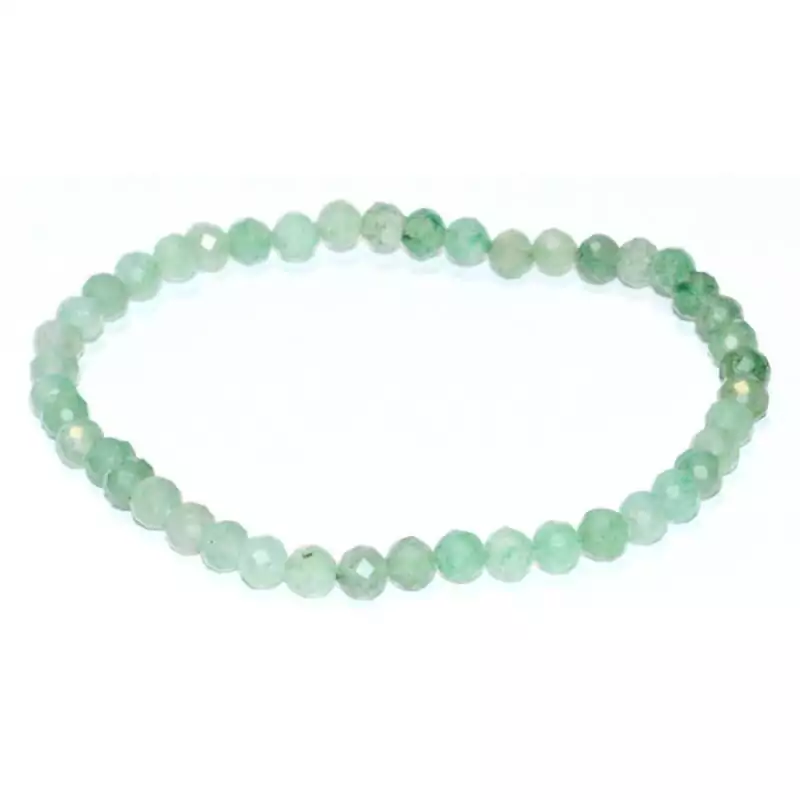
- Stone: Green aventurine
- Bead Size: 4mm
- Shape: Round, faceted
- Color: Pale mint to sea green, with a few deeper green beads
- Closure: None, one continuous loop of beads
Pale Green Aventurine in Faceted 4mm Beads
Aventurine is quartz that holds tiny flakes of other minerals, and in the green variety those flakes are fuchsite, a chromium-bearing mica that supplies the color. Green aventurine runs from light to dark depending on how much fuchsite the quartz carries, and these 4mm beads sit at the light end: pale mint and sea green, with a few deeper green beads and some dark flecks showing in the strand. Every bead is faceted, cut with small flat planes that catch the light and show the green from changing angles. The flakes give aventurine a soft internal shimmer called aventurescence, and the facets add glints of their own. The stone rates about 6.5 to 7 on the Mohs scale, a quartz-level hardness that suits everyday jewelry. The slim 4mm size keeps the strand light on the wrist and leaves room to stack it with other bracelets, whether you add a second strand of the same size or a heavier one with larger beads. Under a window the pale beads look almost translucent, and the deeper ones give the loop a few anchor points of color.
Retail crystal guides link green aventurine with the heart chakra and with luck, growth and opportunity, and one describes it as a lucky stone for gamblers. Those associations belong to modern crystal practice, which borrowed the chakra scheme from Hindu and Buddhist traditions, and they work as symbolism: a color you can look at while you set an intention for a new start. The pale mint tones suit that idea well, since they recall the first leaves of spring. A light green strand sits easily with white, cream and denim, and it reads clearly against dark sleeves, and it gives a stack of darker stones a fresh accent. Because aventurine is a quartz, the beads hold a polish, and the faceting keeps the surface lively under indoor light. Each bracelet varies slightly in its mix of pale and deeper beads, so the strand you choose is its own arrangement. The 4mm size also slips under a cuff, which makes it easy to wear for the whole day as a private marker.
Practical Ritual Applications
Wear the bracelet at the start of something new: the first week of a job, a first draft, a new routine. Rest your thumb on one bead when you sit down to begin, as a cue to take the first step. On an altar, lay it on a cream cloth beside a green candle or a small plant, and let the pale green stand for early growth. At a desk, a dish next to your planner keeps the strand in sight while you work. Before you leave the house on a day with something new on it, a glance at the pale green can serve as a last cue. To stack it with other slim strands, my 4mm and 6mm beaded bracelets collection holds more stones in the same narrow sizes.
How to Wear and Care for Your Green Aventurine Bracelet
Three steps cover inspecting the strand, wearing it at a new start, and cleaning it.
- Inspect the strand in daylight
Hold the bracelet near a window and turn it so the facets catch the light. Find the palest bead and the deepest green one, and notice the dark flecks that show in some beads. That variation is typical of aventurine. Choose one bead as your marker and decide which new beginning the bracelet will mark.
- Wear it at the start of a task
Put the bracelet on when you begin the thing you chose, and touch the marker bead once before you start. In crystal practice green aventurine is tied to luck and the heart chakra, so the bead works as a small cue to begin with a clear head. When the task is done, take the bracelet off and set it where you will see it tomorrow.
- Clean it with warm soapy water
Wipe the beads with a soft cloth or brush and warm soapy water, then dry them. Keep harsh household chemicals away from the bracelet and avoid prolonged heat. Store it in a pouch or lined box apart from other gems, and remove it before strenuous activity to protect the small faceted beads.
The Tarot Fellow Standard
I stock this bracelet for its light, clear green: aventurine in a slim 4mm faceted bead, with a mix of pale and deeper beads along the loop. The heart chakra and luck links are modern crystal lore, and I offer them as symbolism to take or leave. The stone itself is quartz with fuchsite flakes, and the strand shows it in its flecks and shimmer. For other stones to compare, browse my crystals, stones and gemstones collection, where green aventurine sits beside the rest of the shop’s minerals.
Frequently Asked Questions
The name comes from the Italian word for by chance. The reference is to aventurine glass, which Italian glassmakers are said to have found by accident. That glass is still the stone's main imitation, sold as goldstone. Natural aventurine is quartz with mineral flakes, and goldstone is the glass.
India is the most important commercial source of green aventurine, and Wikipedia says the majority of green and blue-green material originates there. Brazil follows as the second major producer. Smaller amounts come from Russia, Spain, Austria, Chile and Tanzania.
Both descriptions appear in the literature. Wikipedia calls aventurine a form of quartzite with platy mineral inclusions, and quartzite is a rock. Minerals.net describes it as a compact variety of quartz and chalcedony with included flakes, and adds that it is sometimes classed as a rock. Gem sellers treat it as a quartz variety, and the green color comes from fuchsite mica scattered through the quartz.

Reviews
There are no reviews yet