

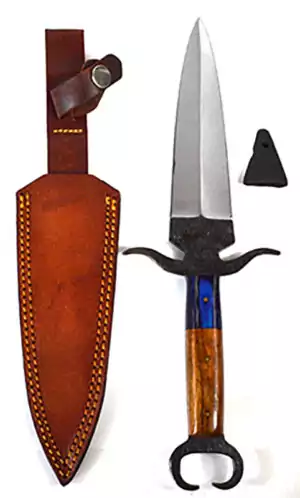

Quick Specs
- Type: Ritual athame, ceremonial dagger
- Size: 5.25 inches overall
- Handle: Stag/deer motif
- Best for: Circle casting, energy direction, Cernunnos devotion, green-path Wicca
The Stag and the Sacred Blade
The stag is one of the oldest symbols in the Western magical tradition. Cernunnos, the antlered god of the Celts, appears in petroglyphs from as far back as the Hallstatt period, seated in the classic cross-legged posture with a torque at his throat and a stag at his side. He governs the wildwood, the cycle of hunt and renewal, and the liminal passage between the tame and untamed worlds. In British witchcraft, Herne the Hunter carries the same archetype, haunting Windsor Forest and embodying the masculine divine in its most elemental form.
An athame is one of the four classical tools of Wiccan practice, standing on the altar alongside the chalice, wand, and pentacle. Unlike the boline, which handles actual physical cutting, the athame never touches physical matter for mundane purposes. Its job is energetic: directing the practitioner’s will, drawing the circle, invoking the quarters, and channeling intent with the focused precision of a blade.
Working with a Stag-Handled Athame
The stag motif makes this athame a natural fit for practitioners who work with the horned god, green-path Wicca, or any tradition that honors the masculine divine through nature symbolism. At 5.25 inches, it’s compact enough for close altar work, travel kits, and one-handed circle casting without the reach of a full-sized blade. The handle brings that wildwood energy directly into your grip at the moment of casting.
Solitary practitioners and coven members alike find a compact athame easier to maneuver in smaller ritual spaces. The stag handle pairs naturally with oak and acorn altar decorations, antler-topped wands, and green or brown altar cloths for sabbat observances tied to the wheel of the year, particularly Beltane, Midsummer, and Mabon, when the wildwood current runs strongest. Browse my full athame collection to see companion pieces that share this elemental-wood aesthetic.
How to Use a Stag Athame
A guide to dedicating and working with your stag athame in circle casting and ritual practice.
- Cleanse and Dedicate
Hold the athame in both hands and pass it briefly through incense smoke or a candle flame. State your intent aloud, dedicating it as a tool of will and direction aligned with the horned god or your path.
- Cast the Circle
Point the athame outward from your dominant hand and walk clockwise, visualizing a line of blue-white light extending from the tip. Trace the full perimeter and return to the starting point to seal it.
- Direct and Close
Point the blade toward each quarter in turn as you call the elemental guardians. To close, walk counterclockwise and pull the circle energy back in. Ground any residual charge by pressing your palm flat to earth.
The Tarot Fellow Standard
I stock this piece because the stag handle gives it a distinct mythological identity that most generic athames lack. It’s sized for real use, not just display, and the Cernunnos connection resonates across Gardnerian Wicca and Celtic reconstructionism. If you’re building a nature-path altar, explore my ritual supplies collection for chalices, cauldrons, and other tools that complement this blade’s aesthetic.
Frequently Asked Questions
The stag connects to Cernunnos, the Celtic horned god of the wildwood, and to Herne the Hunter. It brings masculine divine energy, forest lore, and the cycle of hunt and renewal into your practice through the handle.
Yes. A 5.25-inch athame is fully functional for tracing a ritual circle, directing quarter calls, and channeling energy. Many practitioners prefer a compact blade for close altar work, travel kits, and smaller spaces.
Not in most Wiccan traditions. The athame directs energy, not physical matter. Keeping the blade dull is intentional, distinguishing it from the boline, which is the practical cutting knife used for herbs and cord.
Wrap the athame in natural cloth, ideally black or dark-colored, and keep it in a dedicated pouch or on your altar. Avoid storing it loose in a drawer where the blade or handle could be scratched between uses.


Reviews
There are no reviews yet