

Quick Specs
- Type: Polished rubilite obelisk tower
- Size/Quantity: 0.5-0.7 lb, one piece
- Best for: Heart chakra work, love rituals, collector display
Rubilite: The Rarest Shade of Pink Tourmaline
Rubilite is gem-quality pink-to-red tourmaline graded by its saturated raspberry or ruby-red hue. Tourmaline belongs to a complex boron silicate mineral group, and the elbaite variety produces the widest color range in the family. Rubilite sits at the most sought-after end of that spectrum: only stones that hold their vivid pink-red color under incandescent light without shifting to muddy brown qualify for the rubilite designation under gemological standards.
The obelisk cut draws on ancient Egyptian sacred geometry, where the four-sided tapering column was understood as a conduit between earth and sky. Practitioners in crystal work use the obelisk form to direct and amplify energy upward from a flat base. A rubilite obelisk at this weight carries enough mass to anchor a dedicated altar position rather than simply tucking into a pocket carry kit. Browse my obelisk and tower collection to see the full range of forms available.
Heart Chakra Practice and Love Rituals
Pink and red tourmaline varieties have long associations with Anahata, the heart chakra, across both Western crystal healing traditions and Vedic chakra-based practices. Rubilite in particular is cited by crystal practitioners as supporting passionate love, self-compassion, and the kind of courage required to open the heart after grief or betrayal. It pairs naturally with rose quartz for a softer, nurturing love energy, or with green aventurine when practitioners want to balance receptive and assertive heart qualities simultaneously.
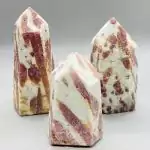
At the collector end of the spectrum, rubilite commands attention because genuinely saturated gem-quality material is genuinely scarce. The finest deposits have historically come from Brazil’s Minas Gerais state, with notable material also from Mozambique and Afghanistan. The pink-white marbled appearance of many rubilite obelisks reflects natural co-formation with white lepidolite or albite matrix, which is geologically characteristic rather than a quality defect.
How to Use a Rubilite Obelisk
Three ways to work with a rubilite obelisk for heart chakra and love rituals.
- Set Your Heart Chakra Intention
Hold the obelisk at chest height with both hands. Breathe slowly and bring full awareness to your chest. State your intention aloud: self-love, calling in a partner, or healing grief from a past relationship.
- Place It on Your Altar or Grid
Position the obelisk point-up at the center of your altar. For a love grid, surround it with rose quartz tumbles, dried rose petals, and a written intention on paper placed beneath the base. Activate clockwise.
- Cleanse Between Sessions
Pass a singing bowl or tuning fork vibration around the obelisk after any emotionally intense session. You may also rest it briefly on a selenite slab. Avoid prolonged direct sunlight, which fades color over time.
The Tarot Fellow Standard
I stock rubilite selectively because saturated gem-grade material matters, and I won’t carry muddy brown-shifted stones just to fill a category. Each piece in this weight class is individually evaluated for color saturation before it earns shelf space. If you’re building a serious heart chakra practice or a collector’s altar, explore my full crystal and gemstone collection for complementary pieces.
Frequently Asked Questions
Rubilite is the gem-grade designation for tourmaline with vivid pink-to-red saturation that holds color under all lighting. Standard pink tourmaline includes lighter or warmer-toned stones that do not meet the rubilite threshold.
Natural rubilite is untreated in most reputable specimens. Some lower-grade tourmaline is heat-treated to improve color, so buying from a trusted source matters. Gem-quality rubilite gets its color from natural manganese content.
This listing covers one piece weighing 0.5 to 0.7 pounds, roughly 225 to 315 grams. That is a solid altar specimen, heavier than pocket crystals but compact enough for a nightstand or dedicated crystal grid layout.
Rubilite is most closely associated with the heart chakra, Anahata, due to its pink-red color. Practitioners also connect deeper red specimens to the root chakra for grounding passion and embodied self-worth.

Reviews
There are no reviews yet