
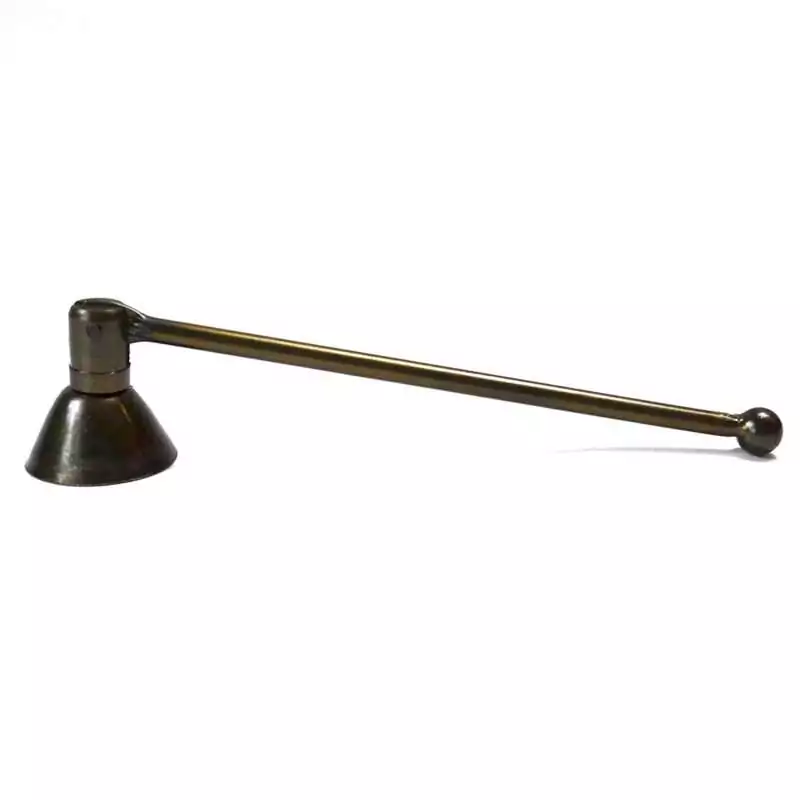


Quick Specs
- Material: metal
- Length: 5 inches
- Bell-shaped extinguishing end on long handle
- Weight: 0.05 lbs
- Works with chime, taper, and pillar candles
A small tool with a long history
The candle snuffer is one of the oldest tool shapes in domestic and sacred life. Depictions of bell-ended extinguishers appear in medieval church inventories and Egyptian tomb art alike. Long before electricity, managing open flame was a serious daily practice, and the snuffer was the civilized answer to the chaos of a blown-out wick. I think about that lineage every time I pick one up. There is a reason this design has not changed in a thousand years.
In many candle-magic practices, blowing out a candle is widely considered disrespectful to the fire element. Fire in these contexts is not decoration – it is an active participant in the working. Blowing sends your breath, with all its mundane energy, directly into a space you have been carefully building. Snuffing closes the flame without interrupting the energetic container. The view is consistent across practices that otherwise share very little: treat fire with deliberate care. Beyond the spiritual reasoning, the practical case is just as strong. Snuffing prevents wax spray onto your altar cloth, cuts smoke production significantly compared to blowing, and leaves the wick in cleaner condition for the next lighting.
At 5 inches, this snuffer is sized for the candles most practitioners work with daily: chime candles, tapers, and smaller pillars. The bell drops neatly over the flame and cuts the oxygen supply cleanly. It is not fancy. It does not need to be. The craft here is in the proportions – a handle long enough to keep your fingers safely away from the flame, a bell wide enough to seal without tilting the candle. I stock this because it is exactly what it needs to be and nothing more.
How to use a candle snuffer
Use your metal candle snuffer to extinguish candles with intention and without wax spray.
- Position the snuffer over the flame
Hold the snuffer by its handle and lower the bell end slowly over the flame. Keep it steady so the bell fully covers the wick. The lack of oxygen extinguishes the flame cleanly without disturbing the wax.
- Watch for the thread of smoke
Once the flame is out, a thin thread of smoke will rise from the wick. This is normal. Let it dissipate naturally before moving the snuffer away.
- Set it down on a heat-safe surface
The bell end retains brief warmth after use. Rest the snuffer on a ceramic dish, tile, or altar plate to protect your surface and keep your workspace tidy.
Tarot Fellow Standard
This is a simple metal tool and I do not oversell it. The snuffer I stock is consistent in construction – the bell seats properly on the handle, the proportions are right for everyday candle work, and it does not wobble or feel like it will fall apart after a month of use. I have had batches of candle accessories before that looked fine in photos and arrived with loose bells or bent handles. These hold. That is the whole of my recommendation: it does what it is supposed to do without drama.
One practical note: if you are using this with very thin chime candles, angle your approach slightly rather than coming straight down. Chime candles are narrow enough that a perfectly vertical descent can catch the edge of the holder rather than the candle. A slight tilt as you lower gives you better coverage. Pair this snuffer with chime candles for your daily ritual work, or browse the full range of candle snuffers and accessories to see what else fits your altar setup.
Frequently asked questions
Yes. The bell is sized to fit over standard chime and taper candles. For wider pillar candles, hold the bell close to the wick and it will still cut airflow enough to snuff cleanly.
Blowing scatters wax, creates more smoke, and in many candle-magic practices is considered disrespectful to the fire element. Snuffing closes the working with intention.
Yes. The snuffer does not touch the wax – it covers the flame from above. Keep the handle parallel to the candle and you will have no contact with liquid wax.
Chime candles, taper candles, and pillar candles. It is not designed for jar candles or votives with deep wells – a long-reach snuffer or wick dipper works better there.



Reviews
There are no reviews yet