
Quick Specs
- Stone: Fluorite
- Bead Size: 6mm
- Cut: Faceted round
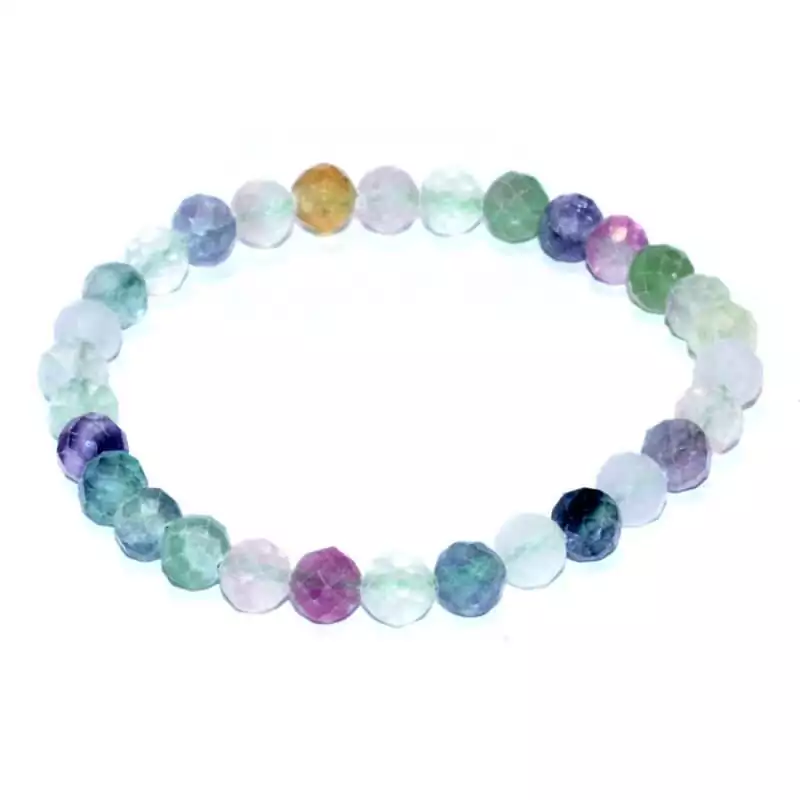
- Colors: Frosted mint green, lilac, violet, with teal, amber and pink accents
- Closure: None, one continuous loop of beads
Pastel Fluorite in Faceted 6mm Beads
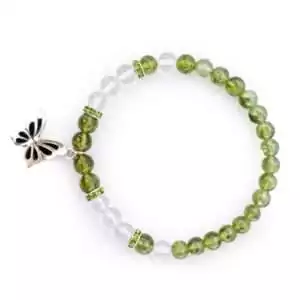
Most of the beads on this strand are pale: a frosted mint green, a milky near-white, a soft lilac and a washed violet, each cut into small flat facets that give it a cloudy, glass-like sparkle. A few beads carry deeper color, including a dark teal-blue, a rich violet, a single amber bead near the top and a couple of pink and magenta ones lower on the loop. The pale beads shade into their neighbors, so the strand moves in soft steps from one tint to the next. Pure fluorite is colorless, and the palest beads sit close to that end of the range, while impurities, radiation and tiny defects called color centers account for the stronger tints. Fluorite is calcium fluoride, CaF2, and it often forms in bands of different color inside one crystal, so beads cut from neighboring zones can look unrelated. At 6mm the loop reads as soft color from a distance and as a scatter of small mirrors up close. The mineral defines 4 on the Mohs scale, which makes it soft, and it splits along four flat planes, which is part of why quartz, at 7, can scratch it.
Fluorite has a long reputation in crystal practice as a stone of mental clarity and focus, and the pastel palette here suits that reputation visually: cool, light and uncluttered. Guides assign chakras by color. One crystal retailer links green fluorite with the heart chakra, purple with the third eye and blue with the throat, and another lists the third eye, heart and throat for the stone as a whole, so a strand with mint, violet and teal touches several of those at once. These are modern crystal-lore associations, and the chakra scheme they borrow comes from Hindu and Buddhist traditions, with the colors and gemstone pairings added in the West much later. Take them as symbolism. The same retailer’s bracelet notes call fluorite a favorite of students and creatives, and a mixed strand like this one works as a small color chart you can touch bead by bead. In size, 6mm sits in the middle of the beaded range: bolder than a 4mm strand, lighter than an 8mm one, and a comfortable width for layering with a watch or a thin metal bangle.
Practical Ritual Applications
Keep the bracelet near the place where you do your thinking: wear it while you plan a week, study for a course or draft a letter, and set it on the desk when you want your hands free. If you write questions in a journal before a card reading, lay it across the page as a marker for the clear-headed mood you are after. If you plan a night of journaling, set the bracelet beside the page before you start. A bowl of water, a white candle and the bracelet make a simple altar arrangement in the same pale, cool palette. For strands in neighboring sizes that stack evenly with this one, browse my 4mm and 6mm beaded bracelets collection, where slim and mid-size beads sit together.
How to Wear and Care for Your 6mm Fluorite Bracelet
Three steps cover choosing a focus word, wearing the bracelet for quiet work, and cleaning a soft stone.
- Choose a focus word
Before you put the bracelet on, pick one word for the hours ahead, such as steady, clear or finished. Hold the bracelet in your open hand for a breath and say the word once. In crystal practice fluorite is linked with mental clarity, so the word and the stone make a simple pairing, and the bead you touch first becomes your reminder.
- Wear it for quiet work
Slide the bracelet on for reading, writing or planning. When your attention drifts, turn the bracelet one bead and look at the color under your thumb. Because fluorite is soft, take the bracelet off for sports, heavy chores and anything that bangs the wrist, and lay it on a soft cloth while you do.
- Wipe, dry and store it apart
Clean the beads with a soft cloth dampened with warm water and mild soap, rinse off the soap and dry them. Skip ultrasonic cleaners, steam and harsh chemicals. Store the bracelet away from harder stones and out of strong sun, since some fluorite fades with prolonged light.
The Tarot Fellow Standard
I stock this bracelet because it shows a lighter side of fluorite: faceted 6mm beads in pastel green, lilac and violet, with a few deeper accents. The beads vary from one to the next because the crystal is zoned. The focus and chakra lore is modern crystal practice, and I offer it as symbolism you can take or leave. If you want to compare fluorite with other stones, browse my crystals, stones and gemstones collection, where tumbled stones, spheres and jewelry share one place.
Frequently Asked Questions
Guides vary, which is common in modern crystal lore. One retailer lists the third eye, heart and throat chakras for fluorite as a whole, while another assigns them by color: purple to the third eye, green to the heart, blue to the throat and yellow to the solar plexus. The chakra scheme itself comes from Hindu and Buddhist traditions, and the color pairings were added in the West much later.
Yes, both names describe calcium fluoride. Georgius Agricola printed fluorspar in 1530, from the German Flussspat, because the mineral works as a flux in smelting. Today fluorspar is mostly the industrial and chemical term, while mineralogists and jewelers say fluorite. Both words trace back to the Latin fluere, 'to flow'.
Fluorite suits occasional wear. The International Gem Society calls it too fragile for most jewelry use and points to protective settings, occasional wear, pendants and earrings, and Minerals.net notes that it is mostly cut as faceted stones for collectors. A bracelet takes more knocks than a pendant, so I would reserve this one for quieter days and store it apart from harder stones.

Reviews
There are no reviews yet