

Quick Specs
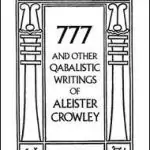
- Brand: Aleister Crowley / Weiser Books
- Type: Reference book, esoteric correspondence tables
- Size: 9.2″ x 6.2″ x 1″
- Size/Quantity: One volume, approx. 9.2 x 6.2 x 1 inches
- Best for: Ceremonial magic study, Thelemic practice, Kabbalah correspondence work, Golden Dawn tradition
777: The Foundational Correspondence Table in Western Magic
Aleister Crowley compiled the tables now known as 777 while working within the Hermetic Order of the Golden Dawn in the early twentieth century, drawing on the order’s systematic approach to mapping all magical phenomena onto the framework of the Kabbalistic Tree of Life. The central table runs 32 rows for the Sephiroth and 22 paths, with columns covering tarot trumps, planetary attributions, divine names, angels, demons, colors, incenses, plants, animals, perfumes, and dozens more categories. It remains the densest single-volume cross-reference in the Western esoteric tradition.
The volume includes additional writings beyond the tables: Liber Trigrammaton, Liber Resh, and other short Thelemic texts that place the correspondence system in context. For practitioners working in any Golden Dawn-derived system, including Thelema, the A.A., or reconstructed Wiccan ceremonial frameworks, the 777 tables function as a decoder ring connecting diverse symbol sets. A spell calling for the herb of the Moon, the color of Mercury, and the stone of Saturn can all be read from the same row of the same table.
Practical Use in Ceremonial and Eclectic Magic
Practitioners who do not identify as Thelemic still find the tables indispensable because the attributions systematized here underlie most English-language grimoire traditions published after 1900. When you encounter a candle color recommendation, a planetary incense, or a tarot card assigned to a ritual operation in any modern book on magic, there is a good chance the author traced the assignment back to these tables. Knowing the source lets you evaluate alternatives and build correspondences with greater precision rather than treating received lists as fixed dogma.
The physical dimensions at 9.2 by 6.2 by 1 inch place it comfortably on a working desk. I keep a copy accessible whenever I am building new rituals, because cross-checking several columns simultaneously is much faster in the printed tables than searching multiple digital sources. Browse my esoteric and occult books for related texts in ceremonial magic, Kabbalah, and Thelema.
How to Use 777 as a Magical Reference
Three ways to use the 777 tables as a practical magical reference rather than just a reading experience.
- Start with a known anchor
Open to the main table and locate something you already know, such as The Moon tarot card. Read across that row to discover the corresponding color, incense, plant, and stone. This reveals how the table works before you need it under pressure.
- Build ritual components from a single Sephirah
Choose a working aim, then locate its Sephirah. Read the row to select a candle color, an incense, a stone, and a deity name that share that attribution, building a coherent ritual toolkit from a single, internally consistent source.
- Cross-check against other systems
When a modern guidebook recommends a specific herb or stone, trace it back to the 777 table and find which Sephirah or path that author drew from. This builds understanding of why the recommendation exists, not just that it exists.
The Tarot Fellow Standard
I stock 777 because it is one of those reference books that serious practitioners of ceremonial magic need to own rather than borrow. The tables are dense but navigable, and having them at hand changes how you build rituals. For tarot-specific study that connects to the same Kabbalistic framework, take a look at my tarot and divination books.
Frequently Asked Questions
The 777 tables are Kabbalistic correspondence charts mapping 32 paths of the Tree of Life to tarot cards, planets, colors, incenses, stones, plants, and divine names. They are the foundational cross-reference for Western ceremonial magic.
No. The correspondence tables are used across many Western esoteric traditions including Golden Dawn, Wicca, and eclectic ceremonial magic. Most English-language magic books after 1900 trace their attributions back to the same source material.
Crowley designed the Thoth Tarot to embody the same attributional system laid out in 777. Each card corresponds to a Sephirah or path, with color, symbolism, and title drawn from the tables. Studying both together reveals the card’s full logic.
777 is a reference tool, not an introductory text. Beginners will find it dense without prior exposure to Kabbalah and tarot. I recommend an introductory Tree of Life book first, then returning to 777 once you can navigate the column headers.



1 review for 777 and Other Qabalistic Writings Aleister Crowley Hermetic