
Quick Specs
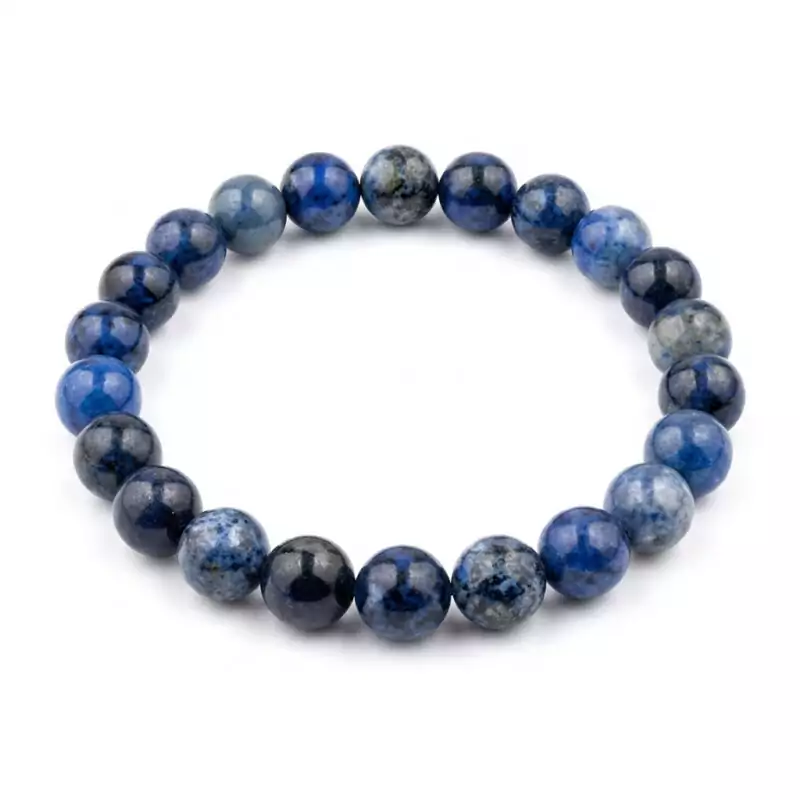
- Stone: Dumortierite
- Type: 8mm round beaded stretch bracelet
- Color: Deep blue to blue-violet
- Best for: Mental discipline, patience work, third eye activation
Dumortierite Crystal Properties and Mineral Origins
Dumortierite is an aluminum borosilicate mineral first described in 1881 by French geologist Eugene Dumortier in the Rhone-Alpes region of France. Its deep blue coloration, ranging from rich cobalt to violet-blue, comes from trace iron within the crystal structure. It forms in high-temperature metamorphic rocks and is found notably in Brazil, Namibia, Madagascar, and parts of the western United States.
This stone is frequently called the “stone of patience,” consistent with how practitioners position it across modern crystal traditions. It resonates with the third eye chakra and carries associations with mental discipline, organizational thinking, and the steady focus that allows complex problems to unfold with clarity. It isn’t a flashy stone the way amethyst or lapis lazuli captures attention; it works quietly over time.
How Dumortierite Differs from Other Blue Stones
Crystal collectors often ask how dumortierite compares to lapis lazuli and sodalite, since all three show blue coloration. Lapis lazuli is a metamorphic rock with pyrite inclusions carrying associations with royalty and truth-telling in ancient Egyptian and Mesopotamian traditions. Sodalite is a feldspathoid mineral linked to rational thought and logic. Dumortierite specifically targets perseverance under pressure and long-arc mental clarity.
These 8mm beads are strung on a stretch cord sized to fit most adult wrists. If you’re building a focus and study stack, dumortierite pairs naturally with fluorite for structure and clear quartz to amplify mental clarity. Browse my crystal beaded bracelet collection to find compatible pairings for your practice.
How to Use Dumortierite 8mm Bracelet
Three practical steps for working with your dumortierite bracelet daily.
- Set Your Intention
Hold the bracelet in both hands before a work session. Breathe steadily and name your focus goal. Dumortierite links to patience, so naming the task you intend to sustain helps anchor the stone’s purpose.
- Wear During Focused Work
Wear it on your left wrist during tasks requiring sustained concentration. Writers, students, and planners find the physical reminder useful for returning attention when the mind drifts or frustration rises during long work periods.
- Cleanse and Reset Weekly
Reset it weekly by placing it on a selenite charging plate overnight or running it briefly under cool water. Avoid prolonged sun exposure, as intense UV light can fade the blue coloration toward a duller gray-blue over time.
The Tarot Fellow Standard
Dumortierite earns its place in my inventory because it fills a specific gap that other blue stones don’t. Lapis lazuli speaks to wisdom; sodalite to logic and rational order. Dumortierite is for endurance, the capacity to stay focused on a task that matters even when the work is unglamorous. I stock this for practitioners building something that requires months of steady attention. If you’re pairing it with meditation tools, explore my chakra and meditation collection for third eye support items that complement this stone.
Frequently Asked Questions
Dumortierite is associated with patience, mental discipline, and third eye activation. Practitioners use it to support focus during long projects, study sessions, and any work requiring organizational thinking and perseverance over time.
All three are blue but differ in use. Lapis lazuli links to royalty and truth. Sodalite targets rational thought. Dumortierite specifically supports endurance and the mental stamina needed for long-term projects and disciplined focus over time.
Dumortierite resonates with the third eye chakra at the brow center. This chakra governs perception, intuition, and mental clarity. Its patience association and link to organized thinking align with the third eye role in focused inner vision.
Brief contact with water is fine, but prolonged submersion weakens elastic cord over time. Avoid extended direct sun exposure, as UV light may gradually fade the deep blue coloration toward a muted gray-blue tone in bright outdoor conditions.




Reviews
There are no reviews yet