
Quick Specs
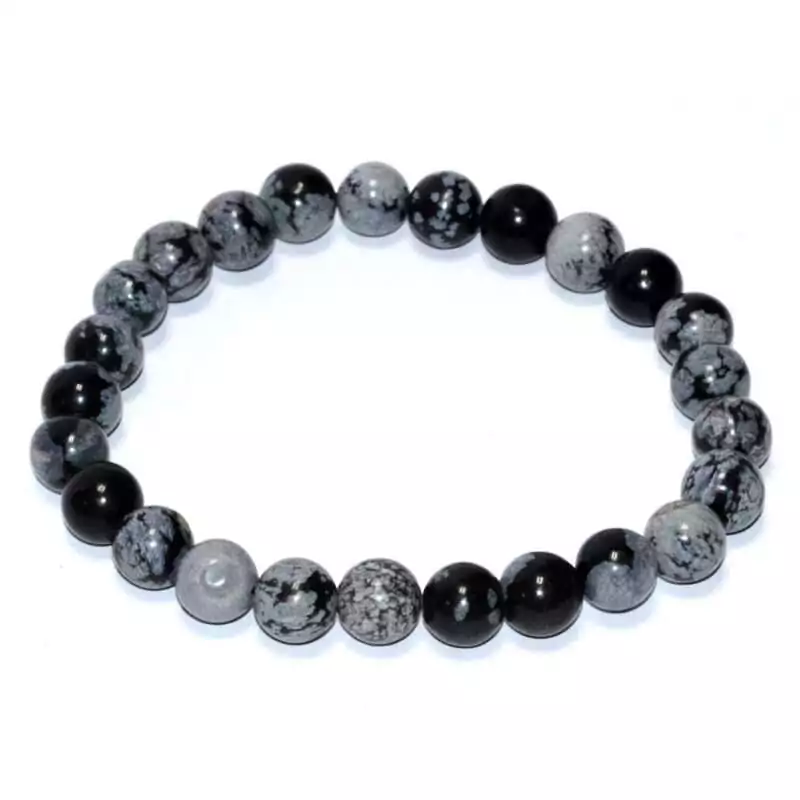
- Stones: Black obsidian and snowflake obsidian
- Bead Size: 8mm
- Shape: Round
- Finish: Polished, glossy
- Color: Black, gray and white
- Closure: None, one continuous loop of beads
Black and Snowflake Obsidian in 8mm Beads
Obsidian is volcanic glass, formed when silica-rich lava cools so fast that crystals barely have time to grow. It is mostly silicon dioxide, with the rest made up of oxides of aluminum, iron, potassium, sodium and calcium, and iron and similar elements give the glass its dark color. Gem references class it as a rock or a mineraloid because its makeup varies and it has no crystal structure. This strand shows two looks of it in round beads that each measure just under a third of an inch. Some beads are solid black and glossy. Others are snowflake obsidian, black glass dotted with white and gray flecks. The flecks are clusters of cristobalite, a silica mineral that crystallized in the glass in radiating groups called spherulites, and they give the variety its name. On these beads the flecks range from fine speckles to broad cloudy patches, and a few beads read mostly gray with dark veining. Obsidian rates about 5 to 6 on the Mohs scale and is brittle, so the beads reward a soft landing when you set the bracelet down.
Root chakra, protection and grounding are the associations crystal lore gives to obsidian. The chakra scheme behind the first of them comes from Hindu and Buddhist traditions, and the pairing with a stone is a modern addition, best taken as symbolism. The black and white of this strand suit that steady mood. Black and gray are easy colors to wear, and the white flecks give the beads some life when light moves across them. At 8mm each bead is large enough to show its own pattern, so a flecked bead and a solid one read as separate pieces along the loop. The strand sits comfortably beside a watch, a leather cuff or a slim silver bangle, and it pairs with dark clothes as readily as with light ones. The glossy beads pick up window light and lamplight as small bright highlights, which makes the solid black ones shine like polished mirrors. With no clasp, the loop has no front or back, so whichever bead lands on top shows its pattern to anyone who looks.
Practical Ritual Applications
Wear the bracelet on days that ask for steadiness: a long commute, a presentation, a family gathering. Before you start, press your feet to the floor and touch one solid black bead and then one flecked bead as a short grounding cue. On an altar, lay it between a black candle and a white one, so the two colors of the strand echo the flames. If you keep a journal, rest the bracelet beside the page when you want to slow your thoughts before writing. To compare more stones in this bead size, my 8mm beaded bracelets collection holds other strands that line up evenly on the wrist. Between wears, a small dish or pouch keeps the strand from rolling off a table.
How to Wear and Care for Your Obsidian Bracelet
Three steps cover reading the pattern, a grounding habit, and safe cleaning.
- Read the pattern in daylight
Hold the bracelet toward a window and turn it slowly. Find the beads with the finest flecks, the ones with broad cloudy patches and the solid black ones. The spread between them is the cristobalite at work, and it is why no two snowflake beads match. Pick one bead you like best to be your anchor bead for the habit in the next step.
- Use it as a grounding cue
Put the bracelet on, plant both feet and take three slow breaths with your thumb resting on the anchor bead. In crystal practice obsidian is tied to grounding, protection and the root chakra, so you can use that bead as a cue to settle before a hard task. A short pause at the start of the day builds the habit fastest.
- Clean it with mild soap and a soft cloth
Wipe the beads with a soft cloth or brush dampened with warm water and a little mild soap, then dry them. Skip ultrasonic and steam cleaners, because obsidian can hold inclusions that expand when heated. Protect the strand from knocks against counters and doorframes, and store it in a pouch away from harder stones that could chip the glass.
The Tarot Fellow Standard
I stock this bracelet for its pairing: plain glossy black obsidian and flecked snowflake obsidian in one 8mm strand, with nothing added. Each strand mixes solid and flecked beads in its own order, so no two look alike, and the two kinds of bead show how different the same volcanic glass can look. The protection and grounding links are modern crystal lore, and I offer them as symbolism you can take or leave. For more stones tied to that theme, browse my balance, grounding and stability stones.
Frequently Asked Questions
Gem references list several. Sheen obsidian shows a golden sheen from aligned gas bubbles, fire obsidian an iridescent, rainbow-like sheen from magnetite nanoparticles, and rainbow obsidian striped bands colored by oriented hedenbergite nanorods. Apache tears are small rounded nuggets, usually embedded in a grayish-white perlite matrix. Obsidian is usually black, sometimes green or brown, and rarely yellow, orange, red or blue.
Obsidian is amorphous, a glass with no crystal structure, so it breaks along smooth curved surfaces and fractures with very sharp edges. It is also brittle, with a Mohs hardness of about 5 to 6. In a bracelet that means a hard knock can chip a bead, so avoid banging the strand against counters and doorframes.
Utah is described as a major source of the snowflake variety. Obsidian itself occurs wherever silica-rich lava cools quickly. In the United States, deposits are listed in Oregon, Utah, Arizona, Colorado, New Mexico, Texas, Washington, Idaho and California, including the Medicine Lake Volcano. Elsewhere it is found in countries such as Mexico, Iceland, Italy, Japan, Turkey and New Zealand.



Reviews
There are no reviews yet