
Quick Specs
- Type: Raw stone pendant necklace
- Stone: Black tourmaline
- Size: Stone about 1/2 by 3/4 inch
- Finish: Raw, unpolished surface with vertical lines
- Cord: Satin, 24 inches
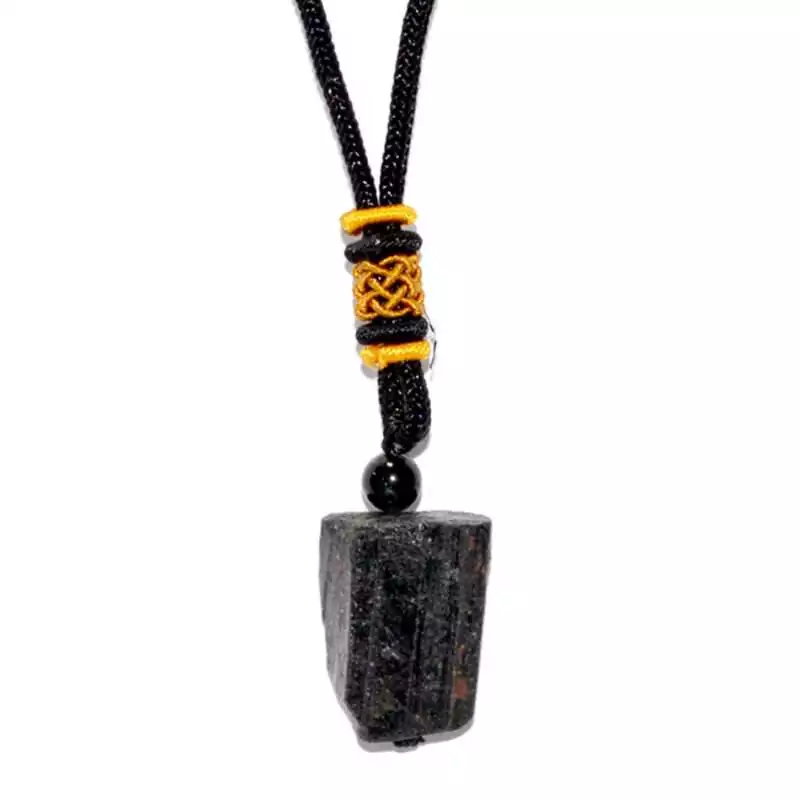
- Accents: Gold-yellow woven knot and round black bead
- Mohs Hardness: 7 to 7.5
A Raw Black Tourmaline on a Cord With a Gold-Yellow Knot
The pendant is a short, thick piece of black tourmaline with a raw surface, about 1/2 inch wide and 3/4 inch tall. Its face is dark and matte, with fine vertical lines running from top to bottom like grain in wood, and a faint reddish-brown tint shows toward the lower right. The edges are rough and the corners irregular, so the stone looks like a natural fragment. A round black bead sits directly above the stone, at the lower end of the cord. The 24 inch cord is black and carries a woven knot of gold-yellow thread, held between small yellow bands, a little way up from the stone. That knot is the one bright color on the piece, and it sets off the black bead and the dark stone below it. From the cord down to the stone, the necklace reads as a single dark line with one warm accent, which gives the raw tourmaline a neat frame and leaves its rough surface in full view. The cord, the bead and the knot all stay small, so the stone remains the largest and darkest part of the piece.
Black tourmaline is usually schorl, the sodium-iron member of the tourmaline group. GIA lists schorl among the major tourmaline species, minerals.net describes it as exclusively black with a submetallic luster, though some specimens are dull, and Wikipedia says schorl may account for 95 percent or more of all tourmaline in nature. Minerals.net gives its composition as a sodium iron aluminum borosilicate that includes hydroxide. The stone rates 7 to 7.5 on the Mohs scale, and GIA rates the toughness of tourmaline as fair. Minerals.net adds that tourmaline is strongly pyroelectric and piezoelectric, so pressure or a change in temperature produces an electric charge and dust particles cling to the ends of the crystal. Wikipedia says gem tourmaline was once called the Ceylonese Magnet because it could attract and then repel hot ashes, an effect of those electrical properties. GIA says tourmaline generally resists light and common chemicals. In modern crystal practice, black tourmaline is linked with protection and grounding and with the root chakra, the first chakra at the base of the spine in the modern scheme.
Practical Ritual Applications
Wear the stone on its 24 inch cord over a plain top, where the gold-yellow knot and the dark stone show clearly. At home, hang the cord from a hook near the door or from a bedpost so the stone swings free. On a desk, lay it on a small dish beside your keys as a quiet marker for the working day. On an altar, set it on a dark cloth between two candles in their own holders, a safe distance from the flame, and let it stand for the grounding theme that crystal practice gives black tourmaline. A raw stone this size fits into a card or a small box as a gift. For other pieces on a cord or chain, browse my necklaces with chain or cord.
How to Wear and Care for the Black Tourmaline Raw Stone Necklace
Three steps cover checking the cord, wearing the stone, and cleaning it.
- Check the Cord and Stone
Lay the necklace on a table and look along the cord at the gold-yellow knot, the black bead and the stone. Hold the stone in your palm and run a fingertip over it, since a raw surface has rough edges that can catch on silk or knitwear. Lift the necklace by the cord to see where the stone falls at 24 inches, then adjust how you wear it.
- Wear It With Care
Take the necklace off for sports, sleep and any task where the stone could be knocked or the cord could catch. GIA warns that sudden temperature change can fracture tourmaline, so remove it before a sauna, a hot tub or a hot shower, and keep it away from stoves and radiators. Wear it where the stone hangs clear of zippers and bag straps.
- Clean and Store It
GIA names warm, soapy water as the best way to clean tourmaline and advises against ultrasonic and steam cleaners. The Gem Society notes that tourmaline attracts more dust than non-conductive stones, so the raw surface may need a wipe now and then. Between wearings, coil the cord loosely in a small pouch or hang the necklace from a hook so the knot keeps its shape.
The Tarot Fellow Standard
I stock this necklace because it keeps black tourmaline in its raw form: a dark stone with the lengthwise lines of the crystal in view, hung from a cord with a gold-yellow knot and a black bead. At about 1/2 by 3/4 inch, the stone sits lightly on the chest. The protection and root chakra links belong to modern crystal lore, and I offer them as themes for your own reflection. If you would like more stones in this vein, browse my protection and energy shifting stones.
Frequently Asked Questions
Usually. Schorl is the black member of the tourmaline group, and minerals.net describes it as exclusively black. Wikipedia says tourmaline is most commonly black and that schorl may account for 95 percent or more of all tourmaline in nature. The colored gem varieties come mostly from other species, and Wikipedia names elbaite as the lithium-rich species that holds most of them.
Crystals.com and astrology.com both link black tourmaline with the root chakra, the one at the base of the spine in the modern chakra scheme. Astrology.com ties that chakra to stability, security and a sense of being grounded. Crystals.com lists protection and grounding as the usual uses of the stone in crystal practice. These pairings come from modern crystal lore, so take them as themes for your own reflection.
Tourmaline crystals grow as long prisms, and the faces of those prisms carry grooves called striations. Minerals.net describes schorl crystals as heavily striated, with deep vertical striations and a rounded, triangular cross-section. Crystal Vaults gives the same picture: prismatic, vertically striated crystals that are triangular in cross-section, long and slender or thick and columnar.


Reviews
There are no reviews yet