

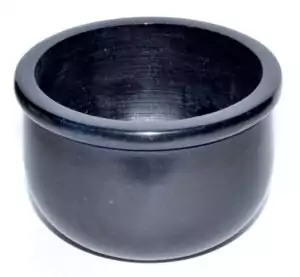

Quick Specs
- Brand: Generic / Artisan
- Type: Black-painted scrying mirror in brass stand
- Size/Quantity: 6-inch mirror diameter, brass holder
- Best for: Scrying, spirit communication, hypnagogic vision work, divination practice
The History of Scrying Mirrors
The practice of gazing into a darkened reflective surface to receive visions is documented across cultures spanning at least two millennia. Aztec priests used polished obsidian discs called “tezcatl” to commune with Tezcatlipoca, the smoking mirror deity, and to prophesy for rulers. When John Dee, advisor to Queen Elizabeth I and one of the most learned men in Elizabethan England, sought angelic communication in the 1580s, he used a black obsidian mirror almost certainly of Aztec origin, now held by the British Museum. He called it his “shewstone” and worked with scryers including Edward Kelley to interpret the visions it produced.
European folk magic carried the black mirror tradition forward well past the Renaissance. Cunning folk, wise women, and ceremonial magicians in the 17th and 18th centuries constructed their own versions using dark glass, blackened metal, or pitch-coated surfaces, often consecrated with planetary timing tied to Saturn or the Moon. The blackened surface distinguishes a scrying mirror from an ordinary looking glass: it absorbs rather than reflects light, creating a depth that seems to pull the gaze inward rather than bouncing it back outward.
How Scrying Works: the Psychology Behind the Darkened Surface
The visual mechanism underlying scrying is well documented in perceptual psychology. The Troxler effect describes the brain’s tendency to suppress stable peripheral stimuli; when you hold a soft, unfocused gaze at a dark surface in low light, the surrounding environment fades and the mind fills the void with hypnagogic imagery, the same class of visual phenomena that occur at the threshold of sleep. Practitioners are not manufacturing hallucinations, they are deliberately inducing a state in which the subconscious mind’s imagery becomes visible to the waking eye.
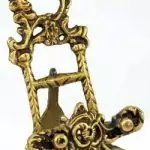
This mirror’s black-painted surface on a rounded glass set in a decorative brass stand provides the ideal setup for this work. The brass stand holds the mirror at a slight angle so the gazer does not see their own reflection, which would interrupt the defocused state the practice requires. Modern practitioners in Wicca, chaos magic, and traditional witchcraft all use black mirrors as focal points for meditation, tools for contacting ancestors or spirit guides, and aids for clairvoyant exercises. Explore my scrying and divination tools in my collection for companion pieces suited to this work.
How to Use a Brass Scrying Mirror
Three steps to begin a scrying session with your brass-mounted black mirror.
- Prepare Your Space
Dim the room so only soft candlelight or a single low lamp remains. Position the mirror on its brass stand at eye level and angled slightly away from any light source so no bright reflections appear on the dark surface.
- Soften Your Gaze
Hold a relaxed, unfocused gaze at the center of the mirror without staring hard. Let your eyes go slightly out of focus, as you would when looking through a window rather than at it. Breathe slowly and allow peripheral vision to fade gradually.
- Interpret and Record
Note any shapes, colors, or impressions that arise without forcing interpretation mid-session. After closing, record observations in a journal immediately. Meaning often clarifies hours or days later with reflection and repeated practice.
The Tarot Fellow Standard
I carry this scrying mirror because it solves a real problem for practitioners who want to work with a black mirror but need a stable, hands-free setup. The brass stand holds the mirror at a usable angle without improvised stacking, which matters when you are trying to maintain a relaxed, unfocused gaze. The 6-inch diameter is large enough for a full visual field in dim light without being so large that it becomes unwieldy on a small altar. The black-painted surface absorbs ambient light rather than reflecting the room back at you, which is exactly what the practice requires. For tools to complete a working divination altar, browse my full altar supplies in my shop.
Frequently Asked Questions
A scrying mirror is a darkened reflective surface used in divination. Practitioners gaze into it in low light to induce a hypnagogic state, receiving visual impressions used for guidance, spirit contact, or clairvoyant exercises.
A black surface absorbs light rather than reflecting it, which prevents the mirror from bouncing the room back at you. This creates the visual void needed for the soft, defocused gaze that allows hypnagogic imagery to surface during a session.
Consecration is optional and depends on your practice. Many practitioners cleanse a new mirror with smoke or moonlight and set a clear intention before the first session. The ritual matters more than any particular method you choose.
A 6-inch mirror is a practical starting size. It is large enough to fill your visual field in dim light without requiring a large dedicated space. Smaller mirrors feel restrictive, while very large ones can be hard to position at the correct angle.





Reviews
There are no reviews yet