

Quick Specs
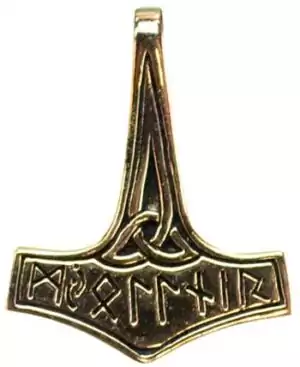
- Type: Bronze Mjollnir pendant necklace
- Size: 0.75″ x 1″
- Size/Quantity: 3/4 inch wide by 1 inch tall, cord included
- Best for: Norse pagan practice, Heathenry, daily protective wear, devotional jewelry
Mjollnir: A Thousand-Year Tradition of Norse Protective Amulets
Mjollnir, the hammer of Thor, is one of the most archaeologically documented religious amulets in European history. Hundreds of Mjollnir pendants have been recovered from Viking Age burial sites and settlements across Scandinavia, Iceland, the British Isles, and Russia, spanning roughly from the 8th to the 11th centuries CE. The amulets vary in size from finger-length cast pieces to tiny worked examples barely larger than a thumbnail, and appear in gold, silver, bronze, and iron depending on the wearer’s resources and the pendant’s intended purpose.
In Norse religious practice, Mjollnir served multiple functions beyond personal protection. It was used to consecrate marriages, naming ceremonies, and rites of passage, invoking Thor’s blessing to sanctify transitions from one life state to another. The hammer also appears in mortuary contexts, laid with the dead as a marker of identity and a symbol of continuation under the god’s guardianship. When Christianity spread across Scandinavia in the 10th and 11th centuries, many Norse practitioners wore both a cross and a Mjollnir as dual amulets, a practice visible in several archaeological finds that contain both symbols together.
Thor in Heathenry and Modern Norse Paganism
In contemporary Heathenry and Asatru, Thor occupies a central devotional position as the defender of humanity and the embodiment of straightforward, reliable strength. Unlike deities who govern cunning or ambiguity, Thor’s domain is the honest application of force in service of protection, a quality that resonates with practitioners who work in physically demanding, dangerous, or high-stakes environments. Wearing Mjollnir is the most direct declaration of Thor’s patronage available, and the gesture carries weight precisely because it has been performed continuously in Norse spiritual tradition for over a thousand years.
The engraved runic details on this pendant connect it to the broader Norse esoteric tradition of runic symbolism, where individual runes and combinations carry specific protective, strengthening, or consecrating meanings. The compact bronze casting is heavier than pewter alternatives at a comparable size, which gives it a physical presence that practitioners report feeling when the pendant moves with the body. Browse my Norse and Celtic pendant collection for companion pieces in this tradition.
How to Use the Bronze Thor’s Hammer Pendant
Three steps for wearing and working with this Mjollnir pendant in Norse pagan and Heathen practice.
- Wear as a Daily Amulet
Wear Mjollnir as a daily protective amulet, as Norse practitioners and Heathens have done for well over a thousand years. The physical weight and presence of the pendant serves as a constant reminder of Thor’s protection.
- Use in Rites of Devotion
Hold the pendant during personal rites honoring the Norse gods, particularly during work involving protection, courage, or the blessing of a new endeavor. Its compact size makes it practical for discreet devotional carry.
- Maintain the Bronze Finish
Store the pendant in a small cloth pouch when not wearing it to protect the bronze finish. A light polish with a dry soft cloth removes surface dulling. Avoid harsh chemicals, which strip the natural bronze patina.
The Tarot Fellow Standard
I stock this pendant because it delivers what Heathen and Norse pagan practitioners actually need: a solid bronze Mjollnir with genuine runic engraving at a size that works for daily wear without being oversized. The compact proportions fit comfortably under a shirt for those who prefer private devotional wear, and it reads clearly as a statement piece when worn openly. The bronze construction puts it a step above pewter in terms of heft and durability. Explore my Viking and Celtic ritual products collection for runes, books, and altar tools that support Norse practice alongside this pendant.
Frequently Asked Questions
Mjollnir was worn by Norse people from at least the 9th century CE as an amulet of protection, blessing, and consecration. Archaeological finds across Scandinavia and Britain confirm its widespread use as personal jewelry.
Bronze is an alloy of copper and tin with a warm golden-brown tone. It is denser and more durable than pewter and develops a natural patina over time. The engraved runic details on this hammer are cast into the bronze.
The pendant measures 3/4 inch wide by 1 inch tall and comes with a cord included. Its compact proportions make it wearable under clothing for discreet daily use or displayed openly as a statement of Norse spiritual identity.
In Heathenry and Norse paganism, Thor is associated with protection, strength, storms, and the defense of both gods and humanity. Wearing Mjollnir is understood as placing oneself under his protection and blessing.
Reviews
There are no reviews yet