

Quick Specs
- Type: Leather journal with latch
- Best for: Spirit communication records, automatic writing, shadow work, witchcraft journaling
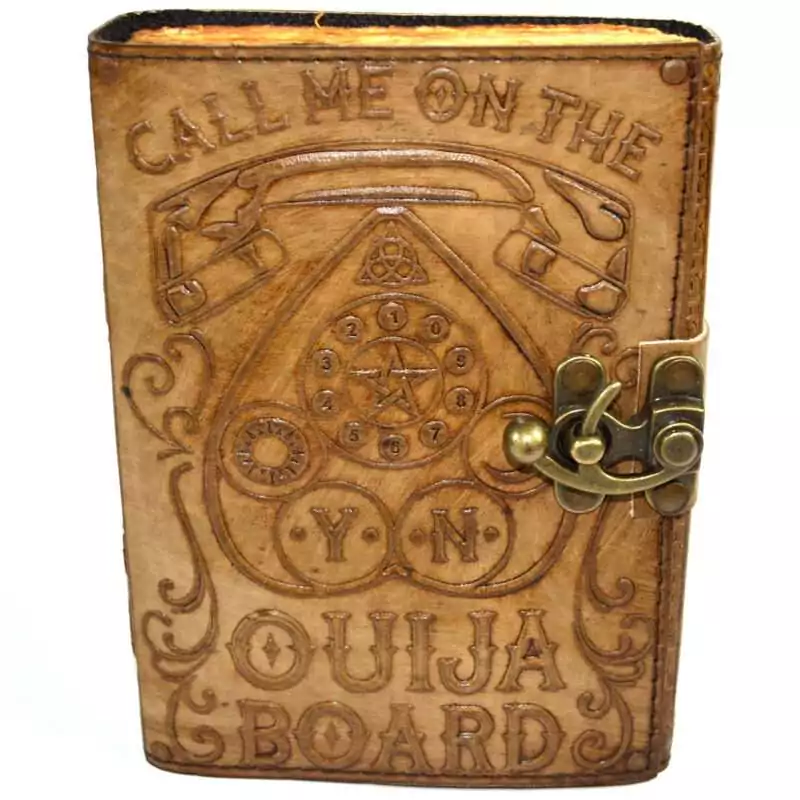
Call Me on the Ouija Board: A Journal for Spirit Work and Shadow Writing
This leather journal carries a Ouija-board-themed cover design with aged-look paper and a latch closure. It is a physical writing journal, not a game or divination instrument, and contains no planchette or movable components. The Ouija aesthetic has become a widely recognized visual shorthand for deliberate communication with the unseen, making this cover a direct statement of intent for practitioners who use automatic writing, spirit journaling, or mediumship records as part of their regular practice.
The Ouija board entered American consumer culture in 1890, patented by Elijah Bond and marketed initially as a parlor novelty. Its absorption into occult and witchcraft practice came gradually, as the board’s structure as an alphabet-based communication device aligned naturally with automatic writing traditions already present in Spiritualist circles. By the mid-twentieth century the Ouija had become a distinct symbol within popular occult culture, appearing across horror literature, divination manuals, and witchcraft aesthetics as a marker of intentional contact with non-physical entities.
Automatic Writing and Spirit Communication in Journal Practice
Automatic writing as a formal discipline traces to nineteenth-century Spiritualism, where mediums used it to record communications claimed to come from deceased persons or higher entities. In contemporary witchcraft and esoteric practice it has evolved into a broader tool for accessing intuitive material, processing shadow content, and creating a written record of inner states during liminal work. The Ouija cover on this journal explicitly names that orientation. Browse my journals collection for more options in ritual writing tools.
The latch closure is a practically meaningful feature for this type of record-keeping. Spirit communication notes and shadow-work entries are often personal enough that a secured closure is more than aesthetic. The aged-look paper adds a visual register of seriousness and permanence that distinguishes these records from casual notes. I stock this journal because practitioners engaged in genuine spirit work benefit from writing tools that acknowledge the nature of the practice. Find it with my full books and journals range.
How to Use Your Ouija Board Journal
Follow these steps to get the most from this book in your practice.
- Set the Atmosphere
Open the journal on a dark-moon night with a single candle burning and the intention to communicate with what lies beyond the ordinary. The Ouija-board cover sets a tone of openness to the unseen from the first page.
- Structure Each Session
Write questions in the left margin and leave the right side blank for answers that arrive through automatic writing, dream recall, or intuitive impressions gathered in the days following each session in the journal.
- Review and Close
Review older entries periodically to trace patterns in the responses you have received. The latch keeps these communications private, and the aged-look paper gives the contents a suitably mysterious, archival quality.
The Tarot Fellow Standard
I chose this journal for my shelf because the Ouija aesthetic is an honest signal of its intended use rather than mere decoration. Practitioners who journal through spirit communication or automatic writing deserve a dedicated, secured writing space, and this one is built for exactly that kind of deliberate, consistent record-keeping.
Frequently Asked Questions
The journal features a Ouija-board-themed leather cover, aged-look paper, and a working latch. It is a physical writing journal, not a game or divination tool, and contains no planchette or movable components of any kind.
The journal suits automatic writing sessions, spirit communication records, dream logs, shadow-work notes, and general witchcraft journaling where the aesthetic of mystery and deliberate contact with the unseen is appropriate.
Yes. The aged-look paper has enough texture to hold ink well. The latch secures the contents, making it a good choice for keeping sensitive records that benefit from a physical sense of enclosure and deliberate access.
The Ouija board, as a parlor game and spiritual tool, entered American popular culture in 1890. Its imagery has since become shorthand for communication with spirits and appears across witchcraft, horror, and occult aesthetics.


Reviews
There are no reviews yet