

Quick Specs
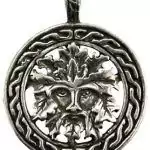
- Type: Celtic nature spirit talisman
- Size: 1.25″
- Size/Quantity: One amulet, 1 1/4″
- Best for: Earth connection, nature magic, growth workings, Celtic and Wiccan practice
The Greenman: An Ancient Face in Stone and Leaf
The foliate face, a human visage emerging from or composed of leaves, vines, and foliage, appears in European stone carving from the Roman period onward and intensifies dramatically in medieval Gothic church architecture. Scholars have documented thousands of examples across England, France, Germany, and Spain, carved into corbels, capitals, and choir stalls often in prominent positions. The name Greenman was popularized by Lady Raglan in a 1939 folklore journal article, though the carving tradition it describes is far older and more widespread across European cultures than any single regional or national tradition.
Modern pagan and Wiccan practitioners have embraced the Greenman as a representation of the male aspect of nature, the God in his vegetation form who dies at harvest and is reborn in spring. This identification draws partly from nineteenth and twentieth century folklore scholarship, including James George Frazer’s The Golden Bough, but it resonates powerfully in practice. The Greenman appears at Beltane, Lughnasadh, and Samhain in contemporary observance as a symbol of the wildness that grows without human permission and the cycles of death and regrowth that no ritual can ultimately control.
Using This Amulet in Earth and Nature Magic
Practitioners working with earth energy, plant magic, or the cycles of the agricultural year find the Greenman a coherent symbol to anchor those workings. At 1 1/4″, this amulet is designed to be worn on a cord, carried in a pocket, or placed at the earth quarter of an altar during circle work. I stock this piece for those who want a specifically vegetative, wildly natural symbol that differs from the more controlled geometry of the pentacle. You can explore my Celtic and Norse jewelry and pendants for related pieces.
How to Use the Celtic Greenman Amulet
Three ways to incorporate the Celtic Greenman Amulet into earth-based and seasonal magical practice.
- Place at the earth quarter of the altar
During circle casting, place this amulet at the north point of your altar to mark the earth quarter. The Greenman’s deep connection to vegetation and the wild natural world makes him a fitting presence at the earth quarter of any ritual space.
- Wear for plant magic and outdoor ritual
Carry or wear this amulet when working with plant allies, performing outdoor rituals, or tending a garden with magical intent. Wearing it signals your intention to engage the wild natural world as a practitioner rather than as a passive observer.
- Invoke at Beltane or harvest sabbats
The Greenman is resonant at Beltane, when vegetation force is at its peak, and at Lughnasadh, when the grain god dies into the harvest. Hold the amulet during your sabbat observance and acknowledge the wild growth that sustains the world.
The Tarot Fellow Standard
I carry this amulet because the Greenman is one of those symbols with genuine depth behind it, traceable in stone across nearly two millennia of European carving. A piece like this connects practice to that long tradition rather than to recent invention. For herbs, plant tools, and accessories that complement nature magic, visit my herbs and accessories section.
Frequently Asked Questions
The foliate face appears in Roman stone carving and intensifies in medieval Gothic church architecture, with thousands of documented examples in English, French, German, and Spanish stonework. The name Greenman was coined by Lady Raglan in 1939.
Contemporary Wiccan practitioners associate the Greenman with the vegetation God who dies at harvest and is reborn in spring. He appears in Beltane and Lughnasadh observances and serves as an altar symbol for earth element work and plant magic.
The Greenman is found across European cultures, not exclusively Celtic ones. Medieval examples appear in German and Spanish churches far from Celtic regions. Celtic pagan practitioners have embraced the image enthusiastically but it is pan-European.
The Greenman aligns most naturally with the north, the earth quarter, because of his association with vegetation and physical growth cycles. Some practitioners place him at the south as a solar vegetation deity in traditions mapping the God to fire.


Reviews
There are no reviews yet