


Quick Specs
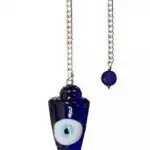
- Material: hand-blown glass evil eye (nazar) bead, traditional concentric circle design in cobalt blue, white, light blue, and black
- Chain: silver-tone metal chain
- Approx. size: pendulum bead approx. 1 inch, total length approx. 7–8 inches including chain
- Use: pendulum divination, dowsing, apotropaic protection carry piece
The Nazar That Moves With You
The evil eye, known as the mati (μάτι) in Greek and the nazar in Turkish and Arabic, is one of the oldest protective concepts in the world. Archaeological evidence places similar eye amulets in ancient Egypt and Mesopotamia, and the blue glass nazar bead we recognize today took shape in the Mediterranean from around the 6th century BC. The logic behind it is beautifully direct: a concentric eye design that stares back at whatever stares at you. Negative energy directed your way, especially envy or jealousy, hits the bead and reflects right back to the sender. It’s apotropaic magic, meaning it works by turning harmful force away rather than simply blocking it. The nazar doesn’t absorb the bad; it mirrors it.
That protective principle is shared across Greek, Turkish, and broader Mediterranean and Middle Eastern traditions. In Greece, the xematiasma ritual addresses the mati curse directly. In Turkey, nazar boncugu beads are pinned to babies’ clothing, hung in doorways, and fastened inside cars. The blue color isn’t arbitrary either. In regions where most people had dark eyes, blue eyes were considered rare and striking, and that strikingness was thought to concentrate the curse. A blue eye looking back was the most direct counter you could carry. It’s a genuinely clever piece of folk logic that’s held up across thousands of years and dozens of cultures.
Hanging that same bead from a pendulum chain gives it a second life as a divination tool. A pendulum works by picking up subtle muscular responses from your own body and translating them into visible movement, and there’s something fitting about the nazar being the weight at the end of it. You’re already asking it to intercept and clarify energy. Now you’re asking it to interpret it too. This isn’t just a novelty pairing. It’s both a working pendulum you can use for yes-or-no questions, chakra scanning, and dowsing practice, and a meaningful carry or display piece that doesn’t require any explanation to people who grew up with the symbol.
How to Use Your Evil Eye Pendulum
How to work with an evil eye pendulum for divination.
- Calibrate Your Yes and No
Hold the chain between your thumb and index finger with your elbow slightly bent. Ask the pendulum to show you 'yes.' Watch for a swing direction or circle. Then ask for 'no' and note the difference.
- Ask a Clear Question
State your question aloud or in your mind, keeping it specific and answerable with yes or no. Hold still and let the pendulum move on its own. Don't force it. Let the swing come from your body's subtle response.
- Close and Thank the Tool
When your session is done, still the pendulum with your free hand and set a clear mental end to the reading. Store it somewhere intentional, a pouch, a dish, or your altar, not loose in a drawer.
The Tarot Fellow Standard
I stock this pendulum because the construction is consistent and the nazar bead itself is properly made. Hand-blown glass nazar beads have a specific look when they’re done right: the concentric circles are clean, the cobalt blue is deep and even, and the white pupil is well-centered. What I receive in my inventory holds up to that standard. These aren’t mass-stamped resin pieces; the bead is genuine glass with the traditional design, which matters if the protective symbolism is part of why you want it. A nazar that doesn’t look like a nazar doesn’t carry the same meaning.
One practical note: glass beads can break if dropped on a hard surface. In nazar tradition, a cracked or broken bead is actually considered a sign it absorbed something on your behalf, so that’s one way to think about it. But if you’re using this purely as a divination tool with heavy daily use, handle it accordingly. The chain is lightweight and functional, not fine jewelry. If you want to wear or display the evil eye in a more durable form, browse our full evil eye collection for other options. And if you’re building out a pendulum practice and want to explore other weights and materials, you’ll find the rest of the range in our pendulum collection.
Frequently Asked Questions
The nazar is an apotropaic amulet from Greek and Turkish tradition that reflects the evil eye curse back to its source. Blue was chosen because rare blue eyes were thought to concentrate the curse, so a blue eye staring back was the direct counter.
Yes. It works the same as any weighted pendulum. Hold the chain, calibrate your yes and no movements, and ask your questions. The evil eye bead is glass, so handle it with reasonable care, but it's a fully functional dowsing tool.
That's your call. Many practitioners rinse new tools under cool water or leave them in moonlight before a first session. Others work with them straight out of the package. There's no single correct approach, so do what feels right for your practice.
In nazar tradition, a cracked bead means it absorbed something on your behalf. Replace it and move on. If you use it purely as a divination tool, a crack affects its balance, so replacement makes sense either way.
Reviews
There are no reviews yet