
Quick Specs
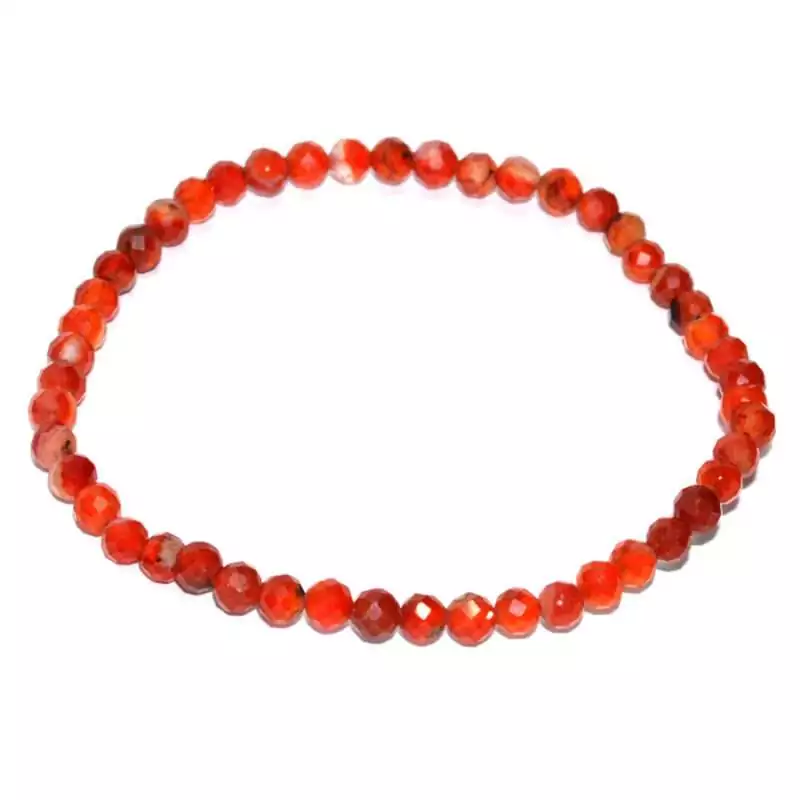
- Stone: Red agate
- Bead Size: 4mm
- Shape: Round, faceted
- Color: Orange-red to brick red with occasional white and dark patches
- Closure: None, one continuous loop of beads
Red Agate in Small Faceted Beads
Red agate is agate in its red shades: banded chalcedony, a fine-grained form of quartz, rated 6.5 to 7 on the Mohs scale. The red comes from iron compounds in the stone, and red agate runs through a wide range of reds, from bright orange-red to burgundy and brownish red. This strand sits in the warm half of that range. Most of the beads are a saturated orange-red, a few turn to a darker brick red, and here and there a bead carries a white cloud or a dark fleck that breaks up the color. Each bead is cut with small flat facets, and at 4mm the facets work like dozens of tiny mirrors, so the strand flickers whenever your wrist moves. Where a facet turns toward the light, a bead shows its brightest orange; where it turns away, the color deepens toward brick red, so a single bead shows several shades at once. The small size means the facets read as a fine sparkle, and the uneven color from bead to bead gives the strand depth. With so many small beads in the loop, the colors repeat and shift along its length.
In modern crystal practice, red agate is linked with the root chakra, the first of the seven in the chakra scheme, and with courage and perseverance. The chakra scheme itself comes from medieval Hindu and Buddhist tantric texts, so these links are modern symbolism, and you can use them as a cue when you need to stay with a hard task. The color makes the bracelet easy to style. Orange-red sits well beside black, which sharpens it, and beside silver or gold, which warm it further. Worn alone, a 4mm strand looks like a thin line of red on the wrist; stacked with two or three other thin strands in neutral tones, it becomes the accent that holds the eye. A dark strand on one side and a pale strand on the other makes the red a warm middle step in the stack, and the three together read as a small gradient from light to dark. The faceted cut adds a fine sparkle that shows up in lamplight and candlelight.
Practical Ritual Applications
Wear the bracelet on a day when you have to follow through: a long project, a training session, a conversation where you plan to hold your ground. Turn it once on your wrist before you begin, and let the red remind you of the sentence you chose that morning. On an altar, the beads look good coiled around a red or black candle, where the facets pick up the flame’s glow. If you keep a seasonal altar for autumn or for the start of a new push at work, a strand of red agate adds warm color without crowding it. For other bracelets built around the same color-and-chakra idea, my chakra stone bracelets collection shows stones and styles in the full seven-color order.
How to Wear and Care for Your Red Agate Bracelet
Three steps cover looking closely, setting one steady intention, and keeping the facets bright.
- Turn it in the light
Hold the bracelet in daylight and slowly turn it so the facets move through the light. Find the brightest orange bead and the darkest brick-red one; that spread of color is typical of red agate. Pick one bead as your starting point, since a single bead is easy to find again with your thumb.
- Set one steady intention
Put the bracelet on and name one thing you intend to finish this week, in a single sentence. Crystal guides link red agate with the root chakra and with perseverance, so touch your starting bead whenever your resolve slips. A few days of repeating this short gesture turns the bracelet into a reminder you can feel without looking at it.
- Clean it gently and keep it out of the sun
Wipe the beads with a soft cloth dampened with warm soapy water, then dry them thoroughly. Avoid steam, ultrasonic cleaners and strong chemicals, since agate is sensitive to heat. Put the bracelet on after makeup and perfume, remove it before swimming or exercise, and store it in a pouch or box away from direct sunlight and warm places.
The Tarot Fellow Standard
I stock this bracelet for its combination of a warm, saturated red in a small faceted cut: 4mm beads of one stone throughout, with a sparkle that shifts as you move. The root chakra and perseverance links come from modern crystal lore, and I offer them as symbolism and a prompt for your own habits. Color and patches vary from bead to bead, so expect a mix of bright and dark reds. For slim strands in other stones, my 4mm and 6mm beaded bracelets collection gathers more of these small sizes.
Frequently Asked Questions
Both are chalcedony colored by iron. Red agate shows a broader range of reds, from burgundy to orange-red and brownish red, and is often banded. Carnelian is usually the more even, translucent orange-red. The line between them is blurry, since some banded carnelian counts as both carnelian and agate, and sard is a darker, harder relative that carnelian shades into.
The red comes naturally from iron compounds in the stone. Heat deepens it: heating causes iron impurities in agate to develop a bright orange to red color, and red agate is often heat-treated to make its color more vivid and clear. Agate is also porous and takes dye readily, so dye is another enhancement used in the trade, and organic dyes can fade with strong light or heat.
They can scratch softer pieces. Agate rates 6.5 to 7 on the Mohs scale, above amazonite at 6 to 6.5 and far above amber at 2 to 2.5. Jewelry guides advise keeping agate in a separate pouch or box to protect other stones from scratches. A soft pouch also keeps dust off the facets.

Reviews
There are no reviews yet