

Quick Specs
- Type: Metal bookmark with a charm
- Size: 4 1/2 inches
- Finish: Silver-toned metal
- Blade: Feather with a raised center spine and a curved hook top
- Charm: Wing on a fine chain
A Silver Feather With a Wing Hanging From a Chain
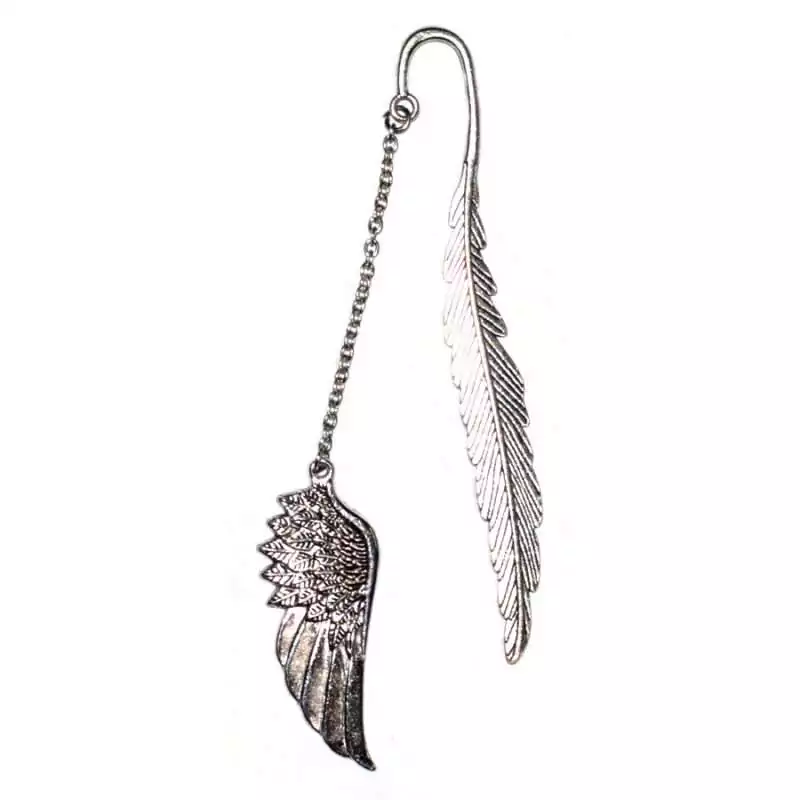
The blade is a flat metal feather that tapers to a rounded point, with a raised center spine and slanting lines running outward from it on both sides. The edges are cut into small, separated barbs, like the vane of a real feather, and the surface is a bright silver tone that darkens in the recesses of the lines. At the top the spine bends over into a curved hook and ends in a small ring. A fine cable chain hangs from the ring, and a wing charm dangles at its end. The charm is a single wing, with rows of small overlapping feathers across the upper half, each marked with its own central line, and long smooth flight feathers below that sweep down to a tip. The same silver tone covers the whole charm, with textured upper rows and smoother, shinier flight feathers beneath them, so the wing seems to gather light toward its tip. The spine runs from the base of the hook down to the tip without a break, and the barbs angle toward the tip in the same direction on both sides, so the blade has a clear sense of direction.
Two feathers share one bookmark and take different forms, drawn from the same family of shapes, with a central line and angled barbs on each, so they read as parts of one bird. The blade is a flat, graceful silhouette that reads clearly from the side of a closed book, and the wing is a fuller shape whose layered rows give it depth. The chain between them lets the wing swing on its own, so when you lift the book the charm turns and catches the light. A single metal tone keeps the piece quiet beside a book jacket, which suits a reader who likes a detail without a loud color, and the bright silver shows up well against a dark cover or a black spine. The raised lines on the blade and the textured rows on the wing hold shadow in their recesses, so the metal looks carved from a distance. At 4 1/2 inches the bookmark is small enough to travel in a bag with the book it marks.
Practical Ritual Applications
Keep it in the book you carry most: a novel, a journal, or a grimoire you return to each evening. A bookmark that looks like a feather suits a reading table with a candle and a cup of tea, and the wing swings gently when you pick the book up. If you read several books at once, a silhouette this distinct makes it easy to spot which one you left open. Slip it into a Tarot guidebook open to the card you’re studying, or a journal where you keep a daily draw. It makes a small gift for a reader, a writer, or a friend who likes wings and feathers in their jewelry and decor. For more things that live beside your books, browse my stationery and writing supplies.
How to Use and Store Your Feather and Wing Bookmark
Slide the feather in, let the wing hang outside, and keep the chain from tangling.
- Slide the Feather In
Open the book to your page and slide the feather blade between the pages, with the curved hook resting over the top edge. Close the book gently so the blade lies flat. If a tightly bound book resists, hold the pages open with your free hand and ease the blade down between them.
- Let the Wing Hang Outside
Check that the chain and the wing charm hang clear of the page block before you close the cover. When you reopen the book, lift the bookmark out by the hook or the blade. Care guides for decorative pieces advise extra care with thin and protruding parts, and the wing is the part that stands out most.
- Wipe and Store It
Between books, wipe the metal with a soft, dry cloth and let the chain lie straight, so the links stay untangled. Keep the bookmark in a dry spot, either flat on a shelf or tucked into a book you will open soon.
The Tarot Fellow Standard
I stock this bookmark for its two feathers: a silver-toned blade with a curved hook and a wing charm on a fine chain. It marks your place in a book and adds a small piece of decoration to the shelf while it does. I carry it for readers who like a quiet touch of fantasy, for writers who keep a quill-like object on the desk, and for gift-givers who need something light for a book lover. For more feather-themed pieces, browse my feathers and writing supplies collection.
Frequently Asked Questions
For well over a thousand years, a feather was the main writing tool in the West. The quill pen, cut from a shed flight feather, dominated from roughly the 6th century to the 19th. Goose feathers were the most common choice, and swan feathers were used for larger lettering. Mass production of steel-nibbed pens began in 1822 and gradually took over.
Yes. The Canadian Conservation Institute lists using a bookmark as the alternative to turning down page corners in its basic book care advice. A dog-eared page is generally frowned upon by people who want to keep a book in its original condition, and unfolding the corner of an old, yellowed page can split the paper along the fold.
The earliest surviving example dates to about the 6th century AD: a piece of ornamented leather with a vellum-lined back, attached by a leather strap to the cover of a Coptic codex found near Sakkara, Egypt. Medieval readers used small parchment strips or cords attached to the headbands of their books. Later bookmarks were made of ribbon, silk, card, leather, silver, brass, and steel.


Reviews
There are no reviews yet