
Quick Specs
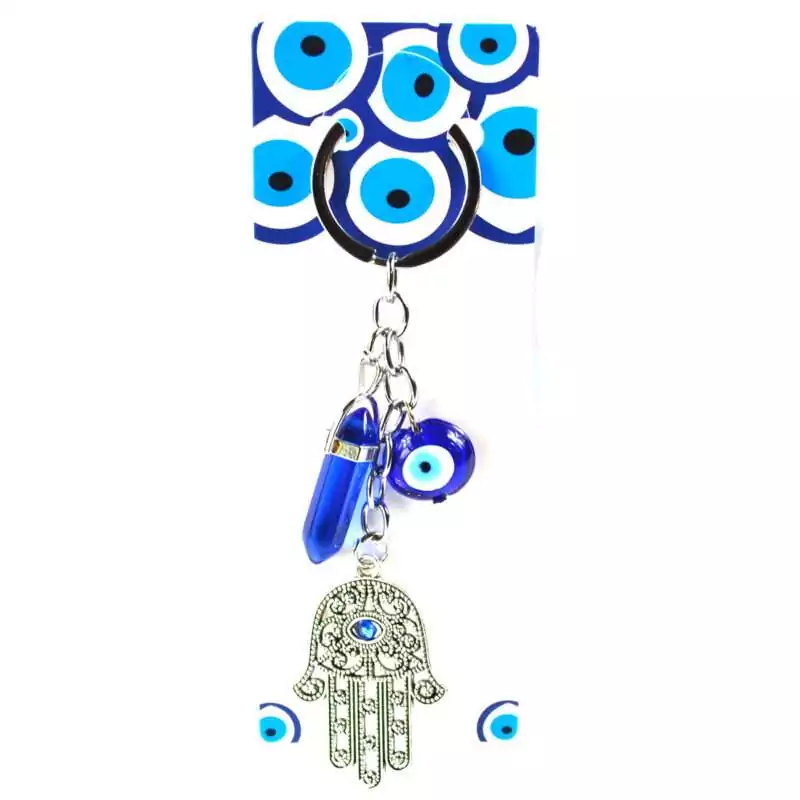
- Type: Evil eye keychain with Hand of Fatima (Hamsa) and point pendant
- Size/Quantity: One keychain
- Best for: Multi-layer protection, daily carry talisman, blessing and warding work
Hand of Fatima with Point: Layered Protective Symbolism
The Hand of Fatima, also called the Hamsa or Khamsa, is a palm-shaped amulet recognized across Islamic, Jewish, and Christian traditions throughout the Middle East and North Africa, with documented use dating to at least the tenth century CE. In Islamic tradition it references the hand of Fatima al-Zahra, daughter of the Prophet Muhammad. In Jewish tradition the same symbol is called the Hand of Miriam, sister of Moses. Both traditions attribute to it the power to protect against the evil eye, deflect harmful intent, and bring blessings to the household or bearer.
This keychain pairs the Hamsa with an evil eye bead and a downward-pointing element, creating a layered talisman that addresses both active warding (the evil eye) and the broader blessing function of the Hamsa. The downward-pointing hand orientation is considered the traditional position for attracting good fortune in many folk interpretations, while the upward orientation signals more active defense. Either orientation is considered valid depending on the practitioner’s tradition and intent.
Cross-Cultural Protection Symbolism in Daily Carry
The Hamsa’s cross-cultural recognition makes it one of the most universally accessible protective symbols in folk magic and spiritual practice. It appears in Moroccan, Tunisian, Israeli, Turkish, and Syrian folk art with consistent protective associations, and it has moved into contemporary Western spiritual practice as a broadly accepted ward. Practitioners who work within multiple traditions or who have eclectic practices often find the Hamsa more accessible than tradition-specific symbols, since its protective intent is recognized across cultural lines. Explore my full amulets and talismans selection for additional protective pieces.
Combining the Hamsa with the evil eye bead on a single piece reinforces the protective intent from both symbolic directions and creates a physically attractive item that most people find easy to carry without it appearing overtly esoteric. This practical discretion is itself a feature that many practitioners value.
How to Use Hand of Fatima Evil Eye Keychain
Three steps for carrying and maintaining your Hand of Fatima evil eye keychain.
- Attach and Carry Daily
Clip this keychain to your keys, bag, or belt loop so it stays with you throughout the day. Consistent carry is the core of talisman work in folk traditions; a piece kept in a drawer does not fulfill its protective function.
- Acknowledge Its Dual Function
The Hamsa carries both a blessing function and a warding function. Some practitioners hold it briefly each morning and state both intentions: one for protection against harmful attention and one for inviting positive circumstances into the day.
- Periodically Refresh With Smoke or Salt
Pass the keychain through frankincense or copal smoke, or rest it on a small dish of sea salt overnight, once a month or whenever it feels energetically heavy. This maintains the piece in line with traditional folk practice.
The Tarot Fellow Standard
I carry this keychain because the Hand of Fatima is one of the few protective symbols that holds genuine cultural weight across three major Abrahamic traditions simultaneously, and pairing it with the evil eye nazar creates a piece with real layered intent rather than decorative symbolism alone. It travels well, requires no special handling, and functions as a consistent daily talisman. For anyone building a full protection kit, browse my evil eye collection to see what complements this piece.
Frequently Asked Questions
They are the same symbol with different names. Hamsa means five in Arabic, referring to the five fingers. In Islamic tradition it is the Hand of Fatima; in Jewish tradition, the Hand of Miriam. Both carry identical protective and blessing symbolism.
Downward-pointing is traditionally linked to inviting blessings and good fortune. Upward-pointing signals active defense against the evil eye. Both orientations are valid, and some pieces can be worn in either direction by intent.
The Hamsa is used across Islamic, Jewish, and Christian communities in the Middle East and North Africa. Many practitioners outside those traditions use it as a widely recognized protective symbol with respectful understanding of its origins.
The blue glass evil eye bead, called nazar, is believed to deflect harmful attention and envious gazes from the bearer. It is one of the oldest continuously used protective symbols, with examples dating to the sixth century BCE.

I love it! Super cute and such a great seller! I have nothing but the best customer service from them. Highly recomend!!