
Quick Specs
- Brand: Brybradan
- Type: Ritual aroma oil (fragrance oil)
- Volume: 1/2 FL OZ (4 drams)
- Ingredients: Duoprime 70, Fragrance, D&C Dyes
- Best for: Petitions for divine intervention, legal matters, emergencies, fast assistance
Mano Poderosa Oil: The Iconographic Origin and Folk Catholic Tradition
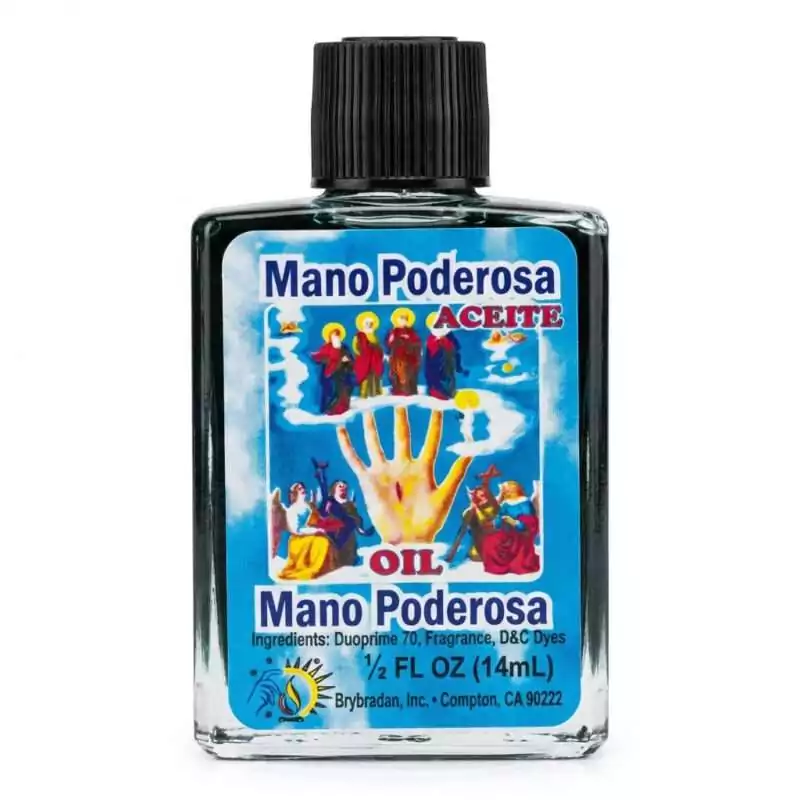
The Mano Poderosa, or All-Powerful Hand, is a devotional image rooted in 18th-century Spanish colonial folk Catholicism. Scholars trace its earliest known Mexican form to tin retablo paintings from approximately 1807 to 1809, with Puerto Rican santo de palo (wooden saint) carvings following in the early 20th century. The image depicts a right hand, typically marked with the stigmatic wound of the crucifixion, with five holy figures standing on each fingertip: in the Mexican tradition, Saint Joachim on the thumb, Saint Joseph on the index finger, the Christ Child on the middle finger, Mary on the ring finger, and Saint Anne on the pinky. This arrangement is sometimes called Las Cinco Personas, or the Five Persons, a compact visual catechism of the Holy Family across three generations.
The image draws on the illustrated mnemonic hands that Franciscan missionaries used in New Spain as teaching devices for illiterate converts. The resulting icon is now found on 7-day candles, prayer cards, oils, and statues throughout botanicas from Los Angeles to New York.
Helping Hand Ritual Oil: Uses in Folk Catholic Practice
As a ritual oil, the Mano Poderosa formula is used to petition the Holy Family collectively for intervention in situations that feel beyond ordinary human resources. The classic application, documented in folk Catholic practice and in botanica tradition, is to anoint the hands before entering a courtroom, a job interview, or any situation where a decision-maker’s goodwill matters. Psalm 121 (“I will lift up mine eyes unto the hills, from whence cometh my help”) is commonly recited with this oil as a petition for fast assistance. In folk Catholic devotion, where petitions to the santos are a familiar part of life, the Mano Poderosa is a generalist appeal to the intercessors of the Holy Family simultaneously. For complementary tools, browse my full ritual oils collection.
This is a Brybradan fragrance oil, not a botanical extract. The base is Duoprime 70, a standard mineral oil carrier used widely in ritual aroma oil production. It is not formulated for aromatherapy or skin care use. These are working oils: their utility is in the ritual application, not in any therapeutic or pharmaceutical claim. If you need a skin-safe oil for personal anointing or aromatherapy, choose a product formulated for that use instead.
How to Use Helping Hand Mano Poderosa Oil
Three ways to use Helping Hand (Mano Poderosa) oil in folk Catholic practice.
- Anoint Your Hands
Place two or three drops into your palms and rub them together slowly. As you do, form your petition clearly in your mind. Recite Psalm 121 or speak your request directly to the Holy Family. Do this before entering any high-stakes situation.
- Dress a Candle
Apply drops to a white or gold candle, rubbing from base to wick to draw assistance toward you. Set a Mano Poderosa image beside the candle. Light it while stating your petition. Allow it to burn completely.
- Anoint an Amulet or Petition Paper
Write your specific need on a piece of paper or anoint a Mano Poderosa charm. Add a small amount of oil, fold the paper toward you, and carry it or place it on your altar. Renew with a fresh drop of oil every few days to keep the petition active.
The Tarot Fellow Standard
I carry the Mano Poderosa oil because it belongs to a specific devotion, and most listings treat it as a generic luck oil without explaining what the Mano Poderosa is. The iconographic background and the connection to the Holy Family in folk Catholic devotion give the oil its meaning. It isn’t a general petition oil. It’s a specific appeal to a specific set of intercessors. Mano Poderosa devotion belongs to a living Mexican folk Catholic tradition, and this oil is a supply for devotion, not a substitute for the guidance of a priest or faith community. For saints, angels, and devotional amulets to pair with this oil, browse my saints and angels amulet collection.
Frequently Asked Questions
It depicts the stigmatic hand of Christ or Saint Francis with five holy figures on each fingertip: Saints Joachim and Anne, Joseph, Mary, and the Christ Child. It represents the full intercessory power of the Holy Family petitioned together.
It is used to petition for fast divine assistance in emergencies, legal situations, and tight circumstances. Practitioners anoint their hands before court appearances and meetings, often reciting Psalm 121 with the oil.
This is a Brybradan ritual fragrance oil, not a skin-care product. It is made for ritual use: dressing candles and petition work. For skin-safe anointing, choose products formulated for topical use.
Most luck oils draw fortune broadly. Helping Hand targets emergency intervention and favor from authority figures. The Mano Poderosa image ties it to the Holy Family's intercession, distinct from general money formulas.



Great spells and very useful, make me want to order more.