
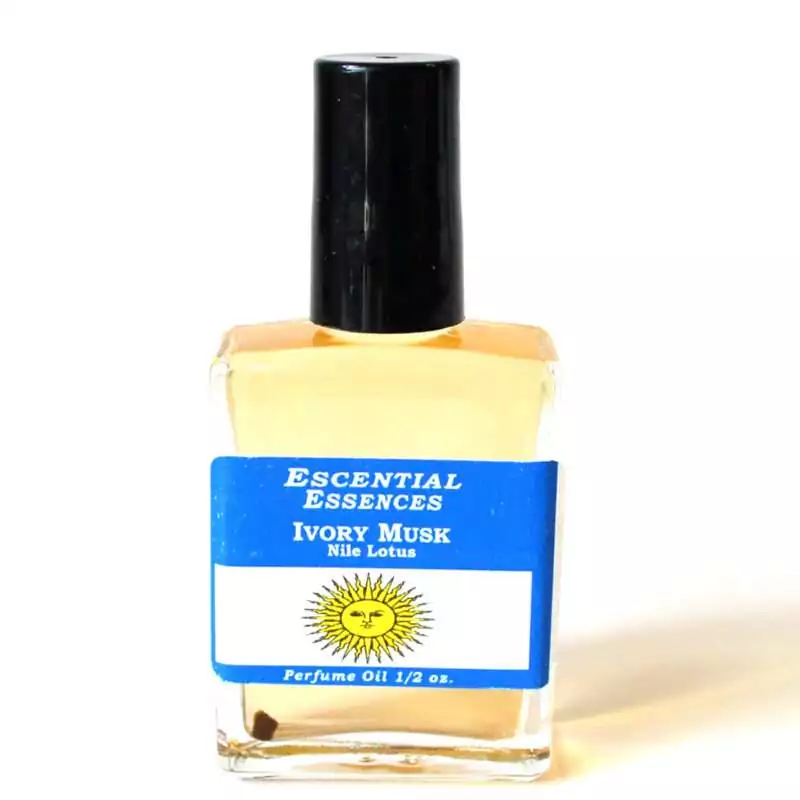

Quick Specs
- Brand: Escential Essences
- Type: Ritual aroma oil (fragrance)
- Scent: Ivory Musk, Nile Lotus
- Size: 1/2 oz
- Made in: USA
- Bottle: Clear glass with a black cap
Ivory Musk Nile Lotus: Egyptian Flower, Perfumer’s Base Note
On the label, Ivory Musk is the scent name and Nile Lotus sits beneath it, and that second line points to Egypt. The lotus of the Nile is a water lily, and Egyptian artists depicted it again and again, including in tombs. It closes at night and opens in the morning, so it became a sun symbol and a sign of rebirth, and lotus petals turned up in Tutankhamun’s tomb. It also belongs to the living. In New Kingdom banquet scenes, musicians play and dancers perform for the guests, and women wear a lotus flower over the forehead or in the hair. The standard banquet ensemble was a harp, a lute, and a double oboe, sometimes joined by a lyre. That is the lotus as everyday pleasure as well as a religious symbol. Put those images together and the flower holds two moods: the quiet of dawn and the noise of a feast. Ivory Musk Nile Lotus gives you a scent to attach to either image. A fragrance can’t tell you which mood to choose. That choice is yours, whether you’re marking a fresh start or a night with friends and music.
Musk is the other half, and in perfumery it has a clear job. It’s a base note, the part of a scent that lasts longest, and perfumers use it as a fixative, an ingredient that helps lighter notes stay in place. That makes musk a natural partner for a floral note like lotus, and a drop on a candle, a cloth, or a charm bag is a reasonable way to use a blend like this. The name Ivory Musk points to a scent family more than a single material, so the oil is best taken as a musk-and-lotus fragrance. A half-ounce bottle is a small size, enough to try the scent on a few different objects before you decide where it belongs in your practice. A drop or two is plenty for a candle or a bag, since anointing is a small gesture: you touch the object, say what it’s for, and set it down. It’s a fit for work about gatherings, performances, and fresh starts, the two moods the lotus carries.
Practical Ritual Applications
Dress a chime candle with a drop or two before a gathering you’re hosting, then light it in a holder while you set the table or tune an instrument. A drop on a charm bag gives you something to carry to a performance, a party, or a reunion. A drop on a cloth runner under a candle puts the scent on the table where people gather, and a drop on a cloth under your altar tools keeps it where you sit. For the dawn side of the lotus, anoint a small candle or bag for a morning of fresh starts and light it before the day gets busy. Mind the wick, wipe your fingers before you touch anything else, and never leave a flame unattended.
How to Anoint With Ivory Musk Oil
Here's a simple way to bring a bottle of musk and lotus oil into a working.
- Choose the mood and the object
Decide which image of the lotus you want to work with, dawn or the feast, and pick one object for it: a candle, a charm bag, or a cloth. Say the aim aloud in one sentence, such as a fresh start this week or a good night with friends. A single object and a single aim keep the scent from blurring across your altar.
- Put on a drop
Tip the bottle against your fingertip, take a drop or two, and spread it over the candle's surface or rub it into the fabric of the bag near its closure. Keep the oil off the wick. Wipe your fingertip on a cloth before you handle anything else, and cap the bottle right away so the rest stays sealed.
- Let the scent settle, then light
Give the object a minute to take the scent. Light the candle in a holder, stay in the room while it burns, and notice how the scent reads as the wax warms. For a charm bag, tuck it into a pocket or a drawer, and add a fresh drop when the scent fades.
The Tarot Fellow Standard
I stock Ivory Musk in the 1/2 oz bottle for people who want a musk-and-lotus scent in a size that suits a candle box or a travel altar kit. It’s an easy first bottle if musk is new to you. The associations here come from Egyptian art and perfumery, so you’re free to use the scent for whatever working suits it. The same scent is also in my shop as stick incense and as cones, for times when you’d rather burn it. Browse my Escential Essences oils collection for other scents from the same line.
Frequently Asked Questions
Most perfumery musk today is synthetic. Natural musk comes from a pod of the male musk deer, collecting it normally kills the animal, and trade in it is controlled under CITES.
Two Egyptian water lilies go by lotus: the blue lotus, Nymphaea caerulea, known as the blue lotus of the Nile, and the white Nymphaea lotus. Both belong to the genus Nymphaea, not to Nelumbo, the genus of the sacred lotus of India. In perfumery a lotus note is usually recreated with synthetic molecules, so Nile Lotus on a label names a scent.
I sell it as a ritual aroma oil for anointing objects. Fragrance components can cause reactions in some people. If you want to try it, dilute a drop in a carrier oil and patch-test a quarter-sized spot on your inner forearm for about a week before wider use. Keep it away from eyes, pets, and children, check with your clinician first if you're pregnant or take medication, and never swallow it.
Keep the cap tight and the bottle at a steady room temperature, away from direct light, heat, and humidity; a closed cabinet works well. Heat and light change a fragrance over time, and air starts wearing on it once the bottle is open, so write the opening date on the label. If the scent turns sour or smells noticeably different from the first drop, retire the oil.


Reviews
There are no reviews yet