


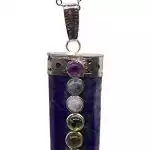
Quick Specs
- Stone: Lapis lazuli
- Type: Chakra necklace
- Chakra Focus: Throat (Vishuddha) and Third Eye (Ajna)
- Best for: Communication, intuition work, meditation, daily spiritual wear
Lapis Lazuli: A Stone of Truth Across Six Thousand Years
Lapis lazuli is one of the oldest continuously used gemstones in human history, mined from the mountains of Badakhshan in present-day Afghanistan since at least 4000 BCE. Ancient Egyptians prized it above almost every other stone, grinding it into the brilliant blue pigment used for tomb paintings and fashioning it into the scarabs and seals of pharaohs and gods. In Mesopotamia, lapis lazuli cylinders were rolled across clay tablets to mark royal documents, and the Epic of Gilgamesh describes the walls of Uruk as adorned with lapis. Medieval European artists paid more for the powdered lapis used for the Virgin Mary’s blue robes in illuminated manuscripts than for gold.
Mineralogically, lapis lazuli is a metamorphic rock rather than a single mineral. Its deep blue color comes primarily from lazurite, a sodium calcium aluminosilicate sulfate, while the characteristic golden flecks are inclusions of pyrite and white veining comes from calcite. The richest-quality lapis, known as royal blue or ultramarine, comes from the Sar-e-Sang mines in Badakhshan, the same source used for ancient Egyptian artifacts. In chakra traditions, lapis lazuli’s rich blue resonates with the fifth chakra, Vishuddha, at the throat, and the sixth chakra, Ajna, at the brow.
Throat Chakra and Third Eye Chakra Work with Lapis Lazuli
In crystal healing and chakra work, lapis lazuli is the stone most consistently associated with the throat chakra’s domain: honest self-expression, the courage to speak truth clearly, and the release of communication blocks. When the Vishuddha chakra is considered imbalanced, practitioners use blue stones like lapis lazuli, blue kyanite, and aquamarine at the throat during meditation. A lapis lazuli necklace positions the stone naturally near the throat throughout the day, making it one of the most functional ways to incorporate this stone into a chakra practice beyond formal meditation sessions.
The third eye chakra (Ajna), located between the eyebrows, governs intuition, inner vision, and the capacity to perceive beyond surface appearances. Lapis lazuli is listed in Tibetan Buddhist tradition as one of the Seven Treasures, connected to the Medicine Buddha, and used in spiritual practice to sharpen mental clarity and access deeper wisdom. Wearing a lapis lazuli necklace is also a consistent practice in folk Islamic tradition across North Africa and the Middle East, where blue stones carry longstanding protective associations.
How to Use the Lapis Lazuli Chakra Necklace
How to use and care for a lapis lazuli chakra necklace for throat and third eye work.
- Wear Near the Throat for Chakra Work
A lapis lazuli necklace resting near the throat keeps the stone close to the Vishuddha chakra throughout the day. Crystal practitioners use this placement to support honest communication and ease tension around self-expression during conversations.
- Use in Meditation for Third Eye Activation
During seated meditation, lay the necklace on the forehead or hold the stone at the third eye point between the eyebrows. Breathe slowly and visualize deep blue light from the stone. This practice is associated with deepening intuition and quieting.
- Cleanse and Recharge the Stone Monthly
Lapis lazuli responds well to moonlight cleansing: leave it on a windowsill during a full moon overnight. You can also smudge it with white sage or Palo Santo smoke. Avoid prolonged soaking as the calcite content makes lapis sensitive to moisture.
The Tarot Fellow Standard
Lapis lazuli is one of the most requested stones in my jewelry collection, and for good reason. It’s a stone with genuine depth of history, from the burial masks of Egyptian pharaohs to the pigment ground for Renaissance altarpieces, and that history doesn’t disappear when it’s worn around a neck today. A lapis chakra necklace is one of the cleaner, more purposeful pieces I carry because it puts an authentic stone in direct contact with the chakra it’s traditionally associated with. Explore more in my crystal gemstone pendant necklaces, and browse complementary chakra tools in my chakra and meditation products.
Frequently Asked Questions
Lapis lazuli is linked to the throat chakra (Vishuddha) for honest communication and the third eye chakra (Ajna) for intuition. Wearing it as a necklace keeps the stone naturally positioned near both chakra points throughout the day.
In crystal healing, lapis lazuli is associated with truth, wisdom, and deepened intuition. It appears in ancient Egyptian, Mesopotamian, Buddhist, and Islamic traditions as a stone of protection and sacred knowledge spanning six thousand years.
Cleanse lapis lazuli by passing it through white sage or Palo Santo smoke, placing it under full moonlight, or setting it on a selenite plate. Avoid extended soaking in water or saltwater because lapis contains calcite, which is water-sensitive.
Yes. Lapis lazuli is frequently used in meditation for third eye activation, placed on the forehead during seated practice. It is one of the seven sacred stones in Tibetan Buddhist tradition, associated with the Medicine Buddha and wisdom.


Reviews
There are no reviews yet