
Quick Specs
- Type: Lidded keepsake box
- Size: 3 3/4 x 4 1/2 x 3 inches
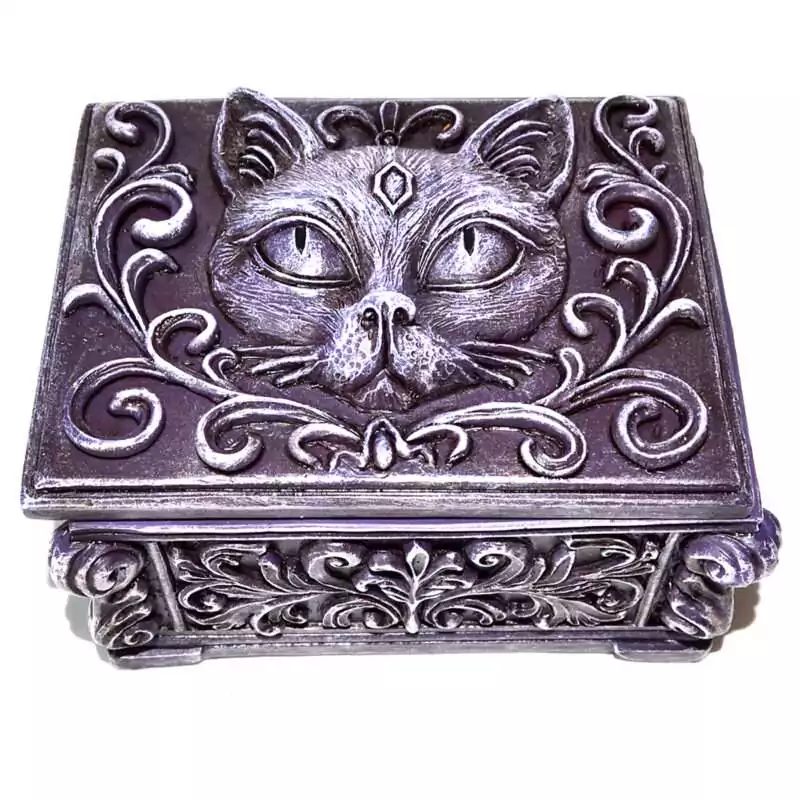
- Lid: Raised cat face with a diamond-shaped jewel on the brow
- Sides: Leaf scrollwork between scrolled corner posts
- Finish: Dusky purple with pale silver highlights
A Jeweled Cat Face Framed by Curling Scrolls
The cat’s face fills the center of the lid in raised relief. Its eyes are wide and almond-shaped, each with a narrow vertical pupil, and the nose and muzzle are textured with fine lines and dots that suggest fur and whisker pads. Fine lines furrow the brow above each eye, long whiskers fan out across the cheeks, and a diamond-shaped jewel sits at the middle of the brow. Pointed ears rise above the face and nearly reach the top edge. Around the head, scrolls curl outward in pairs and end in tight spirals near the corners of the lid, with a small flower-like crest at the top center and a pointed ornament below the chin. A stepped border frames the whole lid, and the flat, darker field behind the relief sets the carving apart. The finish is a dusky purple, brushed with pale silver on every raised edge, so the whiskers, scrolls, and fur lines catch the light while the recesses stay dark. The effect is the look of an old carved panel, with the face standing out as the one calm, steady element among the flourishes.
Below the lid, the box keeps up the decoration. Each side carries a panel of leaf scrollwork, with a central sprig and symmetrical curls spreading to either side, set between corner posts that end in curled volutes like the scrolls on a classical column. The same family of curls appears on the lid and the sides, so the box reads as one carved piece. The lid overhangs the base slightly, which gives the box a clear edge shadow, and small block feet lift it a little above the surface beneath it. At 3 3/4 by 4 1/2 by 3 inches, the box is compact enough for a dresser top, a desk, or an altar shelf, and big enough to hold small things such as rings, charms, and keepsakes. The purple and silver palette suits a room with candles, mirrors, or dark wood. The curling scrolls and the jewel on the brow give the cat a regal air, like a pet in a portrait from an old house, and the face keeps watch from the lid whether the box is full or empty.
Practical Ritual Applications
A box with a face on the lid earns a spot where you will see it daily. On a dresser it can gather rings, earrings, and small charms in one place. On a desk it can hold a few small crystals, a folded note, or a spare key. On an altar shelf it makes a tidy home for small ritual items you like to keep together between uses. The silver highlights catch candlelight, and the cat looks well beside a mirror, a taper in a holder, or a stack of books. As a gift, it suits someone who loves cats, collects keepsake boxes, or likes ornate things with a dark, quiet mood. Browse my boxes, chests, and tables collection for more places to keep small treasures.
How to Display and Care for Your Magical Cat Box
Give it a steady shelf, open it with two hands, and brush the scrollwork gently.
- Give It a Steady Shelf
Set the box on a flat, stable surface such as a dresser, a desk, or an altar shelf, and leave a hand's width of room around it so the lid can be opened freely. The small feet lift the base slightly, so a smooth surface works best. Keep it out of long direct sunlight, which can change the colors of decorative pieces, and away from heaters.
- Open and Fill It With Two Hands
Hold the base steady with one hand and lift the lid with the other. Place small items inside one at a time, wrapping delicate pieces such as a glass charm or a small crystal in a scrap of soft cloth. When you set the lid back, keep its edge clear of the scrolls on the sides so the raised work stays safe from knocks.
- Brush the Scrollwork
Dust the lid and sides with a fine, soft-bristled brush, working into the recesses beside the whiskers, scrolls, and leaf panels with no pressure. Conservators advise avoiding commercial dusting sprays and furniture polish on decorative objects unless a conservator recommends them, so a dry brush is the dependable tool for deep scrollwork.
The Tarot Fellow Standard
I stock this box for its cat: a jeweled face in raised relief, framed by scrolls and set on a base with leaf panels and curled corner posts. It is a decorative piece with a job, since it holds small things neatly, and cats have a long place in folklore, from Egyptian households to the witch lore of medieval Europe. I carry it for people who love cats, collect ornate boxes, or want a quiet keeper for their charms. For more pieces to set beside it, browse my altar supplies collection.
Frequently Asked Questions
In medieval and early modern European folklore, witches and cunning folk were said to be helped by familiars, spirit helpers that most often took the form of small animals. Cats were among them, alongside dogs, toads, hares, and birds. One account notes that Christian authorities in medieval Europe came to see witches as rivals and linked cats with them. Most surviving evidence comes from 16th and 17th century English and Scottish witch trials.
Yes. Cats were valued in ancient Egypt for protecting households and grain from snakes, rodents, and other pests, and the domestic cat was seen as a living form of Bastet, a goddess who protected the household. Cats were also mummified: the first known cat mummification dates to about 1350 BC, and large cat cemeteries have been found at sites such as Bubastis and Saqqara.
Folklore differs by region. In Britain and Ireland, a black cat crossing your path counts as good luck. In Scotland, a black cat arriving at a home signals prosperity, and in Germany a cat walking from left to right brings good luck. The same animal has symbolized prosperity in Japan. Medieval Europe's link between cats and witches is a separate strand of the folklore.
Reviews
There are no reviews yet