
Quick Specs
- Format: Boxed oracle deck set with storybook and guidebook
- Card Count: 32 cards
- Storybook: 80-page hardcover, 5 x 7 inches
- Guidebook: 76 pages, full color
- Author: Marie McWilliams
- Artist: Matt Hughes
- Publisher: U.S. Games Systems
- ISBN: 9781646712694
Inside Mother Mort’s Carnival 1897
The guidebook opens at a carnival that has appeared overnight at the edge of town, with crowds heading for its colorful tents. Mother Mort, a powerful triple goddess, leads you through the carnival, past death-defying acts and a host of frightful characters. Wrongdoers meet their fate here, and people who have suffered more than their share of misery, like young Jane, find a kind of magical cleansing and rebirth. Karma runs through the carnival, and the setting draws on Victorian spiritualism, mystery and mythology. Jane’s carnival odyssey fills the storybook. Marie McWilliams wrote it from a concept by Hope Hughes, and Matt Hughes illustrated and decorated its pages, so the tale and the cards share one artist’s hand. The cards bring you the carnival’s creatures and characters, and the guidebook entries pair a backstory with an interpretation. That gives a reading a place to begin: you meet the character in a short scene, then you consider the message. You can draw one card for a daily check-in, bring a question about a choice or a repeating pattern to the carnival, or spend a slow evening with the story and a notebook.
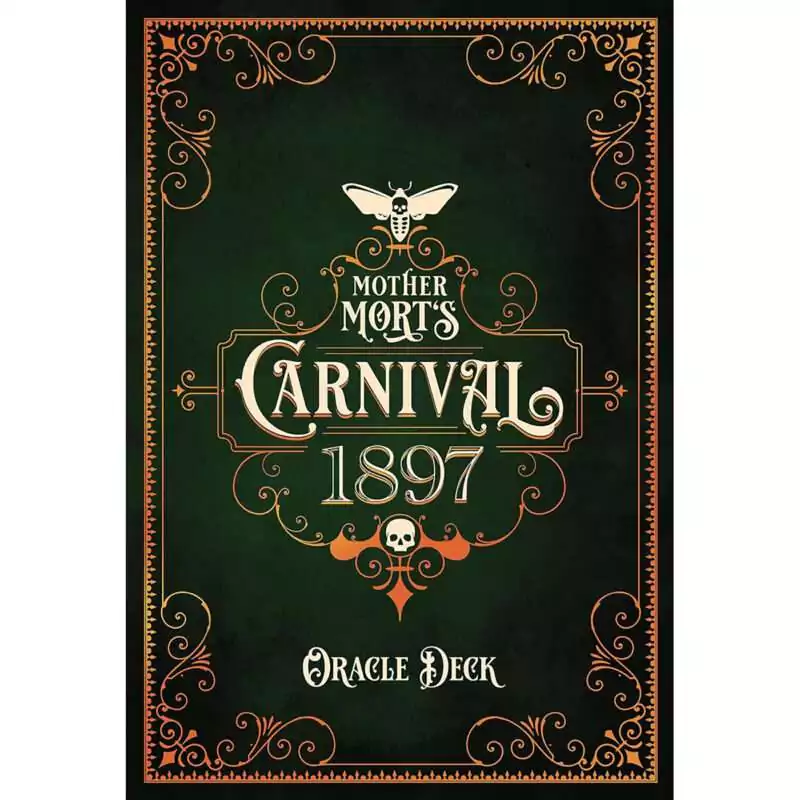
The front of the set shows the mood: a deep green ground framed in orange scrollwork, cream lettering for the title, a cream moth with a skull marking above it and a small white skull below. Matt Hughes draws on Art Nouveau, and the cards carry green foil accents. Light Bringer is one entry in the guidebook. You stare into an ornate lamp until a woman in a glowing white gown appears in its fire, sitting cross-legged with a wreath of lit candles on her head. Her interpretation speaks of illumination, energy and epiphany. Ludas the Wag is a clown who honks a brass horn, kicks his feet and gives out gifts that appear in his hands, and his card speaks of generosity, kindness and play. Each entry opens with the character’s name, then a Backstory that tells how you come across them at the carnival, then an Interpretation. The guidebook’s introduction describes carnivals as society’s balancing act, where satire and theater deliver a kind of karmic justice. A copper-foil carnival ticket comes in the set and works as a bookmark for the storybook.
Practical Ritual Applications
Read the storybook over a few evenings and let the copper-foil ticket mark your place. When you finish, draw one card and read its Backstory before its Interpretation, so you meet the character first and the message second. A card that sits close to your week deserves a few lines in a notebook, and my journals collection has pages for that. For a question about a choice, try a three-card line: one card for the situation, one for what the carnival shows you about it, and one for where it leads. Keep the spread small, since each entry gives you both a story and a meaning to absorb. The deck also suits a single draw at the end of the day, with the guidebook open beside you and no hurry to finish.
How to Read with Mother Mort’s Carnival 1897
Here is a simple way to begin your first reading with this deck.
- Visit the Carnival First
Read the storybook through, using the ticket as a bookmark, so Jane's route among the tents is fresh. Then spread the cards face up and look at each character in turn. Let your eye settle on the ones that draw you, and notice the green foil accents. Page through the guidebook's introduction to see how it describes the carnival before you ask your first question.
- Shuffle and Draw One Card
Shuffle the way you usually do while you think of a question about a choice, a repeating pattern or a change you're weighing. Draw one card and set it in front of you. Look at the character for a full minute and write down the first thing you notice, whether it's a gesture, a prop or a feeling, before you open the guidebook.
- Read the Backstory, Then the Interpretation
Find the card's entry in the guidebook and read the Backstory to see how the carnival introduces the character. Then read the Interpretation and compare it with your first note. Write a few lines on where the card's theme shows up in your own week. When you finish, return the card to the deck and close the book for the day.
The Tarot Fellow Standard
I stock Mother Mort’s Carnival 1897 because it builds an oracle deck around a full story. The storybook, the guidebook and the ticket bookmark come together in one box, so the reading begins before you draw a card. When I choose oracle decks, I look for a guidebook that gives you something to read and write with each card, and for art made with care, and this set offers both. If you enjoy storybook oracles, Lady Stirling’s Wicked Garden Oracle by the same artist follows a similar plan of storybook, 32-card deck and guidebook. You can find both in my oracle decks collection.
Frequently Asked Questions
Start with whichever you like. Guidebook entries pair a Backstory with an Interpretation, so a draw can be read straight from its entry. The storybook follows Jane through the carnival and gives the characters a wider setting, so reading it first adds context to what you meet in the guidebook. Either way, keep the guidebook open beside the cards for your first few readings, and return to the story whenever a character leaves you curious.
In this set Mother Mort is a powerful three-formed goddess who guides you through the carnival and governs its magic. The guidebook's introduction says she has gone by mythological names such as Hecate, Trivia and Ereshkigal. Hecate is a Greek goddess of crossroads and boundaries, often shown with three faces, and Ereshkigal is the Mesopotamian queen of the underworld.
An oracle deck is a set of cards with no fixed structure. Each deck chooses its own number of cards and its own rules, and many come with a guidebook that explains them. In this set the cards show the carnival's creatures and characters, and the guidebook explains them. Shuffle, draw a card, study the artwork for a minute, then read the entry and compare it with your first impression.

Reviews
There are no reviews yet