

Quick Specs
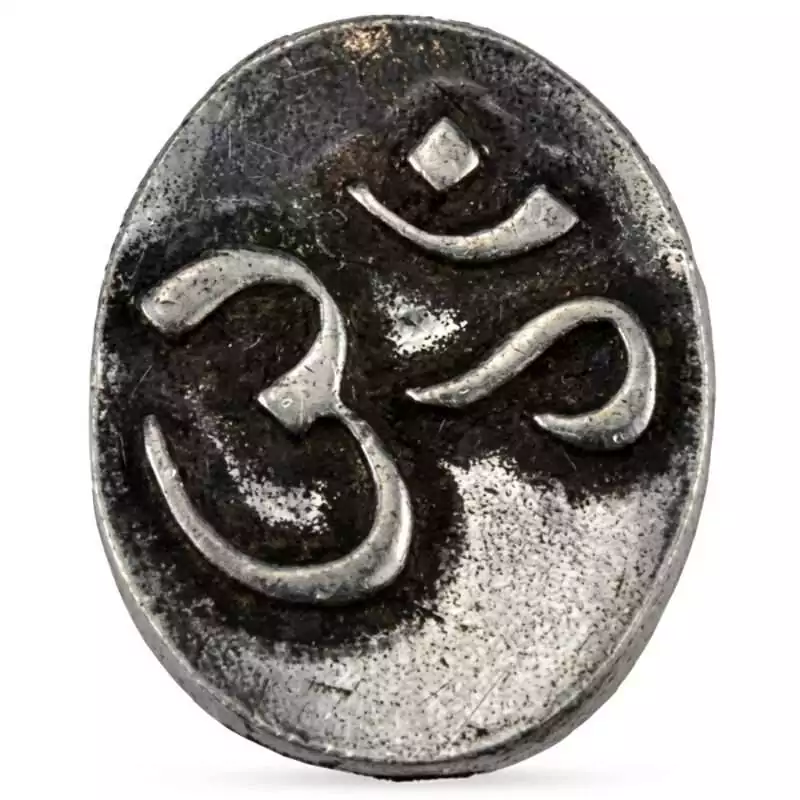
- Type: Lead-free pewter pocket stone inscribed with the Om symbol
- Size: 1″ x 5/8″
- Best for: Meditation practice, Sanskrit mantra work, Hindu and Buddhist devotion
Om (AUM): The Sacred Syllable of Sanskrit Tradition
The Om symbol, written in Devanagari script, represents one of the most ancient and widely used mantras in the Dharmic traditions. Its Sanskrit pronunciation as AUM encodes three distinct phonemes: “A” (Akaar), corresponding to the waking state and creation; “U” (Ukaar), the dream state and preservation; and “M” (Makaar), the deep sleep state and dissolution. The silence that follows each repetition represents turiya, the fourth and transcendent state beyond ordinary consciousness. These four aspects map directly onto Brahman in Hindu theology and onto the three kayas in certain Vajrayana Buddhist frameworks, making Om a compressed symbol of the entire structure of reality.
The Mandukya Upanishad, one of the principal Upanishads, is devoted entirely to the nature of Om, describing it as the imperishable sound that underlies all of existence. In yoga philosophy, Om is classified as a bija mantra, a seed syllable, and is associated with the Ajna (third eye) and Sahasrara (crown) chakras. Modern research on repetitive chanting suggests it may stimulate the vagus nerve, a pathway associated with calm and reduced stress response, giving the traditional claim of its calming properties some physiological grounding.
Om Stone as a Meditation Anchor
This 1″ x 5/8″ pewter stone inscribed with the Om symbol gives practitioners a tactile anchor for mantra-based meditation. Where mala beads track repetitions of a chant, a pocket stone like this serves as a single point of return, a physical reminder to come back to the breath and the syllable when the mind wanders. Holding it during a seated practice or carrying it as a daily reminder of one’s contemplative intention are both common approaches. For practitioners deepening their chakra work, explore my chakra and meditation products for complementary tools.
Pewter has been used in amulet-making since at least the Roman period, and its durability and silver-like appearance make it practical for objects meant to be handled frequently. This stone is a working tool, not a decorative collector’s piece, and its modest size means it fits in a pocket, a meditation bag, or on a small altar without ceremony.
How to Use the Om Pocket Stone
Three steps for using this pewter Om stone in meditation and daily spiritual practice.
- Set Your Meditation Space
Sit comfortably with your spine upright. Hold the Om stone in both hands or rest it in your lap. Take three natural breaths to arrive in the present moment before you begin chanting or silent repetition of the mantra AUM.
- Chant or Silently Repeat AUM
With the stone in your palm, chant AUM aloud or repeat it silently. Let the A sound begin in your lower belly, the U vibrate in your chest, and the M resonate in your head. Return your attention to the stone whenever your mind drifts.
- Carry It as a Daily Reminder
Between meditation sessions, keep the Om stone in your pocket or bag. When you touch it during the day, let it serve as a prompt to pause, breathe, and reconnect with the calm and clarity you cultivate in formal practice.
The Tarot Fellow Standard
I carry this piece because the Om symbol connects to one of the oldest and most rigorously documented contemplative traditions in the world. Unlike many “mindfulness” products that borrow the symbol without context, this stone is genuinely suited for practitioners who study Sanskrit mantra tradition, yoga philosophy, or Vedic spirituality. The lead-free pewter construction holds up to daily handling. For those interested in broader Eastern spiritual tools, browse my Eastern amulets and talismans for related items.
Frequently Asked Questions
The Om (AUM) symbol encodes the three states of consciousness in Sanskrit tradition: waking (A), dream (U), and deep sleep (M). The Mandukya Upanishad describes it as the sound of all existence, making it a compact symbol for universal awareness.
Hold the stone in your palm during seated meditation as a tactile anchor. Chant AUM aloud or silently, feeling the vibration in your belly, chest, and head. Return attention to the stone whenever your mind wanders from the mantra.
Om is linked to the Ajna (third eye) and Sahasrara (crown) chakras in yoga philosophy. It is the bija mantra for the crown chakra, and chanting it is said to open awareness to higher states of consciousness beyond ordinary perception.
Yes. A syllable similar to Om appears in Vajrayana Buddhism, and mantra repetition is shared across many Dharmic traditions. The physical stone works as a meditation anchor regardless of which specific tradition the practitioner follows.



Reviews
There are no reviews yet