
Quick Specs
- Format: Cold cast resin wall plaque, hand-painted with gilded skin tones and polychrome wing feathers
- Dimensions: 12.25 in tall x 11.75 in wide x 2 in deep
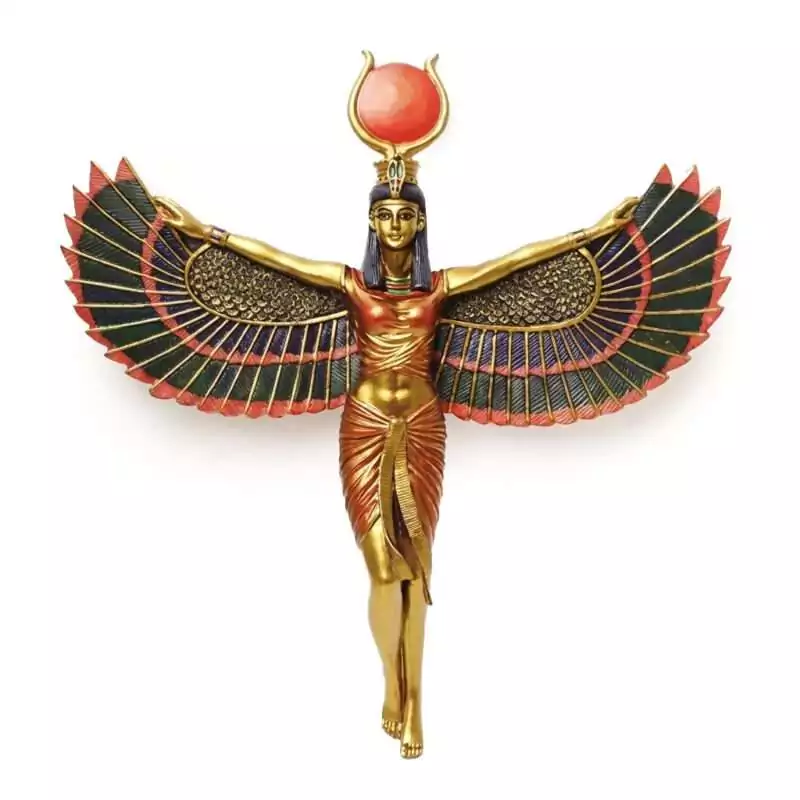
- Iconography: Isis standing with wings unfurled, throne hieroglyph crown with cow horns and solar disk, lapis striped headdress
- Best for: Egyptian and Kemetic altars, mother goddess work, protection and healing rites, ancestor shrines
The Goddess in the Plaque
This wall plaque shows Isis in her most recognizable Egyptian pose, standing upright with her arms lifted and the long pinions of her wings sweeping out from elbow to fingertip. The throne hieroglyph rises from her crown, flanked by cow horns that cradle the solar disk. Her tunic is gilded across the bodice with the kite-feather pattern stylized over her hips. The painted wings carry the layered red, blue, and green of Egyptian temple art rather than a single bronze wash.
The throne on her head is also her name. The hieroglyph reads as st, sometimes transliterated Aset, and Egyptologists translate it as “she of the throne.” The crown identifies her as the seat of kingship, the womb of pharaoh, and the altar of consecration in a single sign. Practitioners I work with read the figure as a wall-hung gateway between two functions, mother and sovereign, with the wings doing the protective work.
Why the Wings Are Open
The Pyramid Texts and Coffin Texts already show Isis as a bird, specifically the kite or kestrel, the raptors sacred to her. When Set scattered Osiris in pieces, Isis and her sister Nephthys flew the length of the Nile in bird form, gathered the body, and Isis fanned breath into Osiris with her wings long enough to conceive Horus. The Egyptian verb sekhen, “to fold the wings,” also meant “to embrace.” Open wings on an altar piece read as that same embrace held wide.
The protective use carried into household practice. Egyptian mothers chanted, “My arms are over this child, the arms of Isis are over him, as she put her arms over her son Horus.” Tomb ceilings showed Isis, Nephthys, Nut, and Maat casting their winged protection out over the burial chamber like a net. Hung above an altar or doorway, this plaque sits in a tradition that is at least four thousand years old.
Working With Aset on the Altar
Modern Kemetic and Goddess-tradition practice draws on Plutarch, the Pyramid Texts, the Book of the Dead, and contemporary reconstructions to ground Isis as a goddess of magic, healing, motherhood, and resurrection. Common offerings are milk and honey, white bread, beer, blue lotus, and water from a clean source. Frankincense and myrrh both have ancient temple precedent. The throne crown invites you to bring questions of authority, protection, and grief into her field, and the open wings tell you the answer often comes as shelter rather than instruction.
How to Hang and Honor This Isis Plaque
A short rite for hanging this Isis plaque and inviting her protective wings into a home altar.
- Hang and consecrate
Mount the plaque above an altar, doorway, or quiet wall facing east where the morning sun finds the gilded wings. Pass frankincense or myrrh in front of her, name her as Aset, lady of the throne, and welcome her wings as protection.
- Set the offerings
Place a small bowl below the plaque with milk, water, or honey, a piece of white bread, and a blue or white candle. Add a sprig of greenery such as palm or lotus if you can. Light the candle, name what you bring, and let it burn safely.
- Sit beneath the wings
Lower your gaze to the offerings and breathe slowly until the room feels still. If you carry grief, fear, or a question of protection, speak it aloud. Thank Isis when finished, snuff the candle, and leave the bowl until the next working.
The Tarot Fellow Standard
I keep this Isis plaque on hand for practitioners building a Kemetic shrine and for anyone who wants a clear protective figure on the wall. Pair it with the Egyptian and Mediterranean pieces in my gods and goddesses collection, or hang it among the relief pieces in my wall hangings selection.
Frequently Asked Questions
The hieroglyph on her head is the throne sign, read as st or Aset, which is also her name. Egyptologists translate it as she of the throne, marking her as the seat of kingship, the womb of pharaoh, and the altar of consecration in a single image.
Isis is a bird goddess whose sacred raptors are the kite and kestrel. The Pyramid Texts describe her fanning life into Osiris with her wings. The Egyptian verb sekhen meant both to fold the wings and to embrace, so they always read as protection.
Milk, honey, beer, water, and white bread carry ancient precedent. Frankincense and myrrh were temple incenses. Blue lotus, palm, and fresh flowers suit her. Place the offering in a small bowl below the plaque and replace it with each new working.
Yes. Isis crossed from Egypt into Greek and Roman practice in late antiquity and has long been honored in eclectic Goddess and Hermetic traditions. The plaque suits any altar that calls on her as mother, healer, or protector regardless of lineage.
Reviews
There are no reviews yet