



Quick Specs
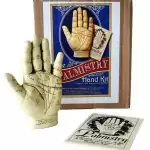
- Type: Palmistry reference hand with mount and line labels
- Size: 5 inches x 3 inches x 1 inch
- Includes: Small guidebook
- Best for: Chiromancy study, client display, divination altar decor
Palmistry Hand Lines and What They Reveal
Palmistry, also known as chiromancy, traces its recorded history to ancient India, where Vedic texts described hand analysis as a branch of astrology called samudrika shastra. The practice spread through China, Egypt, Greece, and Rome before reaching medieval Europe, where court palmists advised nobility and scholars catalogued the lines of the hand in illustrated manuscripts. What distinguishes palmistry from other divination methods is its use of the body itself as a text, a physical record that practitioners read for insight into character, tendency, and pattern rather than guaranteed fate.
The four lines most practitioners learn first are the heart line, the head line, the life line, and the fate line. The heart line runs horizontally below the fingers and is traditionally read for emotional temperament and relationship patterns. The head line crosses the palm at mid-height, and its length, depth, and curve are interpreted for mental style and decision-making tendencies. The life line arcs around the base of the thumb and is frequently misunderstood as predicting lifespan; experienced palmists are clear that it reflects vitality and life changes rather than years. The fate line, running vertically up the palm, is absent in many people and is read for sense of purpose and external influence on one’s path.
The Seven Mounts and Chiromancy Practice
Beyond lines, chiromancy maps seven mounts, the fleshy pads at the base of each finger and along the palm’s edge, each named for a planet. The Mount of Venus anchors below the thumb and relates to warmth, sensuality, and life force. Jupiter’s mount sits below the index finger and speaks to ambition and leadership; Saturn’s below the middle finger to discipline and caution. The Mount of Apollo, below the ring finger, is associated with creativity and success, while Mercury’s mount below the little finger relates to communication and adaptability. The Mounts of Luna and Mars anchor the lower outer edge and center of the palm, traditionally connected to intuition and courage.
A three-dimensional reference model like this palmistry hand is significantly more useful than a flat diagram for developing reading skill. When labels appear on an actual hand shape, readers can cross-reference the position of each feature in relation to the others, which is how a real reading works. Practitioners in training often keep the model on their desk while practicing on clients or family members, glancing at it to confirm mount positions before speaking. The included guidebook adds a written foundation to the physical reference.
How to Use a Palmistry Hand
How to use the palmistry hand as a study and reading reference tool.
- Set Up Your Reference Station
Place the palmistry hand on a flat surface where you read or study. The four cushion tabs on the base keep it stable. Have your guidebook nearby, and position a lamp or candle so the labeled lines and mounts read clearly.
- Identify the Major Lines
Start with the three primary lines every practitioner learns first: the heart line running below the fingers, the head line across the middle of the palm, and the life line curving around the thumb’s base. Note the fate line if present.
- Practice Reading the Mounts
Move to the seven mounts. Venus sits at the base of the thumb, Jupiter below the index finger, Saturn below the middle, Apollo below the ring, Mercury below the little finger, and the Luna and Mars mounts anchor the outer edge and center.
The Tarot Fellow Standard
I stock this palmistry hand because it fills a genuine gap: most beginners learn chiromancy from flat books, then struggle to translate a two-dimensional diagram onto the curves and contours of a real hand. A labeled three-dimensional model bridges that gap immediately. The compact 5 x 3 x 1 inch size works equally well as a desk study tool and as a display piece in a reading room. If you want to pair it with illustrated learning resources, browse my tarot and divination books collection for palm reading and divination guides. For other tools that support hands-on divination practice, explore my scrying and divination tools.
Frequently Asked Questions
A palmistry hand is a labeled reference model showing the major lines and mounts of the palm. Practitioners use it to study chiromancy, demonstrate reading positions to clients, or display as decor in a reading space or altar.
Most palmistry hands mark the four core lines: heart, head, life, and fate. They also label the seven mounts, Venus, Jupiter, Saturn, Apollo, Mercury, Luna, and Mars, giving a complete reference map for a full palm reading session.
Yes. The labeled lines and mounts remove the guesswork beginners face when learning chiromancy. Working from a three-dimensional model rather than a flat diagram helps build muscle memory for locating each feature on a real hand quickly.
This palmistry hand measures 5 inches by 3 inches by 1 inch and sits on four cushion tabs that protect your desk surface. It ships with a small guidebook for reference. The compact size makes it easy to use at a reading table or altar.


Reviews
There are no reviews yet