

Quick Specs
- Type: Natural porcupine quill dip pen
- Size/Quantity: Single quill pen
- Best for: Petition writing, sigil work, grimoire inscriptions, candle carving
Porcupine Quill Pen for Ritual Writing and Spellwork
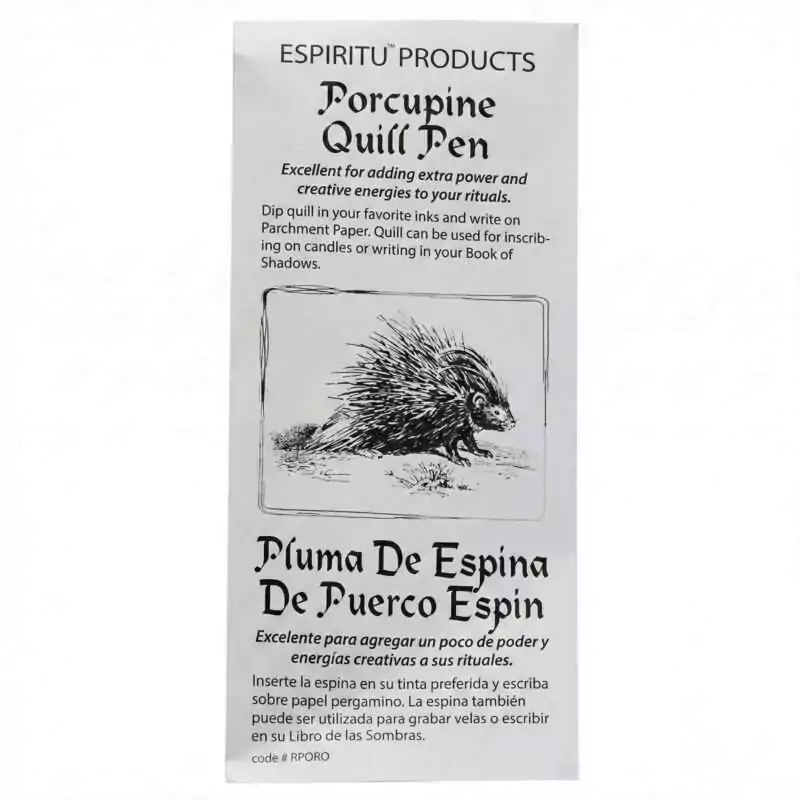
This dip pen is made from a genuine porcupine quill, cleaned and prepared with a pointed nib for writing with ink on parchment, petition paper, or spell paper. Unlike modern plastic dip pens, which are interchangeable tools, a porcupine quill carries the physical character of the animal it came from: each quill is banded in black and white, tapers to a natural point, and holds a slight flexibility that affects the pressure of every stroke. The rhythm of dipping and writing slows the hand down deliberately, which practitioners across multiple traditions describe as an advantage when building intention in written spellwork.
The porcupine (Erethizon dorsatum in North America, Hystrix cristata in Africa and Europe) occupies a specific place in folk magic traditions. In North American Indigenous cultures, porcupine quillwork is one of the oldest decorative and ceremonial art forms on the continent, predating the introduction of glass beads by centuries, and quills were considered materials with spiritual weight. The porcupine’s ability to defend without aggression makes it a symbol suited to protection writing, boundary-setting spells, and uncrossing work in folk magic. Explore more ritual writing supplies in my parchment paper and ink supplies.
Symbolism of Defense, Boundaries, and Precision
The quill pen connects the act of writing directly to the animal’s primary attribute: precision under pressure. A porcupine quill does not deploy randomly. Each quill is individually released in response to contact, which translates well as a metaphor for boundary work that responds to specific intrusion rather than broadcasting general aggression. Practitioners who work with protection spells, uncrossing rituals, or binding work find the porcupine quill fitting as a writing instrument because the symbolism is embedded in the material itself.
The sharp tip also functions as a stylus for soft wax, allowing practitioners to carve names, sigils, or short inscriptions into chime candles or pillar wax before burning. This use requires no ink, just a steady hand and light pressure. It’s a different application from the Steampunk Pen, which is built for extended writing sessions. For high-ritual work where the tool itself contributes to the symbolism, this quill is a considered choice.
How to Use the Porcupine Quill Pen
Three ways to use the porcupine quill pen in ritual and spellwork.
- Prepare Ink and Paper
Fill a small ink well with ritual ink such as Dragon’s Blood, Bat’s Blood, or black India ink. Set out parchment or petition paper. Dip the quill tip just past the nib into the ink, then tap off excess on the bottle rim before writing.
- Write Petitions or Sigils
Write slowly and re-dip the quill every few words or when ink flow slows. The interrupted rhythm is intentional: each dip renews focus on the word or symbol being inscribed. Use short strokes for sigils and steady lines for petition text.
- Carve Candle Inscriptions
Use the dry quill tip as a stylus to trace names, sigils, or runes into soft chime or pillar wax before lighting. Apply light, steady pressure for a clean groove without cracking the candle surface. No ink is needed for this method.
The Tarot Fellow Standard
I stock this quill because it occupies a symbolic space that plastic dip pens and modern fountain pens cannot. The porcupine’s association with defense without aggression, with precision, and with boundary-setting is embedded in the material rather than assigned to it. For practitioners who take the writing instrument seriously as part of the spell, this is the right tool for protection work, banishing petitions, and uncrossing inscriptions. Browse my ritual supplies for inks, papers, and tools that complete a writing kit.
Frequently Asked Questions
Any fluid ritual ink works, including Dragon’s Blood, Bat’s Blood, and black India ink. Avoid thick inks or gel formulas, which clog the nib. Thin the ink slightly with water if it dries in the tip between strokes or runs too slowly.
Yes. The dry quill tip works as a stylus for inscribing names, sigils, or runes into soft wax. Apply light pressure to trace a clean groove without cracking the candle. This is common in candle magic alongside ink writing on parchment.
The porcupine represents protection through precision rather than aggression. In many North American Indigenous traditions, quills carry spiritual weight. In folk magic, the animal is linked to boundary-setting, defense, and uncrossing work.
A porcupine quill is shorter, stiffer, and narrower than a feather quill, giving it more precise control for small sigil work and candle carving. Feather quills suit long-form writing; porcupine quills suit deliberate ritual inscriptions.


Reviews
There are no reviews yet