
Quick Specs
- Brand: Rockpool Publishing
- Authors: Richard Lister and Selena Moon
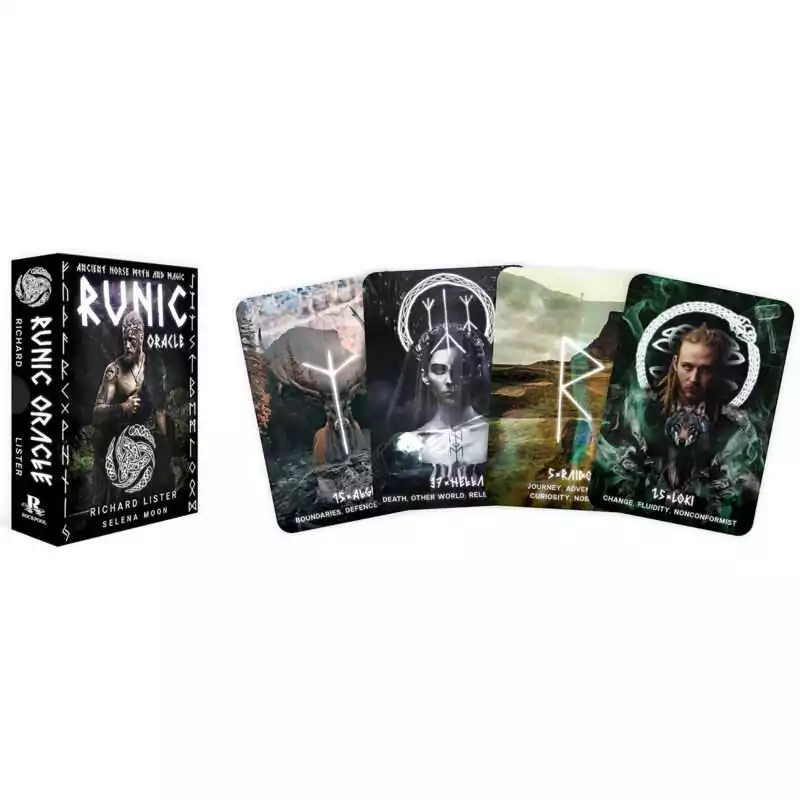
- Type: 44-card oracle deck, velvet finish, with guidebook
- Best for: Norse mythology study, rune divination, Viking ancestral practice
Elder Futhark Runes and Norse Mythological Narrative
The Runic Oracle by Richard Lister and Selena Moon brings the Elder Futhark rune system into an illustrated oracle format, combining the 24 runes of the oldest Germanic runic alphabet with Norse mythological narrative drawn from the Eddas, the sagas, and the broader Scandinavian and Northern European ancestral tradition. Each of the 44 cards covers a rune’s stave, name, and traditional meaning while embedding it in the mythological context that originally gave the runes their interpretive weight: Odin’s sacrifice on Yggdrasil to receive the runes, the Norn sisters weaving fate, the structure of the nine worlds.
Richard Lister is known within the rune and Nordic spirituality community for his work on runic healing and ancestral practice, and his approach in this deck is deliberately narrative rather than purely divinatory. The Runic Oracle is not structured as a replacement for casting physical rune stones but as a contemplative companion to runic study, one that uses the card format to foreground mythological context that tends to be stripped out of keyword-only rune reference guides. Selena Moon’s contribution to the deck design gives it a velvet finish that distinguishes the physical object from standard glossy oracle card stock.
How the Runic Oracle Differs from Physical Rune Sets
Physical rune sets, whether carved from wood, stone, or crystal, are cast onto a cloth or surface and read by the relationships between the fallen pieces, including which runes land face-up versus face-down and how they cluster. The Runic Oracle uses a different mechanism: cards drawn into a structured spread, each accompanied by a detailed mythological narrative and both upright and reversed meanings where applicable. That format suits a different kind of inquiry, one based on contemplation and narrative rather than the spatial relationships of a rune cast. Practitioners who already own crystal or stone rune sets will find the oracle supplements rather than duplicates that practice.
The concept of wyrd, the Old English and Old Norse term for the interconnecting threads of fate and destiny, runs through the deck’s interpretive framework. Unlike the more deterministic conception of fate in some traditions, wyrd in the Norse sense involves the active participation of the individual in weaving their own threads alongside those set by the Norns. That interpretive frame gives the Runic Oracle a nuanced approach to questions about destiny and choice that keyword-only rune guides rarely articulate.
How to Use Runic Oracle
Three approaches for working with the Runic Oracle, from daily single-card draws to structured Norn three-card spreads.
- Study the Elder Futhark Before Reading
Familiarize yourself with the Elder Futhark before reading. The 44 cards combine each rune’s stave and name with Norse mythological context from Richard Lister. Reading both the rune’s traditional meaning and the card’s narrative deepens each draw.
- Use the Wyrd Framework for Daily Draws
Draw one card for a daily runic focus. Sit with the rune’s stave shape and the Norse figure the card presents. Let the wyrd, the Norse concept of fate’s interwoven threads, frame your reading rather than seeking a simple yes or no from the imagery.
- Read in Norn Three-Card Spreads
Use a three-card spread to mirror the Norn structure: one card for what was (Urd), one for what is (Verdandi), one for what will be (Skuld). This layout reflects the Viking view of fate as woven threads, suiting the deck’s Norse ancestral context.
The Tarot Fellow Standard
I stock the Runic Oracle because it does the work that most rune reference guides do not: it situates each rune inside the mythological world that gave it meaning. A keyword list for Fehu or Isa does not explain why those runes carry the interpretive weight they do; the Norse mythological context this deck provides does. If you want to pair card-based runic practice with physical rune casting, browse my rune divination collection for physical sets and complementary tools.
Frequently Asked Questions
The deck has 44 cards with a velvet finish, covering the Elder Futhark runes alongside Norse mythology, the Nordic pantheon, and Viking ancestral lore. Authors Richard Lister and Selena Moon draw on Scandinavian and Northern European oral tradition.
Unlike a physical rune set, which relies on casting individual stones, the Runic Oracle provides illustrated cards with Norse mythological narrative. It suits structured spreads and guided reflection better than traditional rune casting methods do.
Experienced rune practitioners find the Norse mythological context enriching, while beginners benefit from the guidebook’s explanations of the wyrd, the Nordic pantheon, and the Elder Futhark staves. The deck rewards both levels of engagement well.
The Elder Futhark is the oldest runic alphabet, comprising 24 runes used by Germanic and Scandinavian peoples from roughly the 2nd to 8th centuries CE. The Runic Oracle draws on this system and extends it with Norse mythological narrative per card.

Reviews
There are no reviews yet