

- Primary stone: Selenite (crystallized gypsum, CaSO₄·2H₂O)
- Chakra stones: Red Jasper (Root) · Carnelian (Sacral) · Citrine (Solar Plexus) · Green Aventurine (Heart) · Sodalite (Throat) · Amethyst (Third Eye) · Clear Quartz (Crown)
- Chain/cord: Metal chain with finger loop
- Approximate length: 9–11 inches tip to loop
- Water safe: No — keep dry
Selenite, Seven Stones, and the Logic of a Chakra Pendulum
Selenite is a crystallized variety of gypsum — chemical formula CaSO₄·2H₂O — that forms in the monoclinic crystal system. Its name comes from the Greek selēnitēs lithos, “stone of the moon,” a reference to the lunar goddess Selene and to the stone’s pale, almost luminous sheen on fresh cleavage faces. On the Mohs scale it sits at a 2, softer than a fingernail can scratch, which tells you something important before you even pick it up: this is not a workhorse stone. What it is, mineralogically, is a hydrous sulfate — and that “hydrous” matters. The water molecules locked into its crystal lattice are also what make it melt when submerged. Extended contact with water doesn’t just dull the surface; it slowly dissolves the crystal from the outside in. The fibrous variety you’ll often see sold as “satin spar” shares the same chemistry and the same vulnerability.
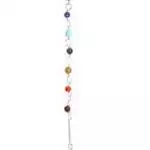
The seven-chakra framework this pendulum is built around originates in Vedic tradition. The chakras — Sanskrit for “wheels” — are first described in the Rigveda, hymns composed roughly 1500 to 1000 BCE, and elaborated through the Upanishads and later Tantric texts. The seven major centers run from the base of the spine (Muladhara, Root) upward through the sacral, solar plexus, heart, throat, and third eye to the crown (Sahasrara). Each center is associated with a quality of consciousness, a Sanskrit seed syllable, and — in contemporary crystal practice — a stone whose color frequency is said to resonate with it. On this pendulum, those seven stones are stacked along the shaft: red jasper anchors the root, carnelian the sacral, citrine the solar plexus, green aventurine the heart, sodalite the throat, amethyst the third eye, and clear quartz at the crown tip or top bead.
The pendulum itself works through what researchers call the ideomotor effect — tiny, unconscious muscle movements in the hand that amplify into visible swings. Whether you read that as pure neuroscience or as the body’s subtle energetic field making itself legible, the practical result is the same: a slight tilt in attention becomes motion you can observe and interpret. The selenite body serves as the weighted point, and in many traditions selenite is considered “self-cleansing” — meaning practitioners use it without the salt-bowl or moonlight resets they’d apply to other stones. That reputation comes partly from its association with the moon and partly from its perceived high vibration; I can’t verify the energetics, but I can confirm the tradition is well established. What I can verify is that selenite absolutely does not cleanse itself of water damage.
How to Use a Selenite Chakra Pendulum
A step-by-step guide to calibrating, scanning, and closing a chakra reading session with a selenite 7-chakra pendulum.
- Calibrate your yes and no
Hold the chain between your thumb and forefinger, letting the pendulum hang freely. Still your hand and ask aloud or silently: “Show me yes.” Wait without forcing. Note the direction of the first consistent movement — clockwise circle, back-and-forth, or side-to-side. Then ask for “no” and note that movement. Do this each session; your baseline can shift. Once you have a reliable yes and no, set your intention: you’re here to gather information, not to confirm what you already think.
- Scan each chakra point
Lie down or ask a partner to lie down. Starting at the root chakra (base of the spine), hold the pendulum two to three inches above the body. Let it settle, then observe — size of the arc, direction, and steadiness. Work upward through each of the seven centers: sacral (just below the navel), solar plexus (above the navel), heart (center of the chest), throat, third eye (between the brows), crown (top of the head). A wide, steady circular swing is commonly read as open and balanced; a tight or erratic movement, or no movement at all, is read as blocked or needing attention. Note what you observe at each point before drawing conclusions.
- Interpret and close
Review what the pendulum showed you across all seven points. For any center that registered as blocked or imbalanced, you can hold the pendulum there again and silently invite that chakra to come back into alignment — many practitioners find the swing gradually widens and evens out as they hold this intention. When you’re finished, thank the tool, still it with your free hand, and set it down. Store it in a soft pouch or wrapped in cloth away from harder stones that could scratch the selenite shaft.
The Tarot Fellow Standard
I source these pendulums through a supplier I’ve worked with for several years whose product quality I’ve tested firsthand across multiple crystal categories. The chakra stones on this pendulum are natural — jasper, carnelian, citrine, aventurine, sodalite, amethyst, and quartz — though the exact shades will vary piece to piece the way any natural stone does. Citrine in particular is often heat-treated to achieve its yellow-orange color; that’s industry standard and doesn’t change its use, but it’s worth knowing. The selenite shaft will vary in translucency and may show the fine striations typical of satin spar gypsum. No two look identical.
A few honest notes before you order: selenite is genuinely fragile. A hard drop onto tile or a knock against another stone can chip or snap the shaft. If you toss this into a bag with other tools, wrap it first. More critically, keep it dry — not just out of running water, but away from humidity and wet hands. Gypsum dissolves slowly but reliably, and a selenite pendulum that’s been wetted repeatedly will start to show surface etching and eventual structural softening. Clean it with a dry or barely damp cloth only. If you want to explore more dowsing tools, browse the full pendulums collection, or if selenite in other forms interests you, the selenite collection has plates, wands, and towers that pair well with this pendulum for a dedicated practice space.
This is one of the most repeated claims in crystal circles, and the honest answer is: it depends on what you mean. In most traditions, selenite is considered high-vibration enough that it doesn’t accumulate the energetic residue that other stones are thought to absorb — meaning practitioners often skip the salt or water cleanse they’d use for obsidian or black tourmaline. That said, “self-cleansing” in the metaphysical sense is a traditional belief, not a verified property. Physically, selenite does not clean itself of anything. If you want to refresh it energetically, leave it in moonlight overnight or pass it through incense smoke — and absolutely keep it away from water.
From base to tip (root to crown): Red Jasper for the Root Chakra (Muladhara), Carnelian for the Sacral Chakra (Svadhisthana), Citrine for the Solar Plexus Chakra (Manipura), Green Aventurine for the Heart Chakra (Anahata), Sodalite for the Throat Chakra (Vishuddha), Amethyst for the Third Eye Chakra (Ajna), and Clear Quartz for the Crown Chakra (Sahasrara). The selenite forms the main weighted body of the pendulum shaft. Stone shades vary naturally between individual pieces.
A single-stone pendulum — amethyst, clear quartz, obsidian — is often chosen to match the practitioner’s intention or a specific chakra they’re working with. A 7-chakra pendulum carries all seven corresponding stones in one tool, which makes it a generalist instrument suited to a full-body scan rather than targeted work on one energy center. The tradeoff is that each individual stone is small, so the resonance of any single one is less concentrated than a dedicated single-stone piece. For full chakra assessments and general practice, the 7-stone format is convenient. For deep work on a single chakra, a dedicated stone pendulum may be a better fit.
No. Selenite is a hydrous calcium sulfate (CaSO₄·2H₂O) with a Mohs hardness of 2. Prolonged water contact causes the mineral to slowly dissolve — you’ll see surface etching, loss of luster, and eventually structural softening. Moon water rituals, crystal baths, and any water-based cleansing method are not suitable for this pendulum. To cleanse it energetically, use dry methods: moonlight, sunlight for short periods, sound (a singing bowl or bell nearby works well), or smoke from sage or palo santo passed around it without letting moisture condense on the shaft.




So pretty! Exactly what I was looking for