

Quick Specs
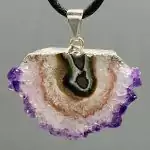
- Material: Natural stalactite slice (calcite and aragonite) with silver plated bail and hardware
- Finish: Silver plated (not sterling silver)
- Stone composition: Amethyst and Agate inclusions within cave calcite matrix
- Shape: Varying — each piece is a unique natural cross-section
- Size: Varies by individual piece (natural formations, not cut to uniform dimensions)
- Weight: Approx. 0.005 lbs
- Cord/chain: Not included — pendant only with bail attached
Time in Stone Form
Stalactites are classified as speleothems — cave formations born from one of geology’s most patient processes. Rainwater absorbs carbon dioxide from soil and atmosphere, becoming a mild carbonic acid that slowly dissolves the calcium carbonate in limestone bedrock above. That mineral-laden water migrates down through cracks until it drips from a cave ceiling into open air. As carbon dioxide escapes into the cave atmosphere, the dissolved calcium carbonate precipitates back into solid form — calcite, and sometimes aragonite — one microscopic ring at a time. Given tens of thousands of years, those rings stack into the icicle shapes we recognize. I find it remarkable that what you hold in your hand is a cross-section of that entire timeline, banded like tree rings but counted in millennia, not seasons.
This particular pendant incorporates stalactite material that carries natural Amethyst and Agate inclusions within its calcite matrix — a geological bonus that gives each slice its own distinct color and pattern. When jewelers section a stalactite to make pendants, they expose those internal rings in a way you never see on the surface of a whole formation. No two cross-sections are ever identical. The silver plating process — an electrochemical technique that bonds a thin silver layer to the base metal bail — gives the hardware a clean, neutral frame that lets the stone speak. I carry these specifically because the variety is genuine: every piece that comes through is its own artifact.
In metaphysical traditions, stalactite material is associated with ancient wisdom, patience, and deep earth energy. Because these formations grow downward — tip pointing toward the ground — they are often used in grounding practices, a directional symbolic logic that shows up in crystal work across cultures. Crystal healers note a particular resonance with the third eye chakra for stalactite pieces that carry purple mineral inclusions, while the calcite base connects broadly to clarity and energetic amplification. I do not think you need to subscribe to any of that to appreciate what it means to wear a piece of the earth that took longer to form than modern human civilization has existed.
How to Work with Your Stalactite Pendant
Three simple ways to get the most from your stalactite pendant, from first contact to long-term care.
- Set Your Intention First
Hold the pendant in your palm and take three slow breaths. Let its cave-aged calcite energy settle against your skin before setting any intention.
- Use It in Meditation
Place it on your sternum or solar plexus during meditation. Stalactites form tip-down, so orient the point toward the earth to reinforce grounding.
- Cleanse and Store Gently
To cleanse, rest it on a piece of selenite overnight or set it in moonlight. Avoid water soaking – silver plating can tarnish with prolonged moisture.
The Tarot Fellow Standard
I source these pendants from a supplier that specializes in natural mineral jewelry — specifically pieces where the stone does the talking and the metalwork stays out of the way. What drew me to this line is the honest variation: no two stalactite cross-sections are the same, and the supplier does not try to match or standardize them. That is exactly how it should be with natural cave material. The silver plating is applied to a base metal bail, not sterling — I want to be direct about that because it matters for anyone with metal sensitivities or who expects sterling. The stone itself is entirely natural, unenhanced calcite with Amethyst and Agate inclusions.
One practical note: because every piece varies in size, shape, and weight, the pendant you receive will not look exactly like any photo you see. That is not a defect — it is the point. If you are someone who needs uniformity in your jewelry, this is not the piece for you. If you appreciate the idea that your pendant is genuinely singular, that is exactly what you are getting.
Pair this pendant with stones from our grounding and earth energy crystal collection for a complementary practice, or browse our full range of crystal gemstone pendants if you are building out a wearable collection.
Stalactite Pendant — Frequently Asked Questions
Each stalactite slice is a one-of-a-kind cross-section of cave calcite. No two share the same banding, color, or inclusions. The photo is representative – yours will differ.
The stalactite itself is natural calcite and aragonite. The setting and bail are silver plated base metal, not sterling silver.
Wipe with a soft dry cloth. Avoid perfume, lotions, and water contact on the metal parts. Store in a pouch away from harder stones that could scratch the surface.
Stalactites form over thousands of years as mineral-rich water drips through limestone. The drips deposit calcite slowly, ring by ring, until the icicle shape emerges.

Reviews
There are no reviews yet