


Quick Specs
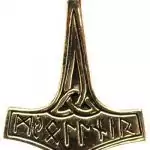
- Type: Bronze pendant amulet
- Size: 1.5″ x 1.25″
- Size/Quantity: 1.5 inches x 1.25 inches, one pendant, cord included
- Best for: Norse pagan practice, Asatru devotion, protection, rune work
Mjollnir: Thor’s Hammer in Norse Tradition
Mjollnir, the hammer of Thor, is one of the most powerful and enduring symbols in Norse religion and modern heathenry. In the Old Norse Eddas, Thor’s hammer is the weapon used to defend Asgard and Midgard against the forces of chaos, and it returns to his hand after each throw, making it an emblem of reliable protection and divine order. Archaeological evidence from Viking Age Scandinavia confirms that Mjollnir amulets were worn widely, found in graves and settlements across Norway, Sweden, Denmark, and Iceland, functioning as talismans of divine protection and consecration.
The hammer amulet predates Christianity’s arrival in Scandinavia and was almost certainly used in the same way the cross was used by Christians, as an identity marker and protective symbol. When Christianity began replacing Norse paganism between the 8th and 11th centuries, Mjollnir amulets appear to have increased in frequency as a counter-symbol. Today in Norse paganism and Asatru, wearing Mjollnir signals devotion to Thor and alignment with the values of strength, protection, and consecrated action.
Elder Futhark Runes and Triquetra Detail
This pendant adds two layers of symbolic depth beyond the basic hammer form. The triquetra on the handle, a three-lobed knot symbol found in Celtic and Norse sacred art, is associated with triple-aspect divine principles and continuous cyclical motion. The Elder Futhark runes inscribed across the hammer’s head constitute the oldest Germanic runic alphabet, used in Norse divination, galdr, and bind rune creation. Browse my rune tools collection for complementary divination supplies from the same tradition.
The pendant measures 1.5 inches by 1.25 inches and is cast in solid bronze, coming with a cord for immediate wear. The bronze material aligns with pre-Christian Norse metalwork traditions, where bronze and iron were the primary amulet materials, while also aging into a rich patina with wear that many practitioners find deepens the piece’s character over time.
How to Use the Thor’s Hammer Bronze Pendant
How to consecrate and use your Mjollnir bronze pendant in Norse pagan and Asatru practice.
- Consecrate with a Hammer Blessing
Hold Mjollnir over a flame or in raised hands and speak a dedication to Thor, naming your purpose: protection, strength, or sanctification. This mirrors how Thor hallows sacred acts with his hammer in Norse ritual tradition.
- Wear During Protective Ritual Work
Put on the pendant before protective workings or entering situations requiring Norse-tradition shielding. The Elder Futhark runes on the hammer head can be activated by tracing each stave mentally before beginning the working.
- Hallow Sacred Objects and Spaces
In Asatru practice, passing Mjollnir over an altar, food, or a new tool consecrates it. Hold the pendant over the object to be hallowed and invoke Thor’s blessing, mirroring traditional hammer use in Norse blot ceremonies.
The Tarot Fellow Standard
I chose this pendant because it combines three genuine Norse symbolic elements: Mjollnir, the Elder Futhark, and the triquetra, into a single piece that earns its complexity rather than adding ornamentation for its own sake. The bronze casting has appropriate heft for a devotional amulet. If you are building a Norse or Celtic practice toolkit, explore my Viking and Celtic collection for altar supplies, runes, and statuary to complement this pendant.
Frequently Asked Questions
Mjollnir is Thor’s hammer in Norse mythology, used to protect Asgard and Midgard from chaos. As an amulet it represents divine protection, strength, and consecration. Viking Age Scandinavians wore it widely as a protective talisman.
The Elder Futhark is the oldest Germanic runic alphabet of 24 characters used in Norse and Germanic cultures for writing, divination, and magical inscription. The runes on this pendant connect it to Norse magical and spiritual practice.
The triquetra is a three-lobed interlaced knot in Celtic and Norse sacred art, associated with triple-aspect divine principles and cyclical motion. On a Mjollnir it connects Norse hammer symbolism to broader northern European tradition.
Yes, a cord is included for immediate wear. You can replace it with a chain or thicker cord of your preference. The bail fits standard cord and chain widths. Many Norse practitioners prefer leather cord for historical authenticity.

Reviews
There are no reviews yet