

Quick Specs
- Stone: Labradorite (plagioclase feldspar), sourced from Madagascar
- Type: Natural free shape (freeform) specimen, polished surface
- Weight: .6 lb or more
- Best for: Altar display, meditation focus, collector specimens, labradorescence photography
Labradorescence: The Science Behind the Flash
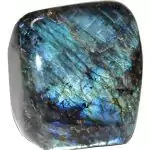
Labradorite is a plagioclase feldspar composed of alternating microscopic layers of albite and anorthite that formed through a process called lamellar twinning during cooling. When light enters the stone at the right angle, it strikes these internal layers and undergoes thin-film interference, scattering across the visible spectrum. The result is labradorescence: an interior flash of electric blue, gold, green, and occasionally violet that seems to move as you tilt the stone. It’s not a surface coating or treatment, it’s a structural optical property built into the mineral itself.
Each piece’s flash pattern is unique because lamellar twinning varies throughout the stone. Some specimens show a dominant single-tone blue across most of the face; others shift through multiple colors depending on the angle. At .6 lb or more, these medium free shapes are large enough to display the full play of color across a significant surface area. A smaller specimen can lose the effect in ambient light; a piece this size holds it even under diffuse room lighting.
Free Shape Specimens and Their Appeal
A free shape, sometimes called a freeform, is a specimen polished smooth but left in the natural shape of the rough stone rather than cut into a tower, sphere, or palm stone. No two free shapes are identical in outline, and the polish is applied to reveal the stone’s flash without forcing it into a standardized form. For labradorite especially, this format respects how the flash sits in the stone: lapidaries orient polished faces toward the most labradorescent planes during finishing, and a freeform allows more of those planes to be preserved. Browse my labradorite and crystal free shapes to compare sizes and pieces.
In practice, a piece this size works well as a permanent altar anchor, a meditation focal point, or a display specimen on a shelf where ambient light will catch it at different angles throughout the day. Nordic and Finnish folklore associated labradorite with the Aurora Borealis, describing it as frozen northern lights trapped in stone, and that legend reflects what you actually see. Practitioners across energy and healing traditions use labradorite for intuition work, aura protection, and third-eye practice, with its visual behavior providing a natural focal point during meditation.
How to Use a Labradorite Free Shape
How to orient, display, and work with your labradorite free shape to get the most from its natural flash and mineral properties.
- Find the Flash Angle
Hold the piece under a direct light source and slowly rotate it until the labradorescence fires. Each stone has its strongest flash at a specific angle. Note that orientation and keep the stone positioned that way for the best display.
- Use as a Meditation Focal Point
Place the free shape in front of you during meditation with a lamp positioned to activate its flash. Focusing on the interior color movement gives the mind a dynamic visual anchor, which many practitioners find easier to hold than a static object.
- Incorporate Into Energy Work
In crystal healing practice, labradorite is placed at the third eye or held in the non-dominant hand during intuition sessions. The .6 lb size fits comfortably in the palm for held work, or can rest on the forehead during lying-down sessions.
The Tarot Fellow Standard
I stock labradorite free shapes because the freeform format shows more of the stone’s labradorescent surface than a standard carved shape would. These pieces are sourced from Madagascar, where labradorite rough consistently produces strong flash with full spectral range. The .6 lb minimum weight ensures you’re getting a display-worthy specimen rather than a token piece. If you want to explore the broader range of my crystal and mineral specimens, there are pieces available across stone types and sizes.
Frequently Asked Questions
Labradorescence is caused by thin-film interference between alternating microscopic layers formed during lamellar twinning. Light scatters between these internal layers, producing the characteristic blue, gold, green, and violet flash.
A free shape is a polished specimen left in its natural rough outline rather than cut into a standardized form like a sphere or tower. Lapidaries polish the surface to reveal flash while preserving the stone’s natural labradorescent face.
This medium labradorite free shape weighs .6 lb or more. That is substantial enough for altar display and held meditation work, with enough surface area to show a strong labradorescent flash under most ambient lighting conditions in a room.
Major commercial labradorite sources include Madagascar, Finland, Canada, and Russia. Madagascar material is known for strong, multi-color flash. The mineral was first formally described from specimens found in Labrador, Canada, in the 1770s.
Reviews
There are no reviews yet