


Quick Specs
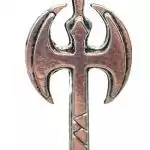
- Type: Pewter double-bladed ax pendant
- Size: 1.5″
- Size/Quantity: 1.5 inches
- Best for: Shango devotion, Santeria and Lucumi practice, protection, justice work
Shango: The Orisha of Thunder, Lightning, and Justice
Shango, also spelled Chango, is one of the most widely venerated Orishas in the Lucumi, Candomble, and Umbanda traditions of the African diaspora. His origins are in the Yoruba kingdom of Oyo in present-day Nigeria, where he is remembered as the fourth Alafin, or king, of Oyo, who was deified after death and became the Orisha of thunder, lightning, and the drumbeat. His presence in the Americas is the direct result of the transatlantic slave trade, which brought Yoruba religious traditions to Cuba, Brazil, Trinidad, and beyond, where they survived and adapted within new cultural contexts.
Shango is associated with justice, virility, dancing, music, fire, and the power to defeat enemies. His sacred colors are red and white, his sacred number is four or six depending on lineage, and his sacred day is Friday in many Cuban Lucumi traditions. He is described in the praise poetry as a king who is as beautiful as he is fierce, whose anger moves like lightning and whose judgments are final. Practitioners call on Shango for protection, victory in disputes, legal matters, and situations requiring raw power and assertiveness.
The Oshe: Shango’s Double-Bladed Axe Symbol
The oshe, or double-headed axe, is Shango’s most recognizable emblem. The dual blades represent his dual nature: the capacity for both destruction and justice, the two-sided quality of power that can cut in any direction. In Santeria ceremony, the oshe appears on Shango’s sopera (ritual vessel) and in ceremonial dance, where his devotees wield double-bladed axe objects during possession rites. The symbol’s bilateral symmetry also carries the idea of balance in strength.
This 1.5-inch pewter pendant is a wearable devotional amulet for practitioners who carry Shango’s protection. It is not a consecrated ceremonial object but a symbol worn to express devotion and alignment with his energy. In Santeria traditions, amulets and elekes (beaded necklaces) mark a practitioner’s relationship to specific Orishas. This pendant serves the same symbolic function in a portable, accessible form. Find related devotional jewelry in my jewelry collection.
How to Use the Shango Double Ax Amulet
How to introduce and use the Shango double ax amulet in Santeria and Lucumi devotional practice.
- Introduce the amulet to Shango’s shrine
Before wearing the amulet, place it on your Shango shrine or near a red and white candle lit in his honor. Address Shango by name and ask that the axe symbol carry his protection. This introduction aligns the piece with your devotional intent.
- Wear or carry in justice and protection work
Wear the pendant for situations requiring Shango’s qualities: court hearings, difficult meetings, competitions, or times when you need assertiveness and clear judgment. His energy is linked to decisive action and righteous outcomes in disputes.
- Refresh the amulet with offerings
Periodically remove the pendant and place it near a fresh offering to Shango, such as red apple, rum, or okra, and a red candle. This refreshes the amulet’s connection to his energy and renews your acknowledgment of his presence in your practice.
The Tarot Fellow Standard
I carry this Shango amulet because the oshe is a significant symbol with a long devotional history, not a generic decorative pendant. This piece is appropriate for practitioners who understand and work within the Lucumi and Santeria traditions. Shango belongs to a living tradition, and this pendant is a supply for devotion, not a substitute for initiation or for the guidance of a godparent and house. For additional devotional jewelry, browse my amulets and talismans collection.
Frequently Asked Questions
Shango is the Orisha of thunder, lightning, justice, and virility in Lucumi and Santeria tradition. He originates in the Yoruba kingdom of Oyo and is widely venerated across the African diaspora traditions of Cuba, Brazil, and Trinidad.
The oshe, or double-headed axe, is Shango’s sacred emblem, symbolizing his dual capacity for destruction and justice. The bilateral blades represent power that can cut in either direction, appearing in his shrines, ceremony, and devotional objects.
Shango’s colors are red and white. His traditional offerings include red apples, bananas, okra, rum, and red palm oil. He is honored with drums and dancing, and his shrines are dressed in red cloth with a wooden or metal double-bladed axe.
Wearing the oshe symbol expresses devotion and alignment with Shango’s protective energy. Full initiation into Santeria is a separate, formal process. This pendant functions as a devotional symbol rather than a consecrated initiation implement.



Reviews
There are no reviews yet