


Quick Specs
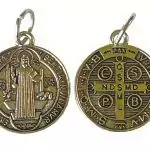
- Type: Amulet medal pendant
- Size: 0.75″
- Size/Quantity: One medal
- Best for: Protection against evil, exorcism rites, protective carrying, folk Catholic devotion
The St. Benedict Medal: History and Symbolism
The Medal of St. Benedict is one of the most widely distributed Catholic protective talismans in the world, with documented use stretching back to the eleventh century and popular distribution accelerating after the seventeenth-century rediscovery of the medal’s exorcism formula at Metten Abbey in Bavaria. Benedict of Nursia, who died around 547 CE, was the founder of Western monasticism and the author of the Benedictine Rule. His association with protection against evil derives from the Dialogues of Pope Gregory the Great, which recount Benedict repelling poisoning, witchcraft, and demonic interference through prayer and the power of the cross.
The reverse of the medal bears the CSSML NDSMD abbreviation, which expands in Latin as “May the holy cross be my light; may the dragon never be my guide,” and the VRSNSMV formula, which abbreviates the Sator prayer: “Begone Satan, suggest not to me your vain things; the cup you offer is evil; drink the poison yourself.” These formulas are not merely decorative. They constitute a formal exorcism prayer encoded on the medal itself, which is why the medal carries significant weight across Catholic and folk Catholic traditions as a practical protection tool.
Uses Across Catholic and Folk Magic Traditions
In folk Catholicism across Latin America and the Caribbean, the St. Benedict medal is embedded into door lintels, buried under thresholds, and placed in vehicles to ward off accidents, evil, and malevolent spiritual forces. It is buried at the corners of properties as a fixed boundary protection, worn by individuals as a personal shield, and given to children as a protective gift.
The medal is recognized by the Vatican as a sacramental, meaning it carries formal Church approval for protective use when worn with faith and prayer. This institutional backing, combined with centuries of popular devotional use, makes the St. Benedict medal unusual among protective talismans: it carries both doctrinal legitimacy and deep folk devotion simultaneously. Browse my crosses, saints, and angels amulets for companion pieces in this tradition.
How to Use a St. Benedict Amulet
How to activate and work with the St. Benedict medal for personal and property protection.
- Bless or consecrate the medal
Before wearing or placing the medal, it is traditional to have it blessed by a Catholic priest, though many practitioners consecrate it themselves through prayer, smoke cleansing, or anointing with protective oil. Hold it and state your intention.
- Wear or place it with intention
Wear the medal on a chain close to the body for personal protection. To protect a space, affix it above a doorway or bury it near the four corners of a property. When placing it in a charm bag, pair it with protective herbs such as rue or hyssop.
- Renew your connection regularly
The St. Benedict medal is not a one-time working. Touch it daily, speak a brief protective prayer, and reanoint with protective oil regularly, especially after any period of spiritual difficulty or when you feel the protection needs to be renewed.
The Tarot Fellow Standard
I carry the St. Benedict medal because it is one of the few protective talismans with documented centuries of unbroken use across both institutional and folk traditions. It earns shelf space on merit. See my protection herbs for plant allies that pair well with this medal in charm bags and threshold workings.
Frequently Asked Questions
The letters CSSML NDSMD abbreviate a Latin sentence meaning the holy cross is my light and the dragon is not my guide. VRSNSMV abbreviates the Sator exorcism prayer ordering Satan away. Together they encode a formal anti-evil prayer on the medal.
Catholic teaching recommends priestly blessing for sacramentals, but many practitioners across folk magic traditions consecrate medals themselves through prayer, smoke, or anointing. The medal carries its power through faith and intentional use.
People wear the St. Benedict medal for personal protection, carry it in charm bags, and bury it at property corners to establish spiritual boundaries. Its formula is a strong ally in protective work.
Yes. Many practitioners outside Catholicism use the medal for its protective symbolism and folk history without doctrinal commitment. Some have carried it for generations as a working tool.




Reviews
There are no reviews yet