


Quick Specs
- Material: Desert rose selenite (gypsum with sand inclusions)
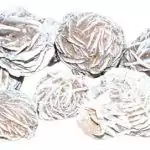
- Quantity: 1 lb bulk lot, multiple rosette formations
- Origin: Arid desert regions; major sources include Mexico, Morocco, and Tunisia
- Best for: Altar display, grounding meditation, crystal charging surface, clarity work
Desert Rose Selenite: Formation, Geology, and Tradition
Desert rose is not a plant but a mineral formation, a naturally occurring rosette of blade-like gypsum or barite crystals that grow outward from a central point, their arrangement mimicking flower petals with uncanny accuracy. The formations develop in arid and semi-arid environments where shallow, mineral-saturated water evaporates repeatedly, leaving calcium sulfate or barium sulfate to crystallize in situ around grains of sand that become permanently embedded in the crystal blades. This process produces each stone’s distinctive sandy, grainy texture and its characteristic warm tan to cream coloration.
The gypsum variety of desert rose shares its mineral family with selenite and satin spar, all forms of calcium sulfate dihydrate. Because of this shared gypsum base, desert rose is traditionally credited with many of the same energetic properties as selenite: crown chakra activation, aura cleansing, and the passive clearing of adjacent crystals placed nearby. Some practitioners also associate it specifically with the sacral chakra due to its earthy, sand-bound origin, making it an unusual stone in that it bridges the high-vibrational crown energies of selenite with the grounding qualities of a desert mineral.
Practical Uses and Honest Care Notes
In past-life and regression work, some practitioners use desert rose as a focal stone on the grounds that its slow geological formation over millennia embeds a quality of deep time into the piece, making it suitable for work that reaches backward through personal or collective history. In contemporary crystal healing, it is more commonly used for clarity of direction, removing mental fog, and supporting decision-making processes. The bulk format makes it ideal for practitioners who want to distribute pieces across multiple altar spaces, include them in kits, or offer them as gifts with context.
Desert rose requires the same water-free care as all gypsum minerals. Never rinse or soak these pieces; gypsum dissolves in prolonged contact with water, and the rosette formations are particularly vulnerable at the crystal blade junctions. Cleanse with sage smoke, sound vibration, or dry methods only. The sculptural beauty of the rosette makes it an excellent display piece on a bookshelf, desk, or altar without requiring any special preparation. Browse my full bulk stone collection for complementary minerals to pair with desert rose.
How to Use Desert Rose Selenite Stones
How to display, use, and care for desert rose selenite bulk stones.
- Display as an Altar Focal Point
Display desert rose clusters in a bowl on a desk or altar, using their natural sculptural form as a focal point during visualization practice. Each rosette’s unique petal formation makes them compelling tactile objects for grounding exercises.
- Use as a Crystal Charging Surface
Place a desert rose beside other crystals on a charging surface to leverage its selenite base. Selenite-family stones traditionally cleanse adjacent pieces; the gypsum matrix in desert rose performs the same function over several hours.
- Care: Keep Completely Dry
Keep desert rose in a dry location away from humidity; gypsum dissolves slowly in water and prolonged exposure will pit and soften these pieces. Do not rinse them under a tap. Brush away dust gently with a dry soft-bristled paintbrush.
The Tarot Fellow Standard
I stock desert rose because it is one of those minerals that does multiple jobs quietly: it looks remarkable on an altar without requiring curation, it clears adjacent stones by proximity, and it carries genuine geological interest that gives practitioners real content to connect with. The pound format delivers enough pieces to spread through a practice space, supply a workshop, or fill a display bowl. For other selenite-family pieces and minerals with similar clearing properties, explore my crystals and gemstones collection.
Frequently Asked Questions
Desert rose is a rosette-shaped gypsum or barite crystal formation, not a plant. It forms in arid desert environments when mineral-rich water evaporates and leaves calcium sulfate or barium sulfate crystallized around sand grains into petal shapes.
Desert rose is mainly gypsum, closely related to selenite. Both are calcium sulfate. Some specimens sold as desert rose are barite, a barium sulfate mineral. Gypsum desert roses are softer and more soluble; barite roses are denser and harder.
Gypsum rates 2 on the Mohs hardness scale, making desert rose among the softer mineral specimens. Handle with care to avoid breakage. The rosette formation is naturally fragile along crystal junctions, and pieces can separate if dropped or squeezed.
A one-pound lot typically contains multiple individual rosette clusters ranging from thumbnail-sized to roughly 2 inches across. Exact count varies since lots are weighed rather than hand-selected for a specific number of individual pieces.
Reviews
There are no reviews yet