
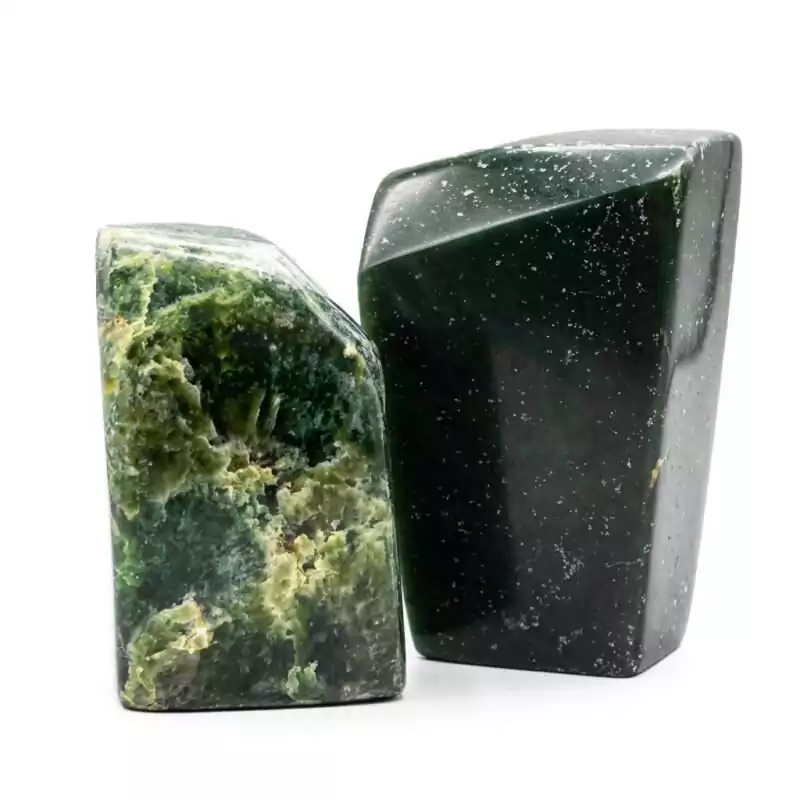

Quick Specs
- Type: Natural jade free-shape specimen set
- Size/Quantity: Two pieces, approximately 2.5 pounds total, organic uncut forms
- Best for: Prosperity altar centerpiece, jade collector display, advanced crystal work
Jade in Free-Shape: Preserving the Stone’s Natural Architecture
A free-shape specimen is a stone that has been extracted, cleaned, and minimally dressed without being cut to a predetermined form such as a sphere, point, slab, or tumbled pebble. The free-shape format preserves the natural contours of the original rough material, including surface texture changes, organic curves, and the color gradients that form as the stone transitions between inclusions and matrix zones. For a material as symbolically loaded as jade, the free-shape format also carries a philosophical alignment: jade’s traditional value in Chinese and Mesoamerican culture is rooted in the stone’s natural beauty, not in imposed geometry.
At approximately 2.5 pounds total across two pieces, this set provides substantial visual presence. Each piece is a distinct individual in form and surface character, which means no two sets will be identical. Jade’s characteristic waxy to greasy luster, produced by its interlocking fibrous crystal structure, is visible on cleaned natural surfaces without any polishing treatment. This set suits collectors who value authentic specimen character over decorative finish, and practitioners who want altar pieces of genuine material weight.
Jade Across Traditions: China, Mesoamerica, and the Maori World
Jade’s cultural depth across three distinct civilizations that developed independently of each other is one of the most remarkable convergences in world history. In China, nephrite jade was the imperial stone for over five thousand years, used in ritual bi discs and cong tubes whose exact ceremonial function remains partly unknown. In Mesoamerica, the Maya and Olmec used jadeite for death masks, celts, and offerings to rain deities. In New Zealand, Maori carvers worked pounamu into hei tiki pendants and weapons that carried the genealogical identity of their owners. Each tradition arrived independently at the stone’s sacred status.
Large jade specimens of this weight class are appropriate as altar centerpieces for abundance, protection, and longevity work. The two-piece format creates a paired grouping that suits altar arrangements requiring balance on either side of a center point, such as flanking a candle, statue, or offering bowl. The natural surface variations in each piece provide tactile interest during hands-on meditation and visual depth that polished or uniformly shaped pieces cannot replicate.
How to Use the Jade Free-Shape Specimen Set
Three focused practices for using large jade free-shape specimens in altar work, meditation, and crystal grid construction.
- Position as a balanced pair on the prosperity altar
Place one piece on each side of the altar center, flanking a green candle or offering bowl. The natural jade surfaces face outward. Speak a prosperity or longevity intention between them at the start of each moon cycle to anchor the working.
- Hold during extended meditation on abundance
Sit with one piece resting in the lap or held in both hands during a twenty-minute seated practice. The density and cool surface of jade ground the body while the intention moves through prosperity, longevity, or heart-centered harmony themes.
- Use as focal stones in a jade and green crystal grid
Position the two large pieces at the north and south poles of a crystal grid. Fill in remaining positions with smaller jade pieces, green aventurine, or malachite. Place a written intention beneath the center stone before activating the grid.
The Tarot Fellow Standard
I carry large jade specimens because they serve practitioners who have moved past the introductory crystal stage and want material with genuine physical presence and historical weight on the altar. At this size, the stones become statements of intent rather than accessories, and jade in particular carries the layered cultural meaning that rewards deep practice. Browse my free-shape crystal specimens for other organic-form stones in this category, and explore abundance and prosperity crystals for complementary stones to build a complete prosperity altar around these jade centerpieces.
Frequently Asked Questions
This set is listed as natural jade, which in the market context most commonly refers to nephrite, the calcium magnesium silicate used in Chinese and Maori traditions for millennia. Ask before purchase if jadeite versus nephrite distinction matters.
Free-shape specimens vary significantly because they are not cut to standard dimensions. Selling by approximate weight gives buyers a reliable indicator of total material. The two-piece format provides a pair for balanced altar placement work.
Wipe with a soft damp cloth to remove dust. Avoid prolonged water soaking or chemical cleaners on unpolished surfaces. Jade does not require regular cleansing rituals, though practitioners often include it in a new moon altar reset practice.
Yes. Jade is one of the oldest abundance stones in documented material culture, central to prosperity and longevity practice in Chinese tradition for five thousand years. Its dense, grounding weight gives the altar substance and lasting intention.
Reviews
There are no reviews yet