

Quick Specs
- Stone: African Turquoise (fossilized jasper)
- Form: Palm stone, polished
- Size: Approximately 2 inches
- Best for: Change and growth work, pocket stone, meditation, worry stone practice
What African Turquoise Actually Is
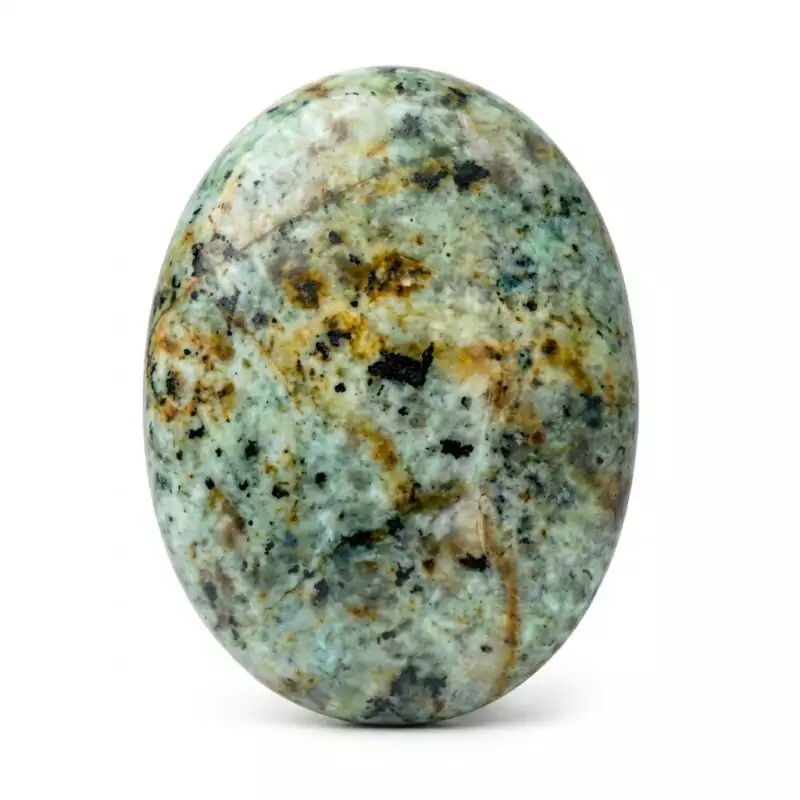
African Turquoise is a trade name, not a mineralogical classification. The stone is actually a form of fossilized jasper naturally formed in Africa and imported via China, part of the broader chalcedony family within the quartz group. Its teal, blue-green, and sometimes olive matrix, peppered with dark brown or black veining, visually resembles genuine turquoise, which is why the trade name has stuck. It is not turquoise in any mineralogical sense. Genuine turquoise is a hydrated copper aluminum phosphate; African Turquoise is opaque silicified jasper with iron-oxide inclusions that produce its characteristic color variation.
That said, African Turquoise is a genuinely attractive stone with its own well-developed set of associations in the crystal-healing community. It’s widely called the Stone of Evolution because practitioners associate it with personal transformation, openness to change, and breaking through stagnant patterns. In crystal work, jasper varieties are generally considered grounding and stabilizing, and African Turquoise carries that earthy baseline alongside its more change-oriented reputation.
Palm Stone Format and Practical Use
The palm stone shape, a smooth, slightly flattened oval sized to fit in the hand, is one of the most practical forms for regular crystal work. It’s comfortable to hold during meditation, easy to carry in a pocket or bag, and suited to the repetitive tactile use of a worry stone. The approximately 2 inch size of this piece is in the standard range for single-hand holding without being too bulky for everyday carry. Each stone is a natural piece, so exact dimensions, color saturation, and matrix patterning will vary.
Practitioners working through life transitions, career changes, relationship shifts, or any period of deliberate personal growth tend to gravitate toward African Turquoise because its associations match the psychological territory. It pairs well in crystal sets with labradorite (transformation) and clear quartz (amplification). For those exploring chakra work, the blue-green tones place it in the throat and heart chakra range, supporting honest communication and emotional flexibility.
How to Use an African Turquoise Palm Stone
Three practical ways to work with an African Turquoise palm stone for daily carry, meditation, and crystal grid use.
- Carry It Daily During Periods of Change
African Turquoise is associated with transition and personal growth. Carry the palm stone in a pocket or bag during a period of change, whether a career shift, relationship transition, or deliberate growth phase. Tactile contact reinforces intent.
- Use It as a Meditation Focus or Worry Stone
Hold the stone in your palm during meditation focused on openness or releasing resistance to change. The polished surface also works as a worry stone: rubbing it between thumb and fingers is a grounding tactile practice used across traditions.
- Pair with Complementary Stones for Crystal Grid Work
In a crystal grid, African Turquoise pairs well with labradorite for transformation and clear quartz to amplify intention. Place it at the center of a grid for personal evolution. Cleanse periodically with sound, moonlight, or dry selenite contact.
The Tarot Fellow Standard
I stock African Turquoise palm stones because the palm format is genuinely practical, not just decorative, and because it’s worth being clear about what the stone actually is. It’s fossilized jasper with teal matrix patterning, not mineralogical turquoise, and it has its own real community of practitioners who work with it specifically for change and growth work. For the full range of worry and palm stones I carry, browse my worry and palm stones collection. For crystals organized by intention and use, explore my change and transitions crystal section to find stones practitioners reach for during life transitions.
Frequently Asked Questions
No. African Turquoise is a trade name for fossilized jasper naturally formed in Africa and distributed through China, in the chalcedony family within the quartz group. Its teal matrix resembles turquoise visually, but it is not the copper aluminum phosphate mineral turquoise is.
Crystal practitioners associate it with personal transformation, openness to change, and breaking through stagnant life patterns. The name reflects the community’s experience working with it during major life transitions, not a geological property.
The blue-green tones place it in the throat and heart chakra range. Practitioners use it for honest communication and emotional flexibility. It also carries the grounding quality of jasper varieties, giving some root chakra resonance as well.
Sound cleansing with a singing bowl, moonlight overnight, and dry selenite are all safe methods. Avoid prolonged water soaking, as extended moisture can affect polished jasper. Brief sunlight is fine but may gradually fade the stone’s color.
Reviews
There are no reviews yet