


Quick Specs
- Format: Illustrated planner, 12 months
- Year Covered: January to December 2027
- Author: Nicci Garaicoa
- Publisher: Rockpool Publishing
- Edition: Northern Hemisphere
- Pages: 160
- ISBN-13: 9781923208483
Twelve Goddesses of the Reef and the Tides
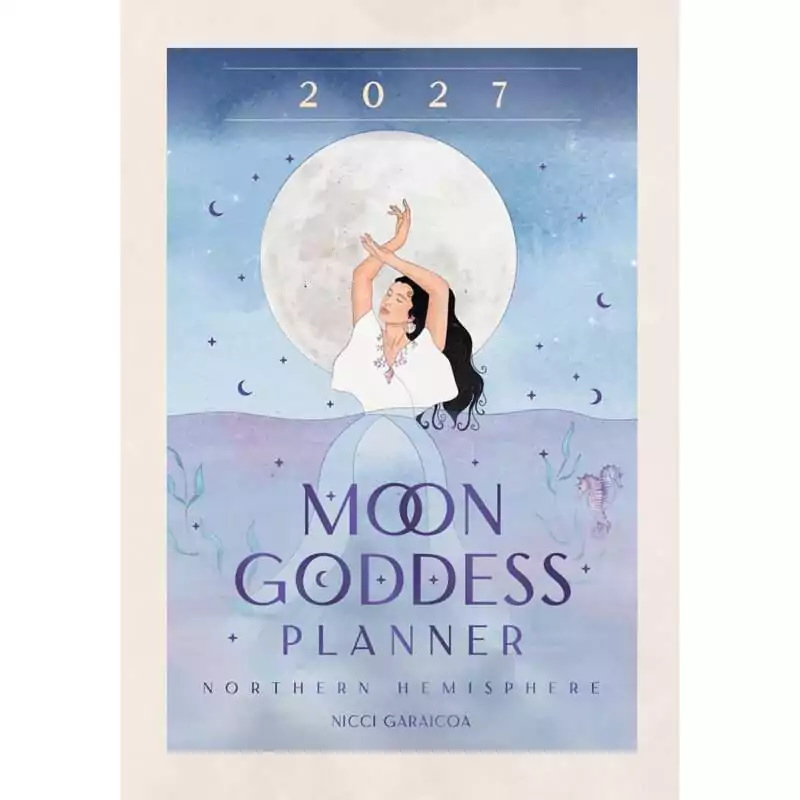
Nicci Garaicoa builds the 2027 planner on one image: the Moon moves the tides, and the tides shape the living reef. The cover shows a woman in white rising from the sea with her arms raised before a full Moon, a seahorse and kelp fronds at her side, all in blue and lavender watercolor washes. Each month introduces one of twelve reef goddesses on a facing spread, with a full-page illustration on the left and her story on the right. January belongs to the Goddess of Coral, titled Foundation, drawn as a woman with long dark hair in a coral-pink gown seated among pale coral branches. Her page presents her as a patient builder of slow growth, and it gives her a mantra, the crystals red coral, jasper and calcite, and the scents of sea minerals, hibiscus and sun-warmed stone before it closes with a short instruction to stay patient and steady. A short letter signed La Luna, the Moon speaking in her own voice, appears near the front, and an about-the-author page on the same spread lists Garaicoa’s other work, including the Moon Goddess Oracle deck.
A seasonal section sits alongside the monthly goddesses. The winter section, My Goddess Winter Wellness Companion, precedes January and offers fill-in prompts for choosing a winter ally among the first three goddesses, a Moon ritual that pairs each phase with a quality, and a three-day moon-water ritual in which a jar of water sits beneath your chosen Moon phase. It continues with prompts on color, sound, body movement and breath, each closing on a line to fill in, such as the color you choose to immerse yourself in this season, how you feel when you surround yourself with it, and a playlist of three songs for the quieter months. The weekly spreads start on Monday, with the first week beginning on December 28, 2026, and the day boxes are open for writing; some days carry a short printed reflection or affirmation, such as a first-of-the-year note inviting you to place your feet on the ground and picture yourself as coral. A bookmark ribbon marks your place, and the paper is FSC-certified.
Practical Ritual Applications
Treat each month as a short devotional project: read the goddess page on the first, copy her mantra onto the weekly spread and choose one practice from her page to repeat. Use the Moon markings to time what you do. The winter section’s list of qualities gives you a map: beginnings and seed-planting at the new Moon, action at the first quarter, release at the full Moon and reflection at the third quarter. At the turn of a season, use the seasonal section’s fill-in lines to choose a goddess to walk beside you and a Moon phase to anchor the season. The open day boxes hold the rest of your life, so write appointments in them, and add a line about how the goddess’s theme showed up that day. If you’d like a figure to keep on your altar or shelf while you work with the planner, browse my gods and goddesses collection.
How to Work With a Goddess Each Month
A monthly rhythm makes the planner a practice.
- Meet her on the first
On the first of the month, read the goddess's story and her mantra aloud, then copy the mantra onto the top of the month's first weekly spread. Notice which line of her page stays with you and underline it. Reading it once at the start gives the weeks that follow a single theme to hold onto.
- Choose one practice
Pick one practice from her page, a crystal to keep nearby, a scent to light, an affirmation to say or a short ritual, and put it in the weekly boxes as a repeated task. One small, repeatable practice is easy to keep. If a week gets crowded, leave the box empty and begin again the next Monday.
- Close the month at the full Moon
At the full Moon, read back through your entries and write a few lines about how the goddess's theme appeared. Note what you'd release and what you'd keep. Then read the next goddess's page before the new month starts, so you meet her already knowing what you're carrying forward.
The Tarot Fellow Standard
I chose this planner for the shop because it commits to one image for the whole year, the reef and the tides, and carries it through the art, the goddess pages, the seasonal sections and the rituals. It suits you if your practice already follows the Moon and you want a planner that feels like part of it, and it gives newcomers one goddess a month to start from. Lunar tools to add to the practice are in my moon products collection.
Frequently Asked Questions
Northern. The cover says so, and the seasonal sections follow Northern months: the winter section covers January, February and March, and asks you to choose a winter ally from those three goddesses. If you live in the Southern Hemisphere, those seasons arrive six months later, so you would use the winter pages in your own winter and read the monthly goddesses in the printed order or in whatever order suits you.
The weekly spreads give every day an open box under its date, and the publisher lists ample writing space among the features. A sample week shows several days with a short printed reflection or affirmation and others left blank, and the Saturday and Sunday boxes sit side by side at the foot of the right-hand page, so they're narrower than the weekdays. It's a good fit for journaling and short entries, and a tight one for a packed schedule.
The theme changes each year. The 2026 planner introduced twelve beach goddesses of sun, sand and shells, illustrated by Olivia Bürki, while the 2027 planner moves to twelve goddesses of the reef and the tides, beginning with the Goddess of Coral in January. If you own the 2026 planner, the 2027 book brings a new set of goddess pages and a new year of dates.
The publisher lists full, new and quarter Moons for 2027 without naming a time zone. The 2026 edition stated that its Moon phases were based on Universal Time, so look for a time zone note in the front pages of your copy before you schedule around an exact time. If it's Universal Time, Eastern Time is five hours behind in winter and four in summer, and Pacific Time is eight and seven hours behind.






Reviews
There are no reviews yet