


Quick Specs
- Format: Illustrated planner, 12 months
- Year Covered: January to December 2027
- Author: Lorriane Anderson
- Illustrator: Tijana Lukovic
- Publisher: Rockpool Publishing
- Pages: 224
- ISBN-13: 9781923208681
The Witness Year, Month by Month
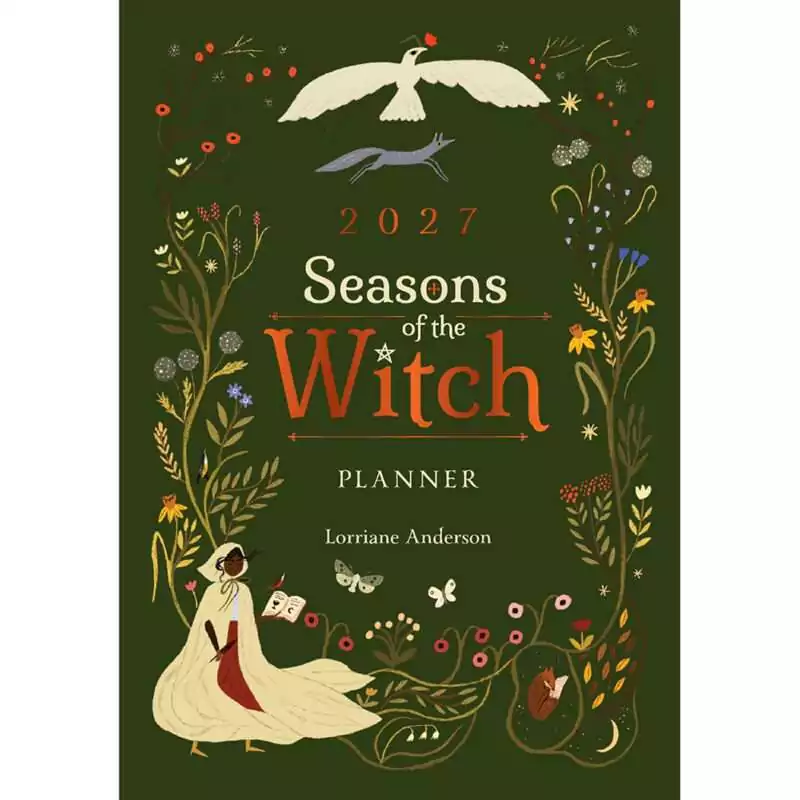
The 2027 edition takes a theme Lorriane Anderson calls the witness year. Her introduction explains it: after a year of talk about transformation, she asks you to notice yourself as you are before deciding to change anything. The cover sets the mood, with a hooded woman in a cream cloak reading an open book among wildflowers, a white bird, a fox and moths on a dark green ground. Inside, each month is an archetype, introduced with a full-page illustration by Tijana Lukovic and a page of text. January is The Spark, set in winter with Imbolc rising and Capricorn’s influence, and its illustration shows a cloaked figure holding a glowing crescent in a snowy woodland while a moth hovers overhead and an owl looks out from a tree. Each opener lists the season, the zodiac influence, an invitation (for January, to witness your sparks: ideas, urges and cravings) and Ritual Essentials, which name a color, a crystal, an oil and a plant or herb. An earlier page, Seasons of the Spirit, shows how sabbats, seasons and signs fit on one wheel, and Anderson notes that she uses the sign that ends in each month, so March is Pisces. The wheel on that page colors each season, names the sabbats around its edge and puts the Moon’s phases at the center.
After the opener come the working pages. A Monday-first month grid sits beside lines for the month’s priorities, things you’d like to do and accomplishments to acknowledge, with a quotation at the foot. A card spread follows, and January’s, The Spark Spread, places five cards with a question for each position, such as what spark is emerging within you and what one small action you can take until the goal is further along. A ruled vision space comes next for notes, drawings or a small vision board, and the planner suggests daily card pulls with space to record them. The weekly spreads run Monday to Sunday and give every day a printed prompt tied to the month’s theme, with open space under it; January’s prompts ask what idea you’re itching to drive forward and what doubts you’ve witnessed lately. Moon events such as the new Moon in Capricorn on January 7 are labeled on their dates. The book also carries a bookmark and a built-in document pocket, and the paper is FSC-certified.
Practical Ritual Applications
Use the planner as a morning page. Read the day’s prompt, answer it in a line or two, and pull a card if you keep a daily draw, since the planner leaves a place to record it. At the start of each month, lay that month’s spread with whichever deck you own and write the answers in the vision space, then reread them on the last day of the month. Use the month grid for dates that matter to your practice, such as new Moons, sabbats and rest days, and keep appointments that need exact times in your everyday calendar. When a sabbat falls in the month, use the Ritual Essentials list to choose a candle color, a crystal and a plant for your altar. If you’re building a deck collection for the monthly spreads, browse my tarot and oracle decks.
How to Work a Monthly Card Spread
A monthly spread gives the month a question to answer by its last day.
- Read the opener first
Read the month's archetype page, noting the season, the zodiac influence and the invitation. Write the invitation at the top of the vision space in your own words. The spread that follows is built on that invitation, so reading it first gives the card positions their context and keeps you from drawing before you know what you're asking.
- Lay the cards in order
Shuffle your deck, then lay the cards in the numbered positions shown on the spread page. Read each against its printed question, and write a line or two beside it in the vision space. Add the card names to the pull log, so that you can find them later. Take your time, since the point of the spread is noticing.
- Return on the last day
On the last day of the month, reread your notes and the invitation. Write what you noticed, what changed and what stayed the same. Then read the next month's opener. Keeping the answers in one place lets you see the year as a sequence of invitations and what you made of each.
The Tarot Fellow Standard
I stock this planner because it builds a full year around reflection: a theme in the introduction, an archetype for every month, a card spread, and a prompt on every day. It suits readers who already know the Seasons of the Witch decks and anyone who wants a planner shaped by the seasons, zodiac and sabbats as much as by dates. Its tone is warm and invitational, and it asks you to notice before you act. Longer writing belongs in a separate notebook, and my journals collection has options.
Frequently Asked Questions
Not on its own, according to buyers of the 2026 edition. Two reviewers wrote that it doesn't open flat, and one hoped for a spiral option in 2027. The publisher's 2027 features list a bookmark and a built-in document pocket and don't mention spiral binding, so plan on a softcover that you hold open or weigh down while you write.
No. The planner draws on the oracle series for its themes and artwork, but its monthly spreads are written as numbered card positions with a question for each, so you can lay them with the Seasons of the Witch decks, a tarot deck or any oracle deck. The publisher's 2026 edition likewise calls them tarot or oracle spreads. Fans of the decks will recognize the series' pairing of seasons, sabbats and zodiac signs.
The weekly pages give each day a printed journal prompt and an open writing area with no hour-by-hour times, so they suit notes, tasks and reflection. The month grid has a box for each date. One reviewer of the 2026 edition called it a spiritual planner that won't replace a regular planner for everyday life, and another praised the space for writing about the day.
Yes. The 2027 edition is organized around the witness year theme from Anderson's introduction, with its own monthly archetypes, spreads and daily prompts, while the 2026 edition built its months around a spiritual focus, self-care challenges and a spread for each month. The structure is similar, a monthly overview, a card log and weekly prompts, so if you own 2026 you're getting new themes, new prompts and a new year of dates in the same format.




Reviews
There are no reviews yet